Skip to content
3arabawy
3arabawy

Hossam el-Hamalawy

  • Home
  • About
  • Archive
  • Blog
  • Photos
  • Books
3arabawy

Hossam el-Hamalawy

Year: 2008

Canal Ropes Company Workers’ Strike

Posted on 12/09/200809/02/2021 By 3arabawy

Canal Ropes Company Workers' Strike اضراب عمال شركة القناة للحبال

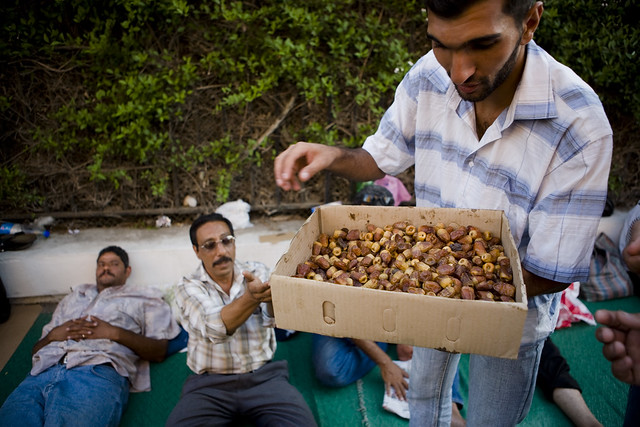
I took the pic above Tuesday in Port Said, as the Canal Ropes Company strikers were about to break their Ramadan fast at sunset. The worker in the ground reaching with his hand to take the dates is a Coptic worker, named Labib Guergiss (Also seen in the pic below).

Canal Ropes Company Workers' Strike اضراب عمال شركة القناة للحبال

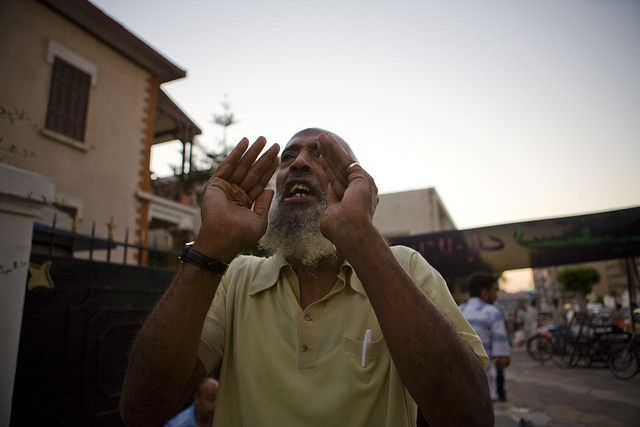
Virtually all workers I meet during strikes, including their leaders, tend to be religiously devout. Many of the Muslims have beards, prayer marks on their foreheads (zebiba), and pray regularly.
Canal Ropes Company Workers' Strike اضراب عمال شركة القناة للحبال

The women workers are usually dressed in higab, if not niqab.

Canal Company for Ports and Large Projects Workers' Sit-In اعتصام عمال شركة القناة للموانئ

The Copts have crosses tattooed on their arms, a practice common among middle and working class Christians. The religiosity however does NOT translate itself mechanically into:

1- Sectarian attitude among the workers from two sects: On the contrary, unity is strongly forged among the strikers, and among the newly rising layer of strike leaders there is a significant number of Copts.

2- A political affiliation or sympathy to the Muslim Brotherhood: No, the biggest and most organized opposition force, as the cliche goes, is not active among labor circles. Its base of support lies mainly among the middle class professionals, lower middle classes and the Islamized sections of our elite. Their capitalist economic agenda, and vague oscillating stands towards privatization, weak intervention on behalf of workers in industrial conflicts that erupt in their parliamentarian constituencies and the general retreat the organization is going through since the 2006 crackdown, means an confused stand towards the strike wave. I usually ask strike leaders I interview on their views regarding the MBs. The responses vary from overt hostility to “they are good people. They do charity.” But in almost all cases, the strikers cite no direct help from the group, let alone leadership.

3- Hostility to the left: Being religious, contrary to the stereotype, does not mean a hostility to leftists and secular activists. Unlike the liberal secularists, radical leftists have a different stand towards religion, and do not put religion as the enemy or as the focal point of the current malaise. I found the workers themselves when they are struggling, to be welcoming to any sincere effort to help them, whether it’s coming from a secular, an Islamist or the devil. What matters for them is who does what during the strike to make it successful? Who stands by them, who stands against them? Who puts 110% effort into a solidarity campaign with them, and who doesn’t give a shit? Some of the strike leaders I know in industrial and service sectors are increasingly describing themselves as “socialists” or “Marxists” while carefully observing the prayer timings, fasting Ramadan, and have zebibas on their foreheads. Personally they are religious, but the political program they present and advocate is left-leaning and secular. There is a clear shift in the mood among the workers and public to the left. It’s been a slow, incremental change that started with the outbreak of the Palestinian intifada eight years ago… a change that has been missed by the Western journalists and researchers obsessed with stories on terrorism, the veiled oppressed women, and the Red Sea Rivera.

4- Subordination of women in the industrial action: The participation of the women workers in the strike wave is an amazing story. They triggered the Winter of Labor Discontent, produced strike leaders and trade union activists, and are defying established gender roles. A Westernized feminist who looks at the pix of the strikers and finds the women to be veiled or in niqab and thus draws a negative conclusion about their status, will miss the whole point.

Mubarak’s Egypt: Will the dam burst?

Posted on 12/09/200809/02/2021 By 3arabawy

From the Economist:

Today, a blinkered visitor might choose to see nothing of Egypt but posh beach resorts and gleaming factories, and hear of little but strong economic growth and a stable, secular government committed to reform. In the Smart Village, a campuslike technology park on Cairo’s western outskirts, construction cranes glint in the mirrored glass of office blocks bearing multinational logos such as Microsoft, Oracle and Vodafone, as well as those of fast-expanding home-grown IT firms. Beyond its perimeter, past a strip of hypermarkets, fast-food outlets and car dealerships, stretch thousands of acres of new suburbs, complete with gated communities, golf courses and private schools. Twenty years ago, the highway that stretches 200km from there to Alexandria ran through empty desert. Lush fields now line the entire crowded, six-lane route, many planted with drip-irrigated garden crops for lucrative European markets.
But remove the blinkers, and the flood of impressions could be starkly different. A glance down one of the narrow, rubbish-strewn alleyways of brick tenements where half of Cairo’s people actually live may reveal a crowd of head-scarved housewives pushing and cursing in an early-morning queue for government-subsidised bread. Such daily humiliations are punctuated by bigger tragedies which, all too often, prove to be the consequence of government negligence. Earlier this month a cliff collapsed on the eastern edge of the capital, hurling giant boulders into a warren of flimsy slum dwellings that had been erected, illegally, in defiance of dire warnings that the site was unsafe. The rockfall buried dozens, perhaps hundreds, of residents alive. Locals complain that long-promised alternative housing had been given to friends and relations of government officials, rather than the needy.
The fact is that most of Egypt’s 75m people struggle to get by, their ambitions thwarted by rising prices, appalling state schools, capricious judges, a plodding and corrupt bureaucracy and a cronyist regime that pretends democracy but in fact crushes all challengers and excludes all participation. The visitor might well conclude that by damming up the normal flow of politics, Egypt’s rulers risk bringing on a deluge. Given rising resentment against the government and a generation-long resurgence of religious feeling, and given the simple fact that Hosni Mubarak, Egypt’s president of the past 27 years, is now 80 years old with no clear successor, it takes little imagination to conjure up an Islamic-tinged revolution sweeping away the autocratic state created in the wake of Egypt’s last big dynastic upheaval, the officers’ coup of July 1952 that overthrew King Farouk. Considering Egypt’s position as the most populous, politically weighty and geographically pivotal Arab state, the ripples could spread wider, too, upsetting the region’s already fragile power structure.
Such visions seem to be common these days. A recent book in English carries the subtitle “The Land of the Pharaohs on the Brink of Revolution”. Another, in Arabic, simply titled “The Final Days”, sports a scowling caricature of President Mubarak on its cover. “This regime is clinically dead and we merely await its funeral,” writes the author, Hamdi Qandil, a prominent Egyptian journalist and critic of the regime. “All paths for peaceful and gradual change are blocked,” he concludes. “The only course left is civil disobedience.”
Many Egyptians appear to have adopted this advice of late. Spontaneous protests have erupted with alarming regularity, ranging from factory strikes to land disputes to urban riots over food prices that have risen even faster than the current, unnerving overall inflation rate of 23%. So far such outbursts have remained disjointed and localised, allowing the government to parry them with a mix of carrots and sticks. Brutal policing has silenced some activists. Wage increases—such as a 30% rise for government workers in May—and a promised widening of state subsidies for essential goods have soothed a few tempers. Yet the common refrain in Cairo salons is of how similar the mood is to the pre-revolutionary atmosphere of 1952.
Then, as now, the gap between a very rich few and the teeming mass of have-nots seemed to yawn ever wider. Then, 2,000 vast estates occupied half of Egypt’s fertile land, while millions of illiterate peasants toiled as sharecroppers. Today, 44% of Egyptians still count as poor or extremely poor, with some 2.6m people so destitute that their entire income cannot cover basic food needs, let alone other expenses. Yet ranks of private jets clutter Cairo’s airport. The flower arrangements at a recent posh wedding, where whisky flowed and the gowns fluttered in from Paris and Milan, were reputed to have cost $60,000 in a country where the average wage is less than $100 a month.

Egypt editor gets jail sentence

Posted on 12/09/200802/01/2021 By 3arabawy

From Agencies:

A court sentenced an Egyptian newspaper editor to one year in jail on Wednesday for having published his paper without a permit from the press council, the state-run MENA news agency reported.
Ahmad Bakr Selim was granted bail on a surety of LE 10,000 pending any appeal against the decision of the Cairo court, which accused him of unlawfully distributing and publishing the Al-Qahira Al-Youm newspaper.

  • Previous
  • 1
  • …
  • 81
  • 82
  • 83
  • …
  • 366
  • Next

Search 3arabawy

Follow 3arabawy

  • Facebook
  • Flickr
  • Instagram
  • Bluesky
  • X
  • YouTube
  • Spotify
©2026 3arabawy