Skip to content
3arabawy
3arabawy

Hossam el-Hamalawy

  • Home
  • About
  • Archive
  • Blog
  • Photos
  • Books
3arabawy

Hossam el-Hamalawy

Year: 2008

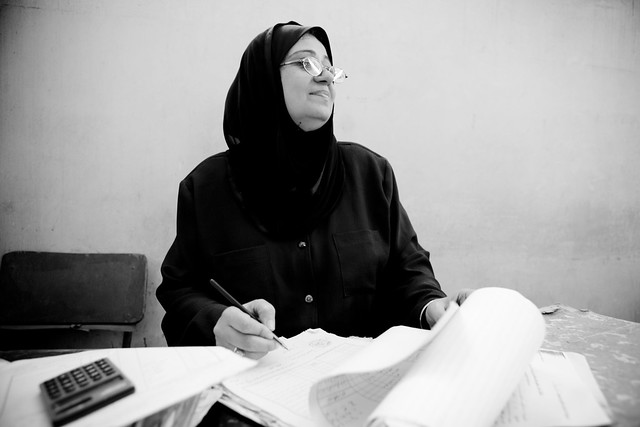
Mervat

Posted on 06/09/200813/01/2021 By 3arabawy

Mervat ميرفت

Mervat, an independent trade unionist from el-Warraq Office, was among the few members of the Giza Union Committee who supported the 2007 strike. Out of 11 union committees which belong to the state-controlled General Union of Bank and Insurance Workers, only the Daqahilya union committee and half of the Giza union committee supported (and took a leading role in) the three month protests, followed by 11 day-street occupation in front of the downtown Cairo ministerial cabinet HQ. The rest of the state-backed trade unionists did their best to sabotage the protests but were completely sidelined by the Higher Strike Committee, which led the 55,000 civil servants to victory.

Recalling the Hussein Hegazi Street occupation, Mervat proudly said: “I slept in the street for 11 days, and was not planning to go home except with my rights regained. There was no difference between men and women in the strike. We were all family. Ostaz Kamal (Abu Eita) was our eldest brother… The women were doing the cooking, and were also leading the chants in demonstrations. The women from Daqahliya particularly were good at chanting and coming up with slogans.” With a shy smile she added, “I’m not good at leading the chants, but I can repeat with the crowd.”

Mervat denounced the state-backed General Federation of Trade Unions‘ position during the strike, and spoke with enthusiasm regarding the establishment of a new free union: “Many of us support it. It’s our right to choose people who can represent us with honesty. There are those of course who are trying to sabotage the project. They are khawana (traitors)! But they are very few. We are on the right side and we will win.”

‘Historic’ verdict freezes government health insurance plans

Posted on 06/09/200831/03/2021 By 3arabawy

Sarah Carr brings us some good news about the fight against the privatization of the country’s health insurance system:

The Administrative Court halted government plans to place Egypt’s health insurance system under the control of a profit-making company, in a judgement issued on Thursday in what a rights advocate called a “historic” verdict.
The case was raised by the Egyptian Initiative for Personal Rights (EIPR) in April 2007.
The verdict forces the government to suspend implementation of its plans until a final verdict is issued.
“In this historic decision the judiciary stood by the public’s right to health, and stood in the path of a government plan aimed at gradually turning health into a profit-driven commodity,” EIPR director Hossam Bahgat said in a statement on Thursday.
In a briefing EIPR explained that in April 2007 a prime ministerial decision was issued which sought to create a holding company for health care and transfer the ownership of all health insurance clinics and hospitals to it.
EIPR’s case contended that in taking this decision the prime minister exceeded the powers given to him by turning public funds into privately-owned funds and transferring assets owned by a public body to companies.
About half of Egypt’s population are insured under the health insurance system.
EIPR suggested in the briefing that the plans also prevent a public body from offering health care to the beneficiaries of health insurance — as it is legally obliged to do by law — and transfers responsibility for tasks assigned to it by law, such as management of funds and employees, to the holding company’s board of administration.
This, the briefing explains, is in violation of Egyptian law which provides that the assets, tasks and competencies of a public body cannot be altered by prime ministerial decree.
In addition, EIPR warns that the cost of the plan to turn social health insurance into a profit-based enterprise would fall on the shoulders of health insurance beneficiaries: the fact that the holding company is profit-driven and has investment functions will add a profit margin to treatment and necessarily increase its cost.
In May 2007 over 20 Egyptian NGOs formed the Committee for the Defence of the Right to Health in order to challenge both the prime ministerial decision concerning the holding company and government plans to privatise health insurance.
Privatization, EIPR says, would mean “dealing with the right to health as a commodity which can be bought and sold for profit, rather than as a service the state is obliged to offer the public on at minimum cost.”
Dr Muhammad Hassan Khalil, a member of the Committee, told Daily News Egypt that the plan for the holding company is “complementary” to a draft law which would alter health insurance beneficiaries’ contributions to their treatment.
“The government has been trying to pass this draft law since January 2006, but has been unsuccessful because of opposition to it.
“The law means less services and more subscription fees, and forces those receiving treatment under health insurance to contribute about one third of the cost of treatment as well as forcing them to pay upfront at the time of receiving treatment,” Khalil explained.

Amnesty: No justice for the Mahalla 49 facing trial before emergency court

Posted on 06/09/200807/02/2021 By 3arabawy

The Mahalla 49 trial resumes today. Amnesty International came out with a strong solidarity statement.

Mahalla prisoners سجناء المحلة

  • Previous
  • 1
  • …
  • 92
  • 93
  • 94
  • …
  • 366
  • Next

Search 3arabawy

Follow 3arabawy

  • Facebook
  • Flickr
  • Instagram
  • Bluesky
  • X
  • YouTube
  • Spotify
©2026 3arabawy