Skip to content
3arabawy
3arabawy

Hossam el-Hamalawy

  • Home
  • About
  • Archive
  • Blog
  • Photos
  • Books
3arabawy

Hossam el-Hamalawy

Category: Blog

Tunnel workers stage peaceful protest for conditions and contracts

Posted on 18/02/200801/01/2021 By 3arabawy

From the Daily News Egypt:

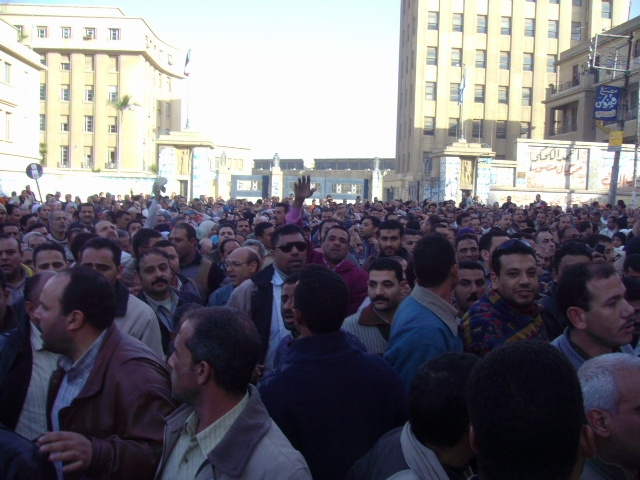
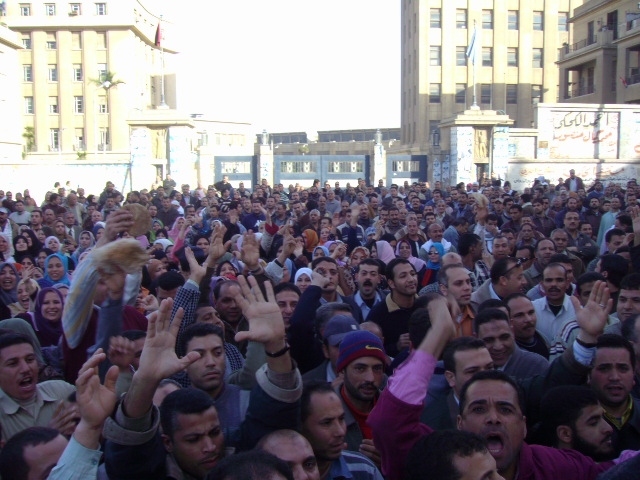
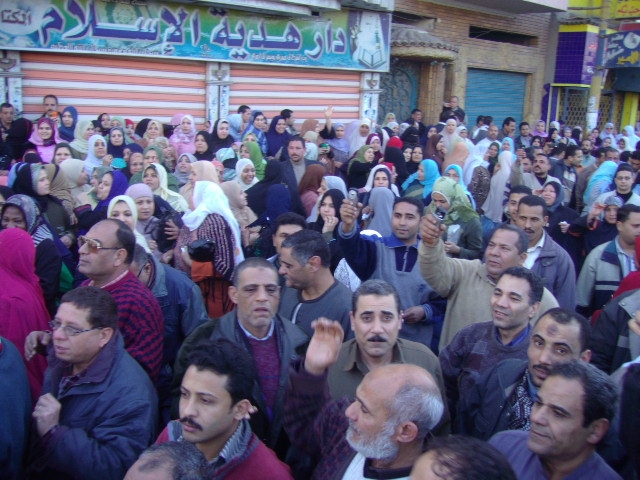
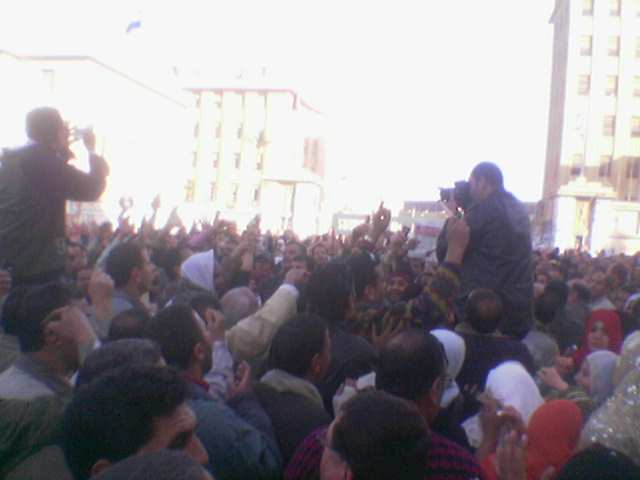
Around 200 tunnel workers congregated in Opera Square on Sunday to protest against their working conditions and temporary contracts.
The tunnel workers, employed in various departments of Cairo’s Al-Azhar tunnel that connects Downtown’s Opera Square to Salah Salem Street, are demanding that they be appointed as permanent employees in fixed positions.
The tunnel falls under the jurisdiction of the National Authority for Tunnels. Currently, 200 of the 250 workers are on temporary government contracts. However, according to their legal statutes, after three years’ work an employee should automatically be put on a permanent contract. Many of the protesters have been working in the tunnels for over four years.
“Most of us are on temporary contracts of six months, and every six months they renew the contracts, but this is illegal,” Muhammad Saad, a 30-year-old tunnel worker told Daily News Egypt. “A few years ago a new law stipulated that all those who have been working in a company for more than three years should be appointed. But only about 50 of 200 people have been awarded permanent contracts.
“We’ve tried complaining to Ata Al-Sharifi, the head of the National Authority for Tunnels, but it was no good. We are sure he has been taking the extra money that would be used for fixed positions and giving it to his personal contacts. It’s not as if there isn’t the money, we have a huge budget of LE 12 million. They used to employ foreign firms who were far more expensive, so now they are using us to save money.”
Daily News Egypt was unable to reach Al-Sharifi for comment.
However, although there are financial benefits to being awarded a permanent contract, monetary gripes made up only a portion of the workers’ protest.
“It’s not just about the money, an appointment gives you rights that every worker should have,” explained Hani Fathy, 26, who has been working in the tunnels for five years. “These include complete health insurance, social insurance and paid holidays.”
Health insurance was a main focus of the employees’ protest, with many having already sustained injuries on the job.
“I was electrocuted about two years ago at a very high voltage,” said Saad, showing an unmistakable scar on his left hand. “I had to spend some time in hospital, but after the first week they started to deduct money from my salary. They said I had brought it on myself. I still can’t move my hand properly; the nerves are in a mess.”
When asked whether they had taken the issue up directly with Al-Sharifi, workers replied, “His answer to us was highly provocative: he threatened to close the tunnel entirely, which is just irresponsible.”
Sayid Ali Amran, who works in the tunnels’ services department, which included cleaning the tunnel wall, told Daily News Egypt, “The Minister of Environment has made several reports on the damaging effects the carbon has on our health. Results showed that it is dangerous to spend more than one hour a day in those tunnels. We spend eight hours a day in them.”
The workers, who congregated peacefully to launch their campaign to the public and the media, were angered by the treatment they received from security.
“This is a peaceful protest, and yet they have put metal railings around us to keep us in, as if we are in a prison. All we want is the protection of the president, and the application of his electoral program which guarantees us fixed contracts.”
The workers, after appearing on Dream TV’s “El Ashera Masaan” daily show decided to spend Sunday night on the street to raise media awareness and alert the public to their peaceful protest.
20,000 demonstrate in Mahalla for minimum wage

Posted on 17/02/200805/02/2021 By 3arabawy

I have to run out now to catch an appointment in Ashby, but I’ll post the reports and photos I received from my contacts in Cairo and Mahalla as soon as I come back home.

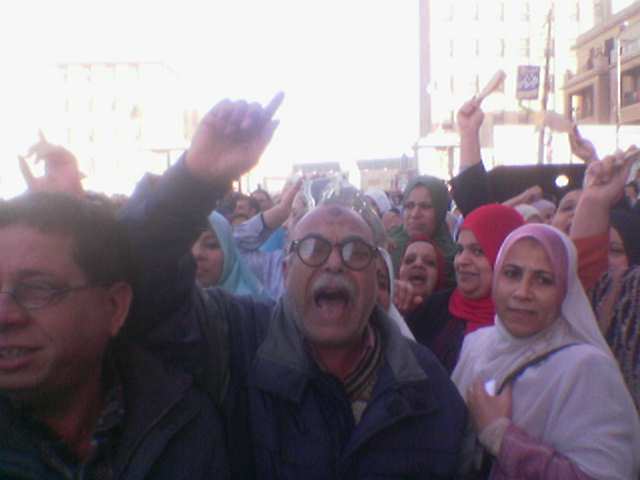
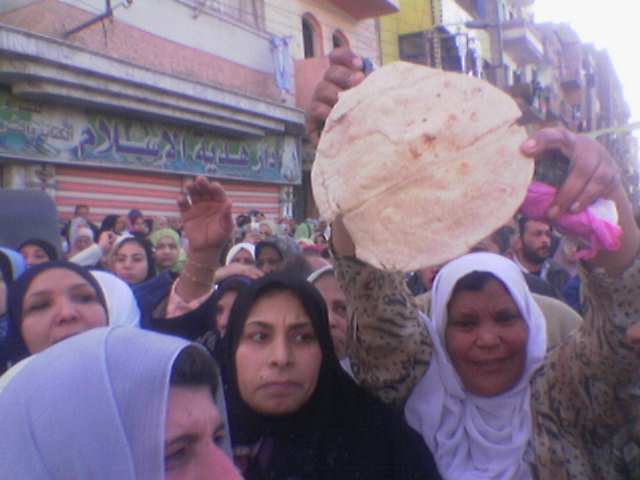
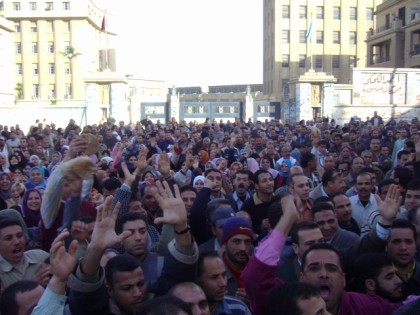
حوالي ٢٠ ألف من عمال وأهالي المحلة يتظاهرون للمطالبة برفع الحد الأدنى للأجور، ١٧ فبراير ٢٠٠٨، عدسة كريم البحيري

I LOVE YOU MAHALLA!

UPDATE: I’m back and the news from Mahalla is thrilling!

Only one day before the convening of the National Council for Wages (the govt entity in charge of setting the minimum wage, and which has not convened since the mid 80s!!!) 10,000 textile workers from Ghazl el-Mahalla took to the streets around 4pm demanding raising the national minimum (monthly) wage to LE1200. Mubarak’s Central Security Forces were out in full gear, and tried to prevent the workers from marching, but the workers managed to storm the company gates, chanting:

” يسقط يسقط حسنى مبارك – ياحاكمنا من عابدين حكمك زفت وزى الطين – هما بياكلوا حمام وفراخ واحنا الفول دوخنا وداخ – ياجمال قول لابوك فى الغربية بيكرهوك

“Down Down Hosni Mubarak!”… “You, who’s ruling us from (the Presidential Place in) Abdeen, your rule is shit!”… “They (the elite) are eating chicken and pigeons, while we are sick of eating beans”… “Gamal (Mubarak), tell your dad, the Gharbeia province (where Mahalla is located) hates him!”

The demonstration, which lasted for roughly an hour, soon swelled as the Mahalla citizens joined the workers and started marching through the streets of the town. The estimates I heard from my sources in Cairo and Mahalla varied.. Some said 5,000 more citizens joined the march, while others put the number at an extra 10,000.

You can read Kareem’s report about the mass protest here. Also, check out some of the photos he took:

  • حوالي ٢٠ ألف من عمال وأهالي المحلة يتظاهرون للمطالبة برفع الحد الأدنى للأجور، ١٧ فبراير ٢٠٠٨، عدسة كريم البحيري
  • حوالي ٢٠ ألف من عمال وأهالي المحلة يتظاهرون للمطالبة برفع الحد الأدنى للأجور، ١٧ فبراير ٢٠٠٨، عدسة كريم البحيري
  • حوالي ٢٠ ألف من عمال وأهالي المحلة يتظاهرون للمطالبة برفع الحد الأدنى للأجور، ١٧ فبراير ٢٠٠٨، عدسة كريم البحيري
  • حوالي ٢٠ ألف من عمال وأهالي المحلة يتظاهرون للمطالبة برفع الحد الأدنى للأجور، ١٧ فبراير ٢٠٠٨، عدسة كريم البحيري
  • حوالي ٢٠ ألف من عمال وأهالي المحلة يتظاهرون للمطالبة برفع الحد الأدنى للأجور، ١٧ فبراير ٢٠٠٨، عدسة كريم البحيري

Some more photos, below, taken by Ad-Dustour’s correspondent Muhammad Abul Dahab:

  • عمال وأهالي المحلة يطالبون برفع الحد الأدنى للأجور، ١٧ فبراير ٢٠٠٨، عدسة محمد أبو الدهب
  • عمال وأهالي المحلة يطالبون برفع الحد الأدنى للأجور، ١٧ فبراير ٢٠٠٨، عدسة محمد أبو الدهب
  • عمال وأهالي المحلة يطالبون برفع الحد الأدنى للأجور، ١٧ فبراير ٢٠٠٨، عدسة محمد أبو الدهب
  • عمال وأهالي المحلة يطالبون برفع الحد الأدنى للأجور، ١٧ فبراير ٢٠٠٨، عدسة محمد أبو الدهب

The protest was organized by labor activists in the Ghazl el-Mahalla company in secrecy, and they notified in advance only a selected number of activist journalists.. This demonstration is ULTRA-SIGNIFICANT:

1- Whatever happens in Ghazl el-Mahalla sets the tone for the entire working class in Egypt, both in the textile sector and others.. This is not new… The strikes by the biggest textile mill in the Middle East, with its 27,000-strong labor force working shoulder to shoulder on the factory floor, have been instrumental in pressuring the regime into economic concessions that get generalized for the whole class since the 1970s if not before. The most recent example of course is the December 2006 strike that launched the Winter of Labor Discontent. HOWEVER, in previous strikes Ghazl el-Mahalla workers struck over demands related to the company ONLY.. and the generalization of gains to other fellow workers used to come by the domino effect… BUT in today’s demo, it was the first time since the January 1977 Bread Intifada that Ghazl el-Mahalla workers took to the streets with NATIONAL demands for the whole class.

2- There’s an increasing process of politicization among the workers in Ghazl el-Mahalla (and elsewhere)… with a clear anti-Mubarak sentiments. I wasn’t present in the December 2006 strike, but those who were there said the anti-regime chants could be heard quietly every now and then but not as much as they were heard in the September 2007 and certainly it was never as clear as yesterday. The chants against Mubarak and his family means more political crystallization for the current labor movement.. and what a leap forward today’s chants in that regards were.

3- Despite repeated requests from friends and readers, I deliberately do NOT blog about the internal politics of strikes, and Who’s Who, and what faction is doing this and what group is doing that… because we are living under a dictatorship, and speaking in details about what’s going on will bloody jeopardize the security of the activists in the factories and will mess up the future of some strikes. Having said that, it is no secret that the revolutionary left is witnessing a revival now, with the establishment of a foothold in some of the major industrial centers… and today’s demonstration which was mobilized by our friends in Mahalla is a clear example of the increasing mobilization capabilities of this leftist revival… One thing I can divulge about Mahalla though, is that among the independent activists whose role was central in December 2006 and in lobbying for the impeachment of the corrupt govt-backed Factory Union Committee officials, there are some who have been gradually co-opted by the authorities in exchange for promises that they would be the “unofficial representatives” of the workers.. This was sensed by some activists including myself in the summer of 2007 during their negotiations with the Labor Ministry and the General Federation, but became clear in the September 2007 Strike (and I’m not gonna mention names or add details, but I think those in Cairo and Mahalla who are reading this know exactly whom I’m talking about). I wouldn’t have even mentioned that, except it’s becoming clear that their role is increasingly negative now in the factory politics, and they have intervened more than once to abort or diffuse protests, or ride the wave if it became clear that the protest will go ahead whether they were there or not… Their role has become sabotaging on occasions, in the same fashion as trade union bureaucrats in Western bourgeois democracies act… It even reached the extent that one of them told Al-Jazeera and Orbit today that the demo included only 150 workers!!!!!! However, this is already costing them politically a lot on the factory floor, in terms of their legitimacy.. And probably the only positive outcome from this is that the other more militant strike leaders who are either members or close to the revolutionary left are now gaining more ground and credibility…

Some Socialists I spoke to earlier in Cairo and Mahalla were literally in tears… tears of joy and happiness that today’s demo was successful. It is another landmark in the struggle to overthrow the West-sponsored Mubarak’s dictatorship… and I can assure you, dear readers, this is just the beginning.

Keep your eyes on Mahalla. More to come.

UPDATE: Here’s a report by Reuters (Arabic Service) on the protest.

UPDATE: Here’s a report by AFP:

At least 10,000 employees of Egypt’s biggest textile factory protested against price hikes on Monday, demanding a sharp rise in the minimum wage nationwide in the first such protest in decades.
Thousands of textile workers gathered at the Ghazl al-Mahalla factory north of Cairo shouting slogans to protest against the rise in the price of basic commodities, a security source told Agence France-Presse.
The workers are demanding that the minimum wage be raised to 1,200 Egyptian pounds ($218) a month for all workers around the country.
“This is the first time there’s a big workers’ demonstration for national demands,” said Sameh Nagib, a sociologist at the American University in Cairo. “This hasn’t happened for decades.”
The demonstration at Mahalla, which has seen a string of strikes in recent years, came as the government’s National Council for Wages met to discuss raising the minimum wage from the current 105 Egyptian pounds.
It is the latest in a spate of industrial action in the country.
Egyptian civil servants working for the Real Estate tax office held a sit-in in December demanding to raise their monthly average from 300 pounds to 1,500.
In September, at least 24,000 workers at the Mahalla factory went on strike over unpaid profit shares and low wages.
The government subsequently agreed to their demands and similar strikes were held in other factories.
“Maybe it’s because of this year of strikes, there’s a lot of pressure (on the government) to come up with a statement or a plan of action,” said Nagib. “Under this pressure they have to do something serious.”

On Riots, Violence, Sabotage: Denmark and the US Ghetto Intifadas

Posted on 17/02/200831/01/2021 By 3arabawy

“The good news is that we’ve made a lot of arrests”… thus spoke Michael Hoejer, the Danish deputy national police commissioner, to the public on the ongoing riots by immigrant youths against the Danish police brutality and racism.

So the first mass scale rebellion came from the immigrants in France, and now Denmark. There’s no reason to say similar events cannot happen in Italy and Spain on that scale. After all, these are countries where Arab and African immigrants are eating shit.

And don’t you ever think for one moment that those rioters’ violence in Denmark is random. They are targeting cars they will never afford, schools they don’t have access to or treated like shit at, and the list goes on. In other words, they are targeting symbols of wealth, power and economic repression in a racist/classist country… not the fucking cartoons… it doesn’t matter what the trigger was… the trigger could be an extremely trivial event.. (remember the French May ’68?)

I posted previously about the Egyptian January 1977 Bread Intifada, with a special focus on the violence (that the media has always depicted sensationally), and why it was explainable if not justified. But there’s wide variety of sociological literature on riots, and it’s always useful to look at examples from other countries.

Conservatives tend to take a criminological approach to riots. Encyclopedia Britannica defines riot, for example, as an “offense against public order involving three or more people and the use of violence, however slight. Like an unlawful assembly, a riot involves a gathering of persons for an illegal purpose. Unlike an unlawful assembly, however, a riot includes violence.”[1] Ralf Conant’s book on the prospects of revolutions in the US expressed concerns for the growing instability in the American society in the 1960s. When defining the act of rioting, he stresses the spontaneous nature of the participants’ behavior, in addition to the lack of “premeditated purpose, plan, or direction, although systematic looting, arson, and attack on persons usually occur once a riot is under way.”[2] However, a task force report submitted to the American National Commission on the Causes and Prevention of Violence, set up to investigate the ghetto riots, tried to challenge the official conception of riots. The academics and lawyers, who were members of the task force, were neither radicals, nor did they advocate riots as a means of changing the status quo. They had the same concerns for the “stability” of the American society, but they advocated a new approach and means of social control that could address the grievances behind the riots. The report criticized some of the conventional theories on the subject. First, such theories “tend to focus on the destructive behavior of disaffected groups while accepting the behavior of authorities as normal, instrumental and rational.”[3] The report pointed out the “destruction”, or the violent behavior, of the forces of the state, can be, and usually is, more “destructive.” Second, these theories “tend to describe collective behavior [i.e., riots] as irrational, formless and immoderate.”[4] The report refuses such assumption; instead it argues that the rioters:

… show a considerable degree of structure, purposiveness, and rationality. Nor is “established” behavior necessarily guided by rational principle. While the beliefs underlying a riot may frequently be inaccurate or exaggerated, they are not necessarily more so than, for example, commonly held beliefs about racial minorities by dominant groups… [concerning] the causes of crime… [and] threats to internal security, and so forth. A measure of irrationality, then, is not a defining characteristic of collective behavior generally or of riots in particular; rather, it is an element of many routine social processes and institutions and forms of collective behavior.[5]

Moreover, continues the report, the so-called “inappropriateness” of riots is relative, depending upon whether there are alternative channels for action or not. The actors use rioting as a means of expressing their political demands in absence of the “normal channels.”[6] It is wrong to view the rioters’ violent behavior as “abnormal,” or as resulting merely from “tensions.” One should not attribute the whole phenomenon to psychological factors and neglect the political dimension. Violence of marginalized groups cannot be compared to the more severe systematic violence of the state. In addition, the rioters usually believe that the use of violence could pressure the state to concede to their own demands, and actually that was true in several cases.[7]

The radical literature, on the other hand, emphasizes the resistance side of riots, and their importance as an expression of defiance to the system. Studying the dynamics of the ghetto riots in the US, Herbert J. Gans considers riots in general as a form of rebellion. Incidents of looting and property destruction, included in the riot, are not impulsive acts, as “in most cases, people destroy or loot only the property of those who have exploited them.”[8] Gans compares the rioting situation to a carnival, not because of the irrationality of the rioters, rather:

They are happy at the sudden chance to exact revenge against those who have long exploited and harassed them. The rebellion becomes a community event; … people feel they are acting together in a way that they rarely can. But, most important, the destruction and looting allows ghetto residents to exert power.[9]

When studying the 1992 Los Angeles riots, triggered by police racist brutality, Alex Callinicos refuses both the idea portrayed by the media about the mass irrationality of rioters, and “race” being the factor behind it. Instead he focuses on the class dynamics of riots. Callinicos examines the economic context of LA, and the impoverishment that hit the city as a result of the austerity measures taken by Regan and Bush (the daddy), better known as “Reganomics.” These measures affected the working class from all ethnicities, not only the blacks. The rioting was of multi-ethnic nature, coming as a reaction of the urban poor against impoverishment and police oppression. The main target for the looting and property destruction was the Korean businesses. However, Callinicos denies “ethnicity” as a factor in making such businesses a target. It is the socioeconomic role played by Koreans merchants that made them a target for the anger and discontent of the masses in LA. The vast majority of Koreans act as entrepreneurs providing “valuable retail access to the ghetto for [big corporations]… without putting whites at risk.”[10] Callinicos is clear about that the “Korean merchants are not the chief exploiters of the black and Latino poor… [b]ut Asian shopkeepers are the only visible, directly accessible representatives of the system responsible for the poverty and degradation suffered by the mass of blacks and Latinos.”[11]

So back to Denmark. To cut a long story short, until the European governments start respecting the rights of immigrants in their countries and treat them equally, and until they stop sending their troops to our region, and until they stop supporting our dictators— expect more embassies torched down in the Middle East and more riots in Europe.

1 Encyclopedia Britannica On Line.
2 Ralph W. Conant, The Prospects For Revolution: A Study of Riots, Civil Disobedience, and Insurrection in Contemporary America (New York: Harper’s Magazine Press 1971), 22.
3 Jerome H. Skolnick. The Politics of Protest: A Task Force Report Submitted to the National Commission on the Causes and Prevention of Violence (New York: Simon And Schuster 1969), 335.
4 Ibid., 335.
5 Ibid., 335-6.
6 Ibid., 336-7.
7 Ibid., 340-1.
8 Herbert J. Gans. “The Ghetto Rebellions and Urban Class Conflict,” in Robert H. Connery, ed., Urban Riots: Violence and Social Change (New York: Colombia University 1968), 43.
9 Ibid., 43.
10 Alex Callinicos, Race and Class (London: Bookmarks 1998), 55.
11 Ibid., 55.

  • Previous
  • 1
  • …
  • 1,325
  • 1,326
  • 1,327
  • …
  • 1,774
  • Next

Search 3arabawy

Follow 3arabawy

  • Facebook
  • Flickr
  • Instagram
  • Bluesky
  • X
  • YouTube
  • Spotify
©2026 3arabawy