Skip to content
3arabawy
3arabawy

Hossam el-Hamalawy

  • Home
  • About
  • Archive
  • Blog
  • Photos
  • Books
3arabawy

Hossam el-Hamalawy

Category: Blog

Kidnapped cleric’s saga continues

Posted on 01/02/200720/01/2021 By 3arabawy

The kidnapped, rendered, tortured cleric Abu Omar’s saga continues:

Egypt cleric lawyer says had no access to files
By Aziz El-Kaissouni
CAIRO, Jan 31 (Reuters) – A lawyer for a Muslim cleric kidnapped in a suspected CIA operation in Italy and handed to Egypt said he had been denied access to medical reports that might back his client’s allegations he was tortured in custody.
Hassan Mustafa Osama Nasr, also known as Abu Omar, has complained he was tortured by Egyptian agents using electric shocks, beatings, rape threats and genital abuse after he was grabbed off a Milan street in 2003 and flown to Egypt.
Lawyer Montasser al-Zayat said his client had shown him marks on his back and arms that Nasr said were burn marks.
He also said Nasr, currently held in Tora prison south of Cairo, had attempted suicide three times while in custody.
Zayat’s comments came as an Italian judge was considering whether to indict 32 suspects including Italy’s former spy chief and a group of Americans believed to be CIA agents in connection with the kidnap.
If tried, the case would be the first criminal procedure over renditions, one of the most controversial aspects of U.S. President George W. Bush’s global “war on terror”.
Zayat said officials had informed him that Nasr had been examined by forensic doctors, but state security prosecutors had ignored his requests for access to the medical reports or any other documents.
“His injuries were examined by forensic doctors. As to what the medical report said, that’s in the file at State Security Prosecution, and we’ve not been able to see the files thus far,” Zayat told Reuters.
“Keeping us from seeing (the medical reports) indicates there’s something. His attempting to commit suicide three times indicates he’s suffering abnormal treatment,” he added.
Egyptian prosecutors could not be reached for comment.
TORTURE IN EGYPT
International rights groups say that torture is systematic in Egyptian jails and police stations. Egypt says it does not condone torture, and that it only occurs in isolated instances.
Washington acknowledges secret transfers of terrorism suspects to third countries, but denies torturing suspects or handing them to countries that do.
Zayat said Nasr, upon arrival in Egypt, was charged with membership in an illegal organization — charges Egypt typically uses against members of the banned Muslim Brotherhood.
But Zayat said those charges were ultimately dropped and Nasr was briefly released in April 2004 before being detained without charge under Egypt’s emergency laws.
He said he believes Nasr was released when Egyptian authorities decided he had no connection to militancy, and that he was later re-arrested after ignoring warnings not to speak to anyone about the kidnapping and rendition.
He said Nasr had a heart condition, diabetes and hypertension, and needed urinary tract surgery.
Photographers to demonstrate against police assaults

Posted on 01/02/200723/12/2020 By 3arabawy

For the first time in their history, Egyptian photographers are getting together to demonstrate on Saturday 11am, in front of the Press Syndicate, against increased police assaults.

Photographers face attacks from police agents and the thugs they deploy in demos, who smash cameras, intimidate, physically assault, and detain photographers while performing their professional duties.

I’m not a professional photographer, but my camera also had its share of Mubarak’s police wrath. Police Captain Muhammad Bassiouny of Bandar Damanhour Police Station stole my camera after his thugs showered me with kicks as I was photographing them kidnapping voters in front of polling stations in Damanhour during the November 2005 parliamentary elections. The camera was returned to me after few days (photos deleted)–only to be smashed by police thugs in June 2006 as I was photographing them kidnapping anti-torture activists.

I’m personally excited about this protest, and will attend it. I hope to see as many of you there. Those brave photographers who played a crucial role in exposing police brutality against peaceful dissent deserve our support. The least we can do to help them is to show up at the syndicate and show them we care. It will boost their morale next time they are working in this war zone, formerly known as Downtown Cairo.

UPDATE: I received the following statement from the protest organizers…

We, Photojournalists and photographers working in Egypt, call on the Egyptian authorities to:
-Provide the needed security measures to protect photojournalists while performing their professional duties
-Protect photojournalists from the irresponsible actions taken by some police agents, that include encouraging thugs to physically assault photographers and smash their cameras. This has led to severe injuries among photographers: Our colleague Amr Nabil of AP has lost his right eye during covering the 2005 parliamentary elections; our colleague Khaled Gamal was subject to thugs’ assaults (in the presence of the security), while covering the trial of Emad el-Gelda. Last but not least, photographers are now banned from entering the Parliament, and cover its sessions.
These violations have to stop now.
Our protest is just the beginning of a campaign to retrieve our rights back.
We also express our solidarity with our Sudanese detained colleague in Guantanamo, Sami el-Haj, Al-Jazeera’s cameraman, and demand his immediate release.

Imbaba police abuse victim identified

Posted on 01/02/200726/12/2020 By 3arabawy

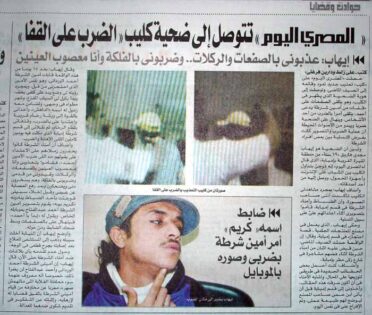
Al-Masry Al-Youm’s investigative journalist Ali Zalat has managed to identify the victim of Imbaba police brutality video, one of the first to be leaked online in April 2006.

According to Thursday’s issue (which I bought an hour ago from a night news stand and should be available online in the morning), the victim is Ihab Magdi Farouk, a 19-year-old worker in a leather factory in El-Mounira El-Gharbeia district of Imbaba, Giza.

Ihab told Al-Masry Al-Youm he was detained by Police Corporals Ahmad Abdel Fattah and Ahmad el-Wardani, in Zaki Mattar Street as the police was breaking up a fight two summers ago. Ihab was then carrying a load of new leather bags. And of course if you look poor and carrying a load of new leather bags, then you cannot be a leather bags distributor (Ihab’s job), you must be a thief! So the two corporals locked him in Imbaba Police Station, till the leather factory owner showed up and explained Ihab had not stolen anything.

Fifteen days later, Ihab bumped into Corporal Ahmad el-Wardani in the street again. The latter just showered him with insults against his mother and family, and then the Corporal pulled out a knife, and dragged Ihab with the help of another police agent into a nearby marble cutting workshop, where they brutally beat him, with kicks and slaps. Then, Corporal Wardani took Ihab to the Imbaba Police Station, where Wardani, his colleague Corporal Abdel Fattah, and other agents kept on sadistically torturing him for two entire days: Ihab was blindfolded, slapped, kicked, whipped with a stick, under the supervision of the corporals and a police officer called Kareem. Before his release, Officer Kareem asked Corporal Abdel Fattah to shower Ihab with slaps, while Kareem was filming them for the fun of it.

Note there is still another leaked abuse video from Imbaba Police Station, and the victim is still unidentified, and the Interior Ministry did not announce any investigation into it yet, though the face of the Corporal is clear in the video.

And only God knows what else happens in that police station that was not caught on camera.

UPDATE: A scan of Al-Masry Al-Youm article.

Al-Masry Al-Youm Report
  • Previous
  • 1
  • …
  • 1,681
  • 1,682
  • 1,683
  • …
  • 1,774
  • Next

Search 3arabawy

Follow 3arabawy

  • Facebook
  • Flickr
  • Instagram
  • Bluesky
  • X
  • YouTube
  • Spotify
©2026 3arabawy