Skip to content
3arabawy
3arabawy

Hossam el-Hamalawy

  • Home
  • About
  • Archive
  • Blog
  • Photos
  • Books
3arabawy

Hossam el-Hamalawy

Tag: شريف القماطي

State Security crack down on Mahalla labor activists

Posted on 16/04/200705/03/2021 By 3arabawy

State Security cracked down today on Mahalla labor activists, banning them from traveling to Cairo to lobby their General Federation of Trade Unions to impeach their corrupt local union branch as well as a set of other demands related to work conditions.

More than 100 workers assembled in the morning near the Mahalla Train Station, where two buses had been hired to transport them to Cairo. One bus was to carry a delegation to the Ministry of Social Insurance, to express solidarity with the Center for Trade Union and Workers’ Services, and the other was to take the workers to the HQ of the General Federation of Trade Unions to stage a sit-in if their demands were not met.

The workers were shocked to find the buses’ owner showing up and instructing his drivers to leave immediately, citing threats from State Security agents of revoking the buses’ licenses and the closure of his business. The agents also were heavily present around the factory compound, and the city entrances/exits. When a group of workers moved to the train station, in an attempt to catch a ride to Cairo, they were met by State Security agents. They besieged the activists, including Muhammad el-Attar, in a circle, and refused to let them move for roughly an hour.

While a handful of workers managed to escape from the police, and trickled to Cairo in microbuses, back in the company, several hundred women workers in the garments-making Factory Section 4 went on strike for 45 mins, protesting the shortage in raw materials supply, which leads to the decrease in their bonuses, which are based on units produced.

Mahalla worker and blogger Kareem el-Beheiri has been following up on the situation there all throughout the day. You can read his postings here.

“There are murmurs in the factory among workers about a second attempt to go to Cairo and launch a sit-in at the General Federation,” he wrote. “There are also murmurs of possibly a new strike. Tension is running high.”

Those workers who managed to make it to Cairo, joined around 30 rights and labor activists who assembled inside the Ministry of Social Insurance compound around 1am to protest the closure of the Center for Trade Union and Workers’ Services offices in Naga’a Hammadi and Mahalla.

There was a group of Central Security Forces soldiers deployed outside the ministry building, in addition to usual faces from State Security’s Counter-Communism bureau and Qasr el-Nil Police Station. But they did not ban the activists’ silent protest. Still, it was amusing to watch plainclothes thugs deployed by the police to guard the ministry’s building.

The activists demanded to meet the Minister, and after negotiations with State Security agents, a delegation (including Kamal Abbas the CTUWS director and Karama Party MP Hamdeen Sabbahi) met with the minister’s assistant in charge of the NGOs portfolio, who basically told them, the decision to close down the CTUWS offices was not “the ministry’s call.” So who’s call was it, asked the activists. The woman refused to reply. “It’s of course a decision by State Security,” commented Kamal Abbas. Another meeting is scheduled on Monday between CTUWS officials and the Ministry.

Here’s a short video clip of today’s protest, shot by the anti-corruption watchdog Shayfeencom

The Center for Socialist Studies issued a statement denouncing the police assaults on labor activists and strikers. Human Rights Watch also blasted Mubarak’s regime’s crackdown on the CTUWS offices:

The Egyptian government should reverse its order to close two offices of the Center for Trade Union and Workers’ Services (CTUWS) and should cease harassing the organization, Human Rights Watch said today.
The organization offers legal aid to Egyptian factory workers, educates them as to their rights, and reports on labor-rights issues in the country. The Ministry of Social Solidarity has blamed the CTUWS for inciting widespread labor unrest around the country. Egyptian officials have ordered two branches of the CTUWS to close within the last two weeks.
“Closing the offices of a labor rights group won’t end labor unrest,” said Sarah Leah Whitson, Middle East director at Human Rights Watch. “The government should be upholding legal commitments to Egyptian workers instead of seeking a scapegoat.”
On April 11, approximately 100 police officers arrived at the CTUWS office in the Nile Delta town of al-Mahalla al-Kubra to deliver an administrative decision ordering its closure. This came just over a week after General al-Sharbini Hashish, head of the Local Council in the southern industrial town of Naga` Hammidi, issued an administrative decision on March 29 ordering the closure of the CTUWS branch there on the grounds that it violated Egypt’s law on associations, though the order did not specify how.
Government action against the Naga` Hammidi branch of the CTUWS began in mid-March, when officials from the Ministry of Manpower and Immigration called the center’s representatives in for questioning, saying they had orders to investigate the legality of the center’s operations. Days before Gen. Hashish issued the order to close the center, the local representative of the Ministry of Social Solidarity requested CTUWS representatives to come to the local office of the Interior Ministry’s office of State Security Investigations. They declined the invitation.
The government’s moves against the CTUWS come amid continuing labor unrest throughout Egypt. According to a March 2 story in the independent newspaper Al-Masri al-Youm, there were 222 sit-ins, strikes, and workers’ demonstrations in 2006. The largest was a public-sector textile workers’ strike at a factory in al-Mahalla al-Kubra in December 2006.
That strike came after the al-Mahalla office of the CTUWS helped inform textile workers of Prime Minister Ahmad Nazif’s March 3, 2006, decree that all public-sector textile workers’ year-end bonuses should henceforth be equal to two months’ salary, up as much as 500 percent from a flat, pre-tax bonus of 100 Egyptian pounds (US$18). Factory managers initially denied that the decree had been issued, saying that it was a nonbinding political promise. When representatives of the government-affiliated General Textile Worker’s Union failed to make good on their election promises to extract the increased bonus from the government, more than 20,000 workers at the Mahalla al-Kubra textile factory went on strike until the government offered a 45-day bonus.
Since then, thousands of workers have resigned from the General Textile Workers’ Union, saying the elections were fixed in favor of the government’s candidates, and more than 30,000 textile workers at other factories in the Delta have staged protests. Thousands of cement factory and railway workers, some of whom told reporters they were inspired by the Mahalla workers’ success, have staged protests ranging from slowdowns to strikes. Officials from the Ministry of Social Solidarity have blamed the CTUWS for the unrest on television talk shows and on the floor of the Shura Council, the upper house of Parliament.

You can find the HRW statement in Arabic here.

Keep your eyes on Mahalla.
Cairo Anti-War Conference: Abu Omar makes an appearance; Sharqawi identifies his torturers

Posted on 31/03/200716/01/2021 By 3arabawy

The second day at Cairo’s 5th Anti-War Conference and 3rd Cairo Social Forum brought earthshaking surprises at it’s Anti-Torture Forum, held on Friday afternoon.

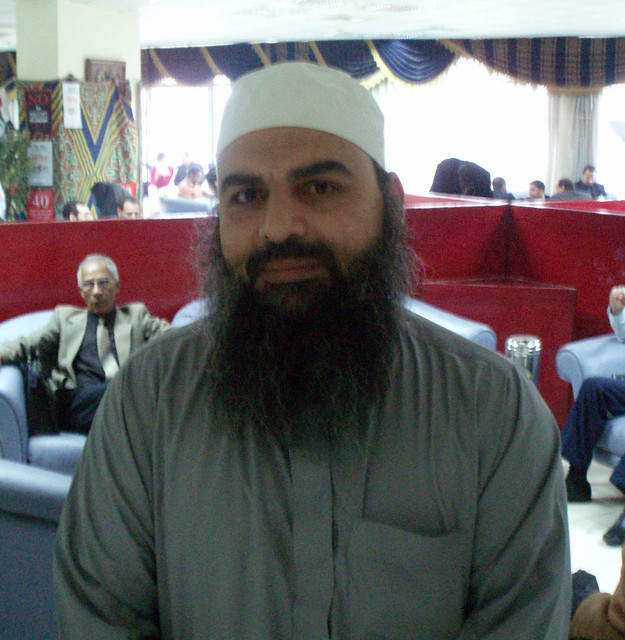
Abu Omar الشيخ أبو عمر

Abu Omar–the Alexandrian cleric kidnapped 2003 by the CIA in Milan and rendered to Egypt where he was brutally tortured–showed up today at the Press Syndicate, defying the travel ban imposed on him by State Security as a condition for his release. Abu Omar took part in the Anti-Torture Forum, chaired by leftist activist Dr. Aida Seif el-Dawla, where he presented his testimony about his torture odyssey from Milan to Cairo, via Germany. “I was severely tortured by the Mukhabarat and State Security,” Abu Omar said. “I was electrocuted for months, till my whole body turned black.”

Abu Omar speaking about his torture ordeal الشيخ أبو عمر يروي تفاصيل واقعة تعذيبه

Abu Omar expressed fears of re-arrest by the Egyptian police for speaking to the media, but insisted he will keep on talking. “If I stay silent, these practices (by the Egyptian security services) will continue.” The cleric also pleaded to be allowed to leave Egypt, back to Italy.

Another political bomb was thrown by blogger Muhammad el-Sharqawi, who gave his testimony about the torture and sexual abuse he faced in Qasr el-Nil Police Station on 25 May 2006. For the first time, Sharqawi named his torturers.

Anti-Torture Forum منتدى مناهضة التعذيب

“Police Major Samaw’al Muhammad Abu Sehla was the first to kidnap me from the car I was in on that day,” Sharqawi told the audience.

Police Major Samaw'al Mohamed Abu Sehla الرائد سماؤل أبو سحلة

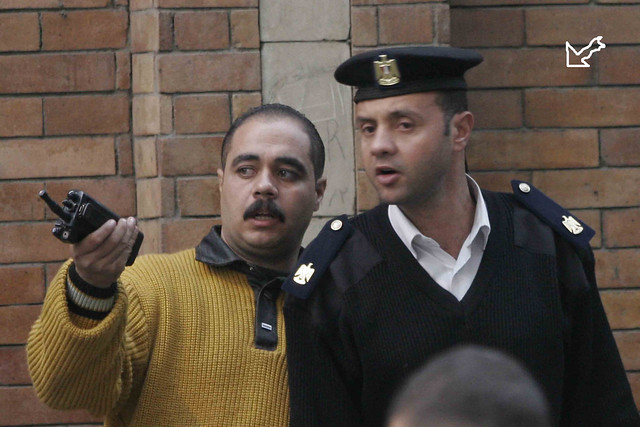
And, “the State Security officer who supervised my torture inside Qasr el-Nil Police Station is named Sherif.”

State Security Officer Sherif el-Qamati

Sharqawi also expressed his frustration with the refusal of the authorities to open an investigation into his abuse, despite the repeated requests by his lawyers, accusing State Security of breaking into his house and stealing his laptop.

HRW to Mubarak’s regime: Investigate police torture, rape of blogger Sharqawi

Posted on 19/03/200702/01/2021 By 3arabawy

The NYC-based rights watchdog issued a statement today, calling on the regime to stop targeting bloggers, and investigate the torture and sexual abuse against leftist blogger Muhammad el-Sharqawi, who was brutalized and sodomized by a State Security officer from the Counter-Communism Bureau (Maktab Mokafahet el-Shyou’eia) with the help of Qasr el-Nil Police Station agents, on 25 May 2006.

Muhammad el-Sharqawi hours before he was kidnapped by State Security on May 25, 2006. Photo courtesy of an activist friend]

Egypt: Investigate Torture, Rape of Activist Blogger
(Cairo, March 19, 2007) — The Egyptian Interior Ministry should immediately investigate and prosecute the torture and rape of pro-democracy activist and blogger Muhammad al-Sharqawi in police custody last year, Human Rights Watch said today. The authorities must also protect him from any police intimidation.
Despite repeated requests from al-Sharqawi and his lawyers since the torture took place almost a year ago, authorities have yet to take any visible action to bring those responsible to justice. Al-Sharqawi, who has campaigned against torture and other human rights abuses at street protests, through his personal blog, and through interviews with the press, told Human Rights Watch that an officer he recognized as having been present when he was abused in custody “always seems to be waiting downstairs from my apartment,” and that unidentified men have come to his door to ask him if he was home and if he lives alone. Around 7 pm on March 10, he came home to find his laptop, which he said contained a new, unreleased video of police abuse, had been stolen. Though cash and other valuables were lying around the apartment, nothing else was taken. Al-Sharqawi told Human Rights Watch that he is no longer sleeping at home.
Also on March 10, the State Security Investigations department of the Interior Ministry issued a report to public prosecutors that named al-Sharqawi and 16 other bloggers, journalists and activists as being responsible for “spreading false news” that could harm Egypt’s image abroad and organizing demonstrations. Among those named in report were bloggers Wa’il Abbas and Alaa Seif al-Islam, who have played a central role in campaigning against police abuse through their blogs. The report also named `Abir al-Askari, a journalist for the weekly Al-Dustur who was assaulted by police at a May 11 demonstration, and leading activists from the Kifaya (“Enough”) movement. On March 15, police dispersed a Kifaya demonstration against proposed amendments to Egypt’s constitution and detained 21 protesters for two days.
“Almost a year after al-Sharqawi was tortured and raped in a police station, the authorities have taken no visible steps to hold to account those responsible for the crime,” Sarah Leah Whitson, Middle East director at Human Rights Watch said. “Rather than allowing police to intimidate and harass this young activist, the Egyptian government should be doing everything it can to prosecute the officers who tortured him.”
Security forces first arrested al-Sharqawi on April 24 at a demonstration in support of judicial independence in Cairo and released him on May 23. Agents of the State Security Investigations (SSI) bureau of the Interior Ministry arrested him again on May 25 as he was leaving another peaceful demonstration in downtown Cairo. The demonstration on May 25 commemorated the one-year anniversary of violent attacks by police and ruling party supporters against journalists and demonstrators, who had been urging a boycott of a constitutional referendum.
Al-Sharqawi told Human Rights Watch that his captors beat him for hours and then raped him with a cardboard tube at the Qasr al-Nil police station before transferring him to the State Security Prosecutor’s office in Heliopolis. When his lawyers saw al-Sharqawi at the prosecutor’s office late at night on May 25, they immediately asked for him to receive a forensic medical examination and treatment for his injuries, which one lawyer described as the worst case of police abuse that he had seen in 12 years. The prosecutor refused this initial request, but noted al-Sharqawi’s injuries, and al-Sharqawi only saw a prison doctor four days later. His lawyers have not seen any report on al-Sharqawi’s injuries drafted by either the prosecutor or doctor, and the Interior Ministry has denied that he was tortured.
Al-Sharqawi’s lawyers said they filed three written requests with General Prosecutor Muhammad Faisal to investigate his allegations of torture, and al-Sharqawi told Human Rights Watch that he also repeatedly told the prosecutor he had been tortured in custody.
The authorities subsequently charged al-Sharqawi with “chanting slogans against the regime liable to disturb public order and social peace,” “insulting the president,” “insulting and assaulting officials in the course of performing their duties,” “calling for an unlicensed assembly,” and “disrupting traffic” and held him at Tora prison until a prosecutor ordered his release on July 18. His case is still open.
“Bloggers have shown the world how torture are endemic in Egypt’s police stations,” said Whitson. “The Egyptian government needs to show the world that it will bring the perpetrators of these serious crimes to justice.”
Egypt is a party to the Convention Against Torture as well as the International Covenant on Civil and Political Rights. It is thus obliged to prohibit any form of torture and ill-treatment, and to take positive measures to protect victims by carrying out thorough, impartial and prompt investigations into allegations of torture and filing criminal charges where appropriate. Article 42 of Egypt’s constitution further provides that any person in detention “shall be treated in a manner concomitant with the preservation of his dignity” and that “no physical or moral (m`anawi) harm is to be inflicted upon him.”

  • Previous
  • 1
  • 2
  • 3

Search 3arabawy

Follow 3arabawy

  • Facebook
  • Flickr
  • Instagram
  • X
  • YouTube
©2025 3arabawy