Skip to content
3arabawy
3arabawy

Hossam el-Hamalawy

  • Home
  • About
  • Archive
  • Blog
  • Photos
  • Books
3arabawy

Hossam el-Hamalawy

Tag: abu omar

Abu Omar meets his Italian lawyer in Cairo, seeks travel documents

Posted on 04/06/200705/03/2021 By 3arabawy

Abu Omar finally met his Italian lawyer Carmelo Scambia Sunday in Cairo, where he signed the official documents to get Scambia on the case. The two later went to the Italian Consulate in Cairo, without a prior appointment, accompanied by Abu Omar’s Egyptian lawyer Montasser el-Zayat.
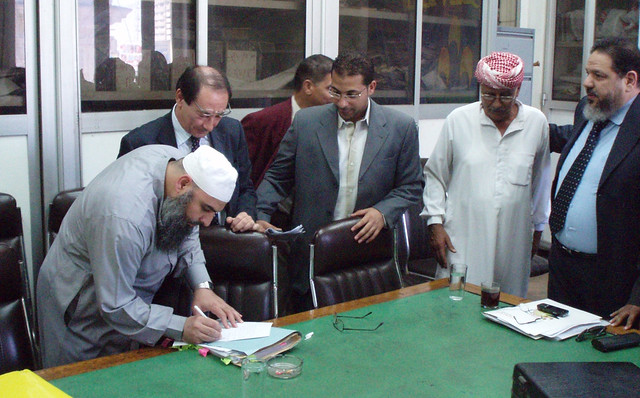
Abu Omar signing the power of attorney, in the presence of Carmelo Scambia and Montasser el-Zayat, at Cairo’s Lawyers’ Syndicate

The reason for the visit was to get the consulate stamp on the Italian translation of the Egyptian documents. Also, Abu Omar wants to issue new Italian travel documents, instead of those confiscated by the Egyptian Mukhabarat on his arrival in Cairo on a CIA-chartered flight in February 2003 to face a torture odyssey, or what the CIA calls “extraordinary rendition.”

The three were met by the Italian Consular. While he was happy to process Abu Omar’s translated documents, he said he was not authorized to issue him travel documents, asking him instead to go to apply at the Italian Consulate in Alexandria, his city of residence. Abu Omar is planning to go there today.
Abu Omar threatens hunger strike in response to security hassles

Posted on 21/05/200720/01/2021 By 3arabawy

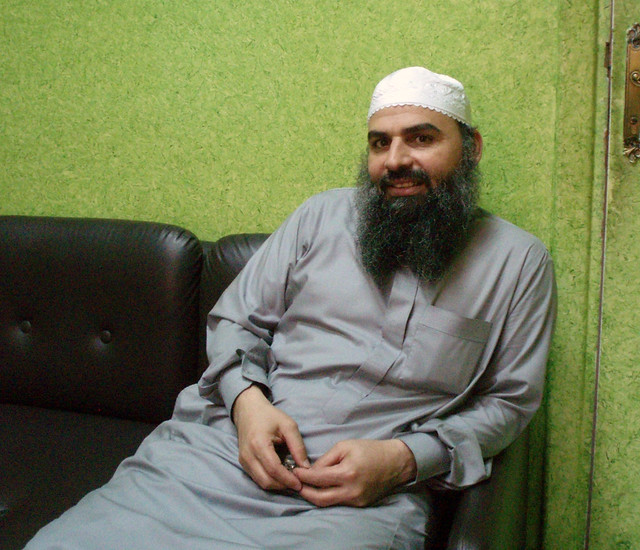
One hundred days have passed since Abu Omar’s release from State Security custody, and his saga continues.

Abu Omar was kidnapped from Milan, by the CIA in February 2003, part of their extraordinary renditions program, and was flown to Egypt where he was brutally tortured by the Mukhabarat and State Security Police.

Abu Omar أبو عمر

Abu Omar is still banned from traveling outside the country. Moreover the government refuses to issue him a National ID card. This basically means he cannot open a bank account, issue a passport, or conduct any sort of transaction. He basically does not exist any more in the eyes of the law.

Abu Omar says he sent a letter to State Security Police demanding his documents, but they have ignored him completely. “If my problem does not get solved soon, I’ll travel to Cairo to protest and stage a hunger strike,” he told me tonight. “I’m expecting my arrest any minute, and have already prepared my bag with items I’ll need in prison.”

Follow up on Abu Omar

Posted on 24/02/200720/01/2021 By 3arabawy

A follow up on Abu Omar’s case by journalist Nadia Abou El-Magd:

Cleric at center of alleged CIA kidnapping case says he was tortured in Egypt
ALEXANDRIA (AP) _ An Egyptian cleric, speaking publicly for the first time, said that Egyptian officials tortured him in prison after he was kidnapped in Italy _ allegedly by CIA agents _ and sent here for interrogation.
The claims by Osama Hassan Mustafa Nasr sharpened the controversy over the CIA’s “extraordinary rendition” program, just days after Italy indicted 26 Americans and five Italian agents accused of seizing him.
The case is the first criminal trial connected to the rendition policy, in which U.S. agents secretly transferred terror suspects for interrogation to third countries where critics say they faced torture.
Italy has signaled it won’t seek the extradition of the 25 CIA agents and one U.S. Air Force lieutenant colonel, but it will likely try them in absentia. From the outset, U.S. officials have declined comment on the case.
Nasr, also known as Abu Omar, showed up unexpectedly Thursday at the trial of an Egyptian blogger in this Mediterranean coastal city _ his first public appearance since he was released Feb. 11 after four years in Egyptian custody.
“I was subjected to the worst kind of torture in Egyptian prisons. I have scars of torture all over my body,” Nasr told journalists outside the trial, which is unrelated to his case.
The 44-year-old bearded Muslim preacher showed dark, circular scars on his wrists and ankles that he said were from electrical shocks by Egyptian interrogators. He said he also has scars on his stomach and other areas but was embarrassed to show them in a public place.
He expressed fears that Egyptian security services would re-arrest him for speaking out. “I could be arrested the moment I leave here,” Nasr said.
“I don’t want trouble with anyone anymore. My body cannot bear any more prison and torture,” he said.
Nasr’s case has given a rare look into the renditions program.
Italian prosecutors say Nasr _ suspected of recruiting fighters for radical Islamic causes _ was kidnapped from the streets of Milan in February 2003 by CIA agents with help from Italian agents. He was allegedly taken to Aviano Air Base near Venice, then to Ramstein Air Base in southern Germany, and finally to Egypt.

U.S. officials said in December 2005 that up to 150 terror suspects had been seized and flown to their homelands for interrogation under the renditions program.
The Bush administration has insisted that it gets guarantees from those countries that suspects will not be tortured. Egypt, Syria, Algeria and Saudi Arabia _ all countries with records of torture, according to human rights activists _ are believed to be among the countries where suspects have been sent.
In Washington, U.S. State Department deputy spokesman Tom Casey said the administration has nothing more to say on Nasr’s case, adding that the United States “does not render people to countries where we assume they will be mistreated or tortured.”
Egypt, a close U.S. ally, has kept silent over its role in the program.
Nasr was freed in 2004, but was arrested again three weeks later after he spoke to a journalist by telephone. Egypt never acknowledged he was in custody, but the prime minister said in 2005 that “people have been sent” to Egypt, without elaborating.
An Italian prosecutor issued an arrest warrant for Nasr in April 2005 as part of a terrorism inquiry. Nasr was accused of fighting in Afghanistan and Bosnia, though his Egyptian lawyer denied he had ever visited those countries.
Nasr said Thursday he was innocent and wanted to return to Italy, where he was granted political asylum in 2001, four years after entering illegally. He appealed to Italy for help, saying Egyptian authorities had barred him from traveling.
“I want to go back and stand in front of the Italian judiciary and prove my innocence,” he said.
Italian prosecutor Armando Spataro said Thursday that judicial authorities would like Nasr to testify against the American and Italian agents. Egypt has never responded to an Italian request for access to the cleric.
“Obviously it would be useful to hear what he has to say, but obviously it does not depend on us,” Spataro said. “If he is banned from leaving (Egypt) there’s nothing we can do.”
Nasr spoke at the trial of Abdul-Kareem Nabil, a blogger from Alexandria who was convicted Thursday of insulting Islam and Egyptian President Hosni Mubarak in his Internet writings and sentenced to four years in prison.
Nasr said Nabil was his neighbor in Alexandria, though it appeared he came to the court to make his appeal to the media. After the court session, he told an Associated Press reporter that he could not speak more for fear of arrest.

  • Previous
  • 1
  • 2
  • 3
  • Next

Search 3arabawy

Follow 3arabawy

  • Facebook
  • Flickr
  • Instagram
  • X
  • YouTube
©2025 3arabawy