Skip to content
3arabawy
3arabawy

Hossam el-Hamalawy

  • Home
  • About
  • Archive
  • Blog
  • Photos
  • Books
3arabawy

Hossam el-Hamalawy

Tag: diplomacy

European Parliament bashes Mubarak’s rights record

Posted on 18/01/200805/02/2021 By 3arabawy

From Al-Jazeera:

European Union politicians have adopted a resolution criticizing Egypt’s human rights record, as Cairo threatened to sever ties with the assembly and summoned EU ambassadors to complain.
In the vote, 52 of the 59 deputies present at the European parliament on Thursday voted in favor of the text, while the other seven abstained.
Daniel Cohn-Bendit, the assembly Green leader, said “the European parliament is sovereign and decides what it wants to decide”.
“If we have to criticize the rights situation in Egypt or Guantanamo or anywhere else, we’re going to do it. I couldn’t care less what they think in the Egyptian capital.”
The resolution criticizes Egypt over the status of religious minorities, alleged torture practices and the decades-long state of emergency.
It also calls for the immediate release of jailed dissident Ayman Nur, who mounted an unprecedented campaign against Hosni Mubarak, Egypt’s president, in the 2005 presidential elections.
He was jailed for five years for fraud in a conviction widely seen as politically motivated.
In Cairo, the foreign ministry summoned EU ambassadors “to inform them of Egypt’s complete rejection of a draft resolution over human rights in Egypt”, a spokesman said.
Abu Omar meets his Italian lawyer in Cairo, seeks travel documents

Posted on 04/06/200705/03/2021 By 3arabawy

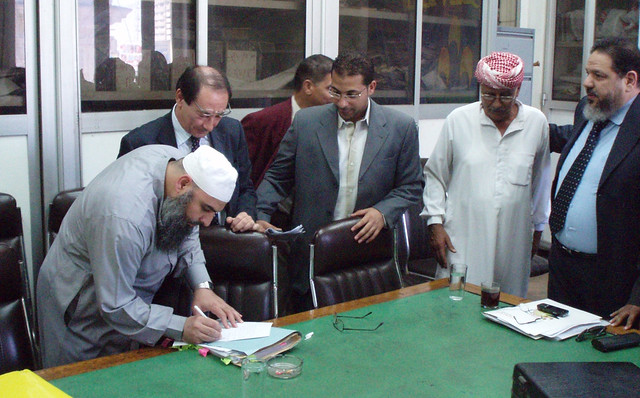
Abu Omar finally met his Italian lawyer Carmelo Scambia Sunday in Cairo, where he signed the official documents to get Scambia on the case. The two later went to the Italian Consulate in Cairo, without a prior appointment, accompanied by Abu Omar’s Egyptian lawyer Montasser el-Zayat.

Abu Omar signing the power of attorney, in the presence of Carmelo Scambia and Montasser el-Zayat, at Cairo’s Lawyers’ Syndicate

The reason for the visit was to get the consulate stamp on the Italian translation of the Egyptian documents. Also, Abu Omar wants to issue new Italian travel documents, instead of those confiscated by the Egyptian Mukhabarat on his arrival in Cairo on a CIA-chartered flight in February 2003 to face a torture odyssey, or what the CIA calls “extraordinary rendition.”

The three were met by the Italian Consular. While he was happy to process Abu Omar’s translated documents, he said he was not authorized to issue him travel documents, asking him instead to go to apply at the Italian Consulate in Alexandria, his city of residence. Abu Omar is planning to go there today.

Interview with former Israeli ambassadors to Cairo

Posted on 09/10/200602/02/2021 By 3arabawy

Ynet ran a very interesting interview with two former Israeli ambassadors to Egypt about Cairo’s dwindling diplomatic weight in Arab and Third World politics.

Putting aside the ultra-rosy picture they drew of Egypt’s former dictator Anwar el-Sadat, and the paranoia one of the ambassadors had on the prospects of a “Muslim Brothers coup,” I found it interesting to know a bit more about Tel-Aviv’s take on Mubarak’s personality, the Egyptian Foreign Ministry, and what they saw to be the reasons behind Cairo’s downfall.

25 years later – not what Sadat dreamt
Twenty-five years after Sadat’s assassination, Egypt has lost its status as leader of Arab world. Its economy is faltering, relations with Washington and Israel are not moving forward,political system is atrophied, and Muslim Brotherhood has not remained idle. Where is Mubarak leading the Land of the Nile? A conversation with former ambassadors
Roee Nahmias
The shock was great when a group from the Egyptian Islamic Jihad, led by Khalid al-Islambuli, burst into a military parade celebrating the anniversary of Egypt’s “victory” in the “October War” and opened fire at the VIP section of the reviewing stand. Anwar Sadat, the architect of both the Yom Kippur War and the peace agreement with Israel, was killed on the spot. His vice president, Hosni Mubarak, became Egypt’s president. If Sadat were to return now, 25 years later, what would he think of Egypt? According to former Israeli ambassadors to Egypt, he would not have been especially pleased.
“Politically, if Sadat were to open his eyes, he wouldn’t recognize Egypt’s position and role, and I think that he would be very dissatisfied,” said Eli Shaked, Israel’s last ambassador to Egypt, in a conversation with Ynet. “Egypt has lost its status as leader and head of the Arab world and as an influential force among Third World countries, non-aligned countries, and even African countries. In the last quarter century it has lost the heavyweight status it had in the days of (Gamal Abdel) Nasser and Sadat. Mubarak’s Egypt is no longer an influential force, and certainly not on the Dark Continent.
“To a large extent, Africa has moved forward and Egypt has been stagnant, that is, has regressed,” Shaked continues. “Politically and even economically, look where South Africa—which abandoned apartheid only in the early 90s—is, where Nigeria is, and where Egypt is. They’ve taken Egypt’s place as the most influential country in Africa.”
A good example of this decline can be seen in an incident from the world of sports that on the face of it did not appear important. Egypt was competing to host the 2010 World Cup, which will be held in Africa. It invested enormous sums of money in the effort, recruited former UN Secretary General Boutros Boutrous-Ghali, and received assurances, but it suffered a resounding defeat in the voting, with South Africa getting 15 votes, Morocco 10, and Egypt precisely 0.
“Egypt appointed a parliamentary investigative committee, but it wasn’t serious. A government isn’t going to investigate itself, after all. It emerged from this that Egypt was humiliated by Africa, which turned its back on Egypt,” explains Shaked. “It was a politically-motivated vote, a settling of Africa’s accounts with Egypt. The African states were never happy with Egypt’s disdain for them—I saw this during my tenure there as well—and then it was translated into real terms. If Egypt thinks that, in the framework of the Security Council reorganization being discussed, it can represent Africa as a permanent member, it’s mistaken. It has no chance.”
A Corpse Not Yet Buried
Who is responsible for this situation? According to Shaked, it’s President Mubarak. “He made strategic decisions in which the Foreign Ministry and the Ministry of Intelligence played a supporting role. The Egyptian Foreign Ministry is a large and overblown organization, but its ability to move things is very limited. The Ministry of Intelligence headed by Omar Suleiman deals mostly with the Palestinian issue, and even there its success is limited. Egypt has on several occasions made explicit threats and given explicit ultimatums to the Palestinians, but the Palestinians—Hamas, Arafat, and others—saw that nothing happened if they rejected the ultimatum. Egypt is no longer a dominant force in the region, and the strength of others like Saudi Arabia is only growing. The Arab League, Egypt’s baby, has become an irrelevant organization, a corpse that hasn’t yet been buried.”
What would have happened had it not been for Sadat? Shaked guesses that if Mubarak had succeeded Nasser, Egypt would not have moved forward, because of Mubarak’s personality. “If Mubarak had succeeded Nasser in 1970, the Yom Kippur War would not have broken out in 1973, but the Egyptian president would also not have come to visit Jerusalem and the peace treaty with Israel would not have been signed. That’s because, while Mubarak showed stability in the last quarter century, he also showed a lack of initiative and a lack of creativity, unlike Sadat. Mubarak was the man who wanted to preserve the status quo, and that means stagnation, if not regression. This is happening while the nations of the world, including the African states, are marching two and even four steps forward.”
Much has been said about the economic distress that threatens Egypt. For years there were warnings that the economy would collapse under the strain of the growing population, and Shaked still believes this is liable to happen. “Egypt is not prepared to assimilate the million and a half babies born every year. The per capita GNP there is insignificant compared to Israel’s, and they look with great envy at (our) economic and technological accomplishments.
“I have no doubt that if Sadat had remained alive, things would look different, especially on the issue of peace and relations with Israel, which were his baby. In ’73, for example, he announced that there would be political and economic openness, and permitted six political parties to exist. Since then there has been stagnation, and Mubarak has contributed nothing to the development of pluralism. Local politics is in a deep freeze, and relations with Washington are in crisis.”
And what about the initiative to build nuclear reactors “for future generations”? “This is being led by events in a way that isn’t smart,” notes the former ambassador. “My assessment is that Sadat would have been cautious on this issue and would have distanced himself from any similarity to Iran and North Korea. Nevertheless, it’s a long way from declarations to the building of nuclear power stations.”
Muslim Brotherhood’s ambush
Against the backdrop of Eygpt’s slow decline, Shaked warns about the Muslim Brotherhood. “I have no doubt that the moment they smell weakness in the government, they’ll try to stage a coup. This is the big fear in Cairo, and it’s concrete. Most of Mubarak’s efforts are concentrated on the struggle against them, and with no small justification. They have millions of supporters who are very frustrated by the success of radical Islam in the Middle East, but not so much at home, and they are awaiting the opportunity. Egypt definitely is in a process of political decline… I can definitely say that Cairo today cannot be proud of any achievement in any realm. Mubarak has a big role in this.”
Zvi Mazel, another former Israeli ambassador to Egypt, also believes that Egypt’s problems are far from simple. “Mubarak’s years are problematic years for Egypt. Sadat’s time was full of hope. He made peace with Israel and wanted mainly to address economic issues, and to move from the Soviet bloc to the west in this realm. He in fact succeeded and received generous aid, but in recent years Egypt has not developed economically.
“Mubarak has not succeeded in developing Egypt and removing it from poverty, nor has he succeeded in establishing serious industry. He has not contributed to the development of the political system, and the result is the atrophying of political parties and the growth of radical Islam. We are definitely liable to reach a state of instability from which extremist Islam is liable to gain even more. At this point it doesn’t look like Egypt will meet the needs of its growing population, and there is a race between the danger of the rise of extremist forces and the chance that Egypt will succeed in recovering in spite of everything.
“I assume that if, against this backdrop, Sadat were to wake up, he would not be pleased with what he saw. He would see a different Egypt in his mind’s eye: Instead of peace and a solution to the Palestinian problem – the strengthening of extremist forces.
“At this point,” Mazel notes, “I don’t see an attempt at a coup on the horizon. The army and the security apparatus are loyal to the secular regime. But to the extent that the economic situation doesn’t improve, Egypt will also sink into a worse state. The situation is complicated and problematic, and I assume that this is not the Egypt that Sadat saw in his mind’s eye.”

  • Previous
  • 1
  • …
  • 11
  • 12
  • 13
  • Next

Search 3arabawy

Follow 3arabawy

  • Facebook
  • Flickr
  • Instagram
  • X
  • YouTube
©2025 3arabawy