Skip to content
3arabawy
3arabawy

Hossam el-Hamalawy

  • Home
  • About
  • Archive
  • Blog
  • Photos
  • Books
3arabawy

Hossam el-Hamalawy

Tag: mahalla

EgyptAir flight attendants demand improving work conditions

Posted on 16/05/200705/03/2021 By 3arabawy

More than 100 flight attendants with EgyptAir showed up at their association’s headquarters in Heliopolis, to demand improving their work conditions.
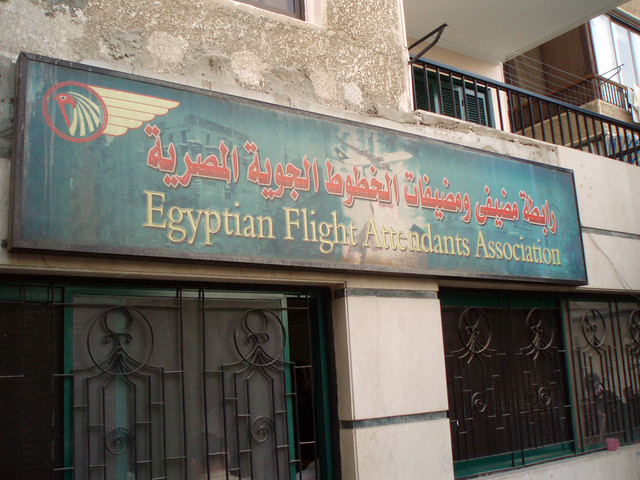
Egyptian Flight Attendants Association رابطة مضيفي ومضيفات الخطوط الجوية المصرية

In a stormy meeting with their union representatives, the flight attendants complained from abusive treatment by their bosses:

1-The attendants demanded increasing the value of their health insurance, and to make it include work injuries and diseases not covered by the current one. They are also demanding they see this insurance contract EgyptAir has with Misr Insurance, which the management insists on keeping its documents secret!

2-Those who lose their flight licenses for medical reasons, are transferred to desk jobs, with 50% loss in income. The flight attendants want that changed.

3-The attendants are also charging that management is infested with corruption, and that “flight managers” are chosen according to their personal contacts with senior managers, not according to a specific work regulation or experience.

There will be another meeting for the association on 29 May, where union officials promised they’ll get back to the attendants with answers from the management regarding their demands.

There are between 2000 to 2,500 flight attendants with the govt-owned carrier EgyptAir. The union officials in today’s meeting were not welcoming to the presence of the media, and refused to allow journalists to photograph inside the room. We had to stay outside and follow the meeting through the window. The union officials told the attendants also that they insisted on keeping today’s meeting limited in numbers, though hundreds more wanted to attend, so as not to “disrupt work in the company, and not to stir troubles with the security.”

One of the things I thought was extremely interesting was one flight attendant who stood up during the meeting, shouting angrily at his union officials saying: “If we want to get our rights, we have to act as the textile workers.”

Labor unrest spreads

Posted on 15/05/200728/12/2020 By 3arabawy

From IPS:

Workers in Cairo’s vital public transport sector threatened to go on strike earlier this month if the state did not meet their list of demands. The incident was only the latest in a spate of strikes and protests in recent months that local commentators attribute to the steadily rising cost of living.
“These workers’ actions are a result of the crushing economic situation,” Magdi Hussein, secretary-general of the Labour Party, officially frozen by the government since 2000, told IPS. “But with the current political upheaval in Egypt, workers have begun breaking down the wall of fear by wielding the weapons of the strike and the sit-in.”
On May 1, some 3,000 employees of the state-run Transportation Authority, including drivers, ticket collectors and maintenance workers, threatened a general strike, demanding better pay and benefits. In a show of force, workers briefly prevented buses from departing from a major depot in the capital’s Nasr City district.
After calling for a sit-in strike until their demands were met, transport workers were joined on the following day by an estimated 1,000 employees of Cairo’s state-run Metro Authority, who produced a similar list of demands.
Two days of subsequent negotiations resulted in a promise from the transportation ministry that workers’ complaints would be looked into. The ministry further vowed to issue a decision on the matter later this month.
“We held the sit-in because we demand our basic rights, which are stipulated by law,” a leader of the Metro workers’ labor action told IPS. “But if we aren’t granted our basic rights, we’ll call for a major sit-in strike in earnest.”
According to Ali Hashem, editor-in-chief at the government-run Dar al-Tahrir print house and a specialist on transport issues, the ministry will most likely meet most, if not all, of the workers’ demands.
“The ministry is committed to improving public transport services,” he told IPS. “But this can’t be done without improving the situation of the workers in the sector.”
Egypt has seen an unprecedented number of organized labor actions in the last six months. Since the beginning of this year, more than 50 strikes and labor protests have been called, with 11 in the last week of April alone.
Labour actions have been organized in several of Egypt’s most important industries, in both the public and private sectors. In addition to pubic transport, these have included the textiles, construction and industrial manufacturing sectors.
The biggest labor action was in December, when some 25,000 workers participated in a strike at the state-owned Egypt Company for Spinning and Weaving in the Nile Delta city of Mahalla. After three days of striking, which reportedly cost the company some 12 million dollars, workers’ demands for promised bonuses were finally met.
Saad al-Husseini, MP from Mahalla and secretary-general of the Muslim Brotherhood bloc in parliament, described the strike as “the spark that inspired other oppressed workers in Egypt to press for their rights.”
He went on to cite the main reasons for the success of the Mahalla action. “Workers held a peaceful strike and didn’t threaten any of the company’s assets, they didn’t insult the government and they didn’t get sidetracked by other political issues,” al-Husseini told IPS.
Notably, the recent labor unrest has been marked by the absence of official union representation, with most actions being independently organized by workers themselves. The reason for this, say labor organizers and commentators, is that the Egyptian Trade Union Federation (ETUF) — the only legal union representation available — has largely failed to protect workers’ rights.
They claim that the ETUF lacks genuine independence and ultimately answers to the ruling National Democratic Party of President Hosni Mubarak. In many cases, along with better pay and benefits, strike organizers have also demanded the removal of their official union representatives.
“Our union has always sided with the state rather than siding with us,” said the organizer of the metro sit-in, who did not wish to be named.

Strikes in Egypt spread from center of gravity

Posted on 10/05/200727/12/2020 By 3arabawy

Joel Beinin and I co-authored a new article for the Middle East Report Online about the current longest and strongest wave of labor protests since the end of World War II in Egypt.

  • Previous
  • 1
  • …
  • 147
  • 148
  • 149
  • …
  • 160
  • Next

Search 3arabawy

Follow 3arabawy

  • Facebook
  • Flickr
  • Instagram
  • X
  • YouTube
©2025 3arabawy