Skip to content
3arabawy
3arabawy

Hossam el-Hamalawy

  • Home
  • About
  • Archive
  • Blog
  • Photos
  • Books
3arabawy

Hossam el-Hamalawy

Tag: memory of the class

Ten days that shook the world

Posted on 15/08/200831/01/2021 By 3arabawy

John Reed describing the transformation of Russian society with the outbreak of the 1917 revolution:

As in all such times, the petty conventional life of the city went on, ignoring the Revolution as much as possible. The poets made verses–but not about the Revolution. The realistic painters painted scenes from medieval Russian history–anything but the Revolution. Young ladies from the provinces came up to the capital to learn French and cultivate their voices, and the gay young beautiful officers wore their gold-trimmed crimson bashliki and their elaborate Caucasian swords around the hotel lobbies. The ladies of the minor bureaucratic set took tea with each other in the afternoon, carrying each her little gold or silver or jewelled sugar-box, and half a loaf of bread in her muff, and wished that the Tsar were back, or that the Germans would come, or anything that would solve the servant problem–. The daughter of a friend of mine came home one afternoon in hysterics because the woman street-car conductor had called her “Comrade!”
All around them great Russia was in travail, bearing a new world. The servants one used to treat like animals and pay next to nothing, were getting independent. A pair of shoes cost more than a hundred rubles, and as wages averaged about thirty-five rubles a month the servants refused to stand in queue and wear out their shoes. But more than that. In the new Russia every man and woman could vote; there were working-class newspapers, saying new and startling things; there were the Soviets; and there were the Unions. The izvoshtchiki (cab-drivers) had a Union; they were also represented in the Petrograd Soviet. The waiters and hotel servants were organized, and refused tips. On the walls of restaurants they put up signs which read, “No tips taken here–” or, “Just because a man has to make his living waiting on table is no reason to insult him by offering him a tip!”

Tax Strike Chants

Posted on 14/08/200810/02/2021 By 3arabawy

Real Estate Tax Collectors' Strike إضراب موظفي الضرائب العقارية

Anyone who visited Hussein Hegazi Street, last year during the Real Estate Tax Collectors’ strike, must have noticed Adham, the young tax collector from Beheira. Adham was on the shoulders of his colleagues most of the time, leading thousands of strikes in their chants, rhyming, singing holding the mike, raising the morale when it’s low, and setting the crowds with fiery enthusiasm.

But behind Adham was also an army of poets, lyricists, and composers. All are ordinary tax collectors and participants in the strike who had or discovered talents as soon as the struggle necessitated it. I had a very pleasant chat, during my trip to Minya, with one of the tax collectors who was part of this effort.

“I always loved poetry,” he said smiling, “both colloquial and classic. When the people [tax collectors] gathered in Hussein Hegazi, I started composing chants, write them on a piece of paper, and give it to the strike committee members or whoever holding the microphone. I’m not good with chanting. I can write only. I then started paying attention to which chants are getting picked up, and which ones were not popular. It was challenging, as there were people from all provinces in Egypt and had different accents. So we had to try to compose chants and slogans that would work well with everybody’s tongue.”

Later, I took from one of the strike leaders some of the handwritten papers that were distributed during the occupation.

Some other chants were previously compiled here.

‘6th of April: To be or not to be’

Posted on 11/08/200808/02/2021 By 3arabawy

In the run up to the 6th of April, Ghazl el-Mahalla turned into a battleground of propaganda and agitation between the Textile Workers’ League activists on the one hand, and on the other were the management, security and the group of workers around Attar and Habib who were trying to sabotage the strike.

Each camp was distributing hundreds and thousands of statements in the week prior to the 6th of April. According to two labor organizers I spoke with, the militancy in the garments section, that is composed largely of women workers, was the highest. These were the same workers who started the 7th of December strike, as 3000 of them struck and started marching, chanting “Where are the men? Here we are the women!”

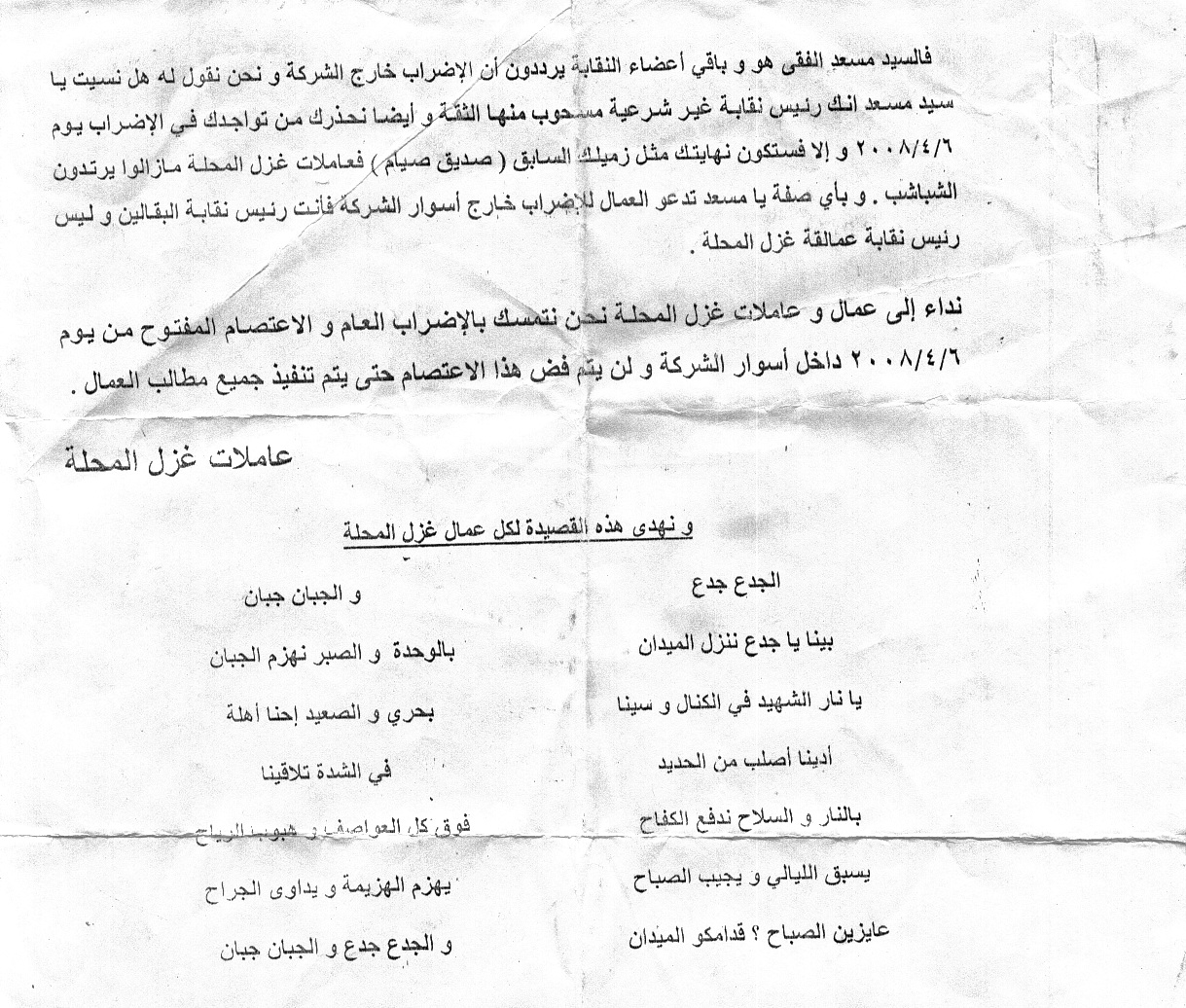
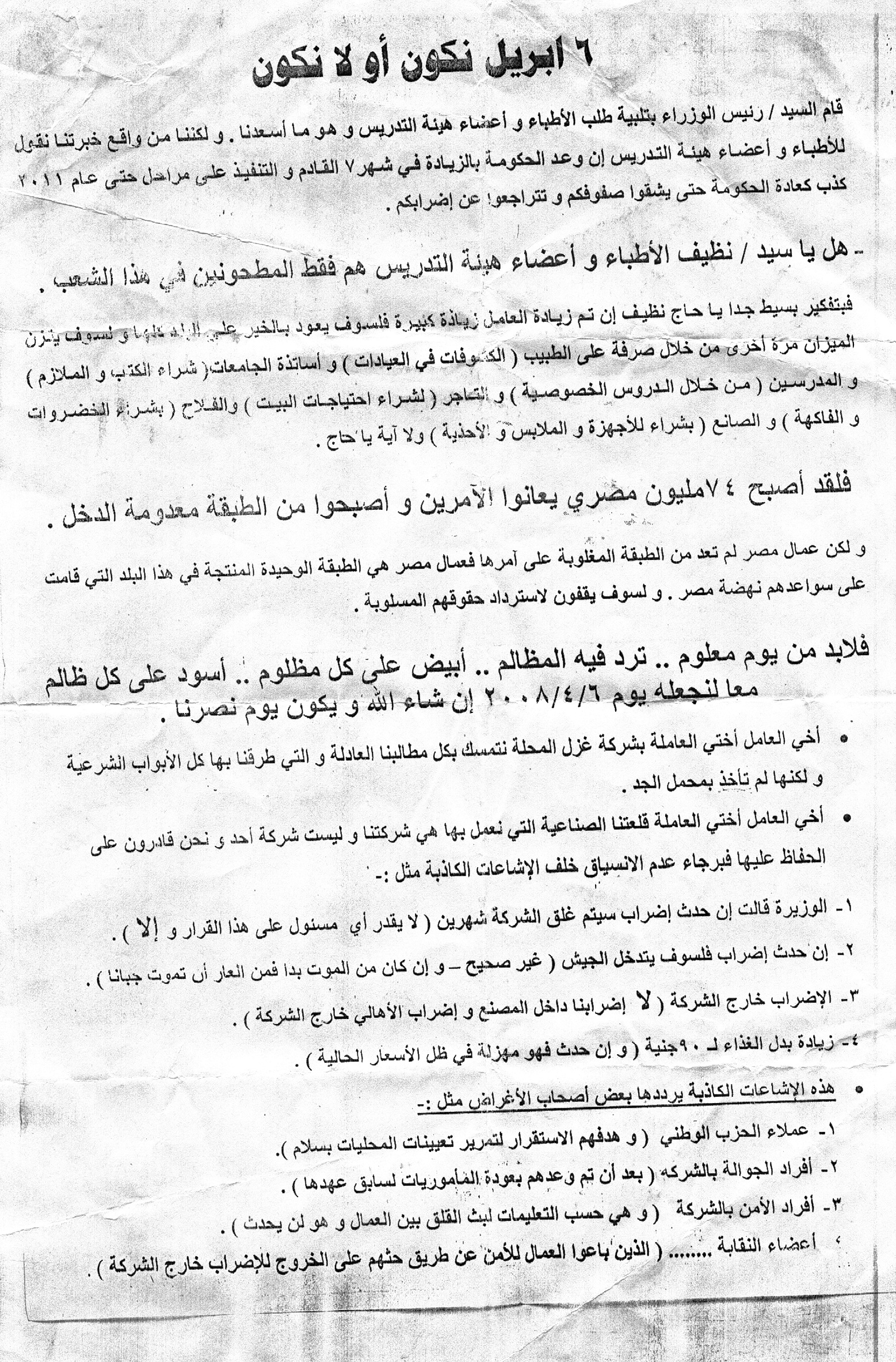
One of the strongest pro-strike statements, distributed in the factory, appeared a couple of days prior to the uprising, titled “The 6th of April: To be or not to be,” signed by “The Women Workers of Ghazl el-Mahalla,” who were close to the Textile Workers’ League.

The statement denounced PM Nazif, the National Democratic Party, the company security and the state-backed union officials, endorsing the call to strike:

  • Previous
  • 1
  • …
  • 15
  • 16
  • 17
  • …
  • 33
  • Next

Search 3arabawy

Follow 3arabawy

  • Facebook
  • Flickr
  • Instagram
  • X
  • YouTube
  • Spotify
©2026 3arabawy