Skip to content
3arabawy
3arabawy

Hossam el-Hamalawy

  • Home
  • About
  • Archive
  • Blog
  • Photos
  • Books
3arabawy

Hossam el-Hamalawy

Tag: mubarak

Mubarak proposes 30% public sector pay rise

Posted on 30/04/200812/01/2021 By 3arabawy

The dictator gave his May Day speech. Here’s a Reuters report, by Jonathan Wright:

CAIRO, April 30 – Egyptian President Hosni Mubarak, responding to unrest over low salaries and high food prices, proposed on Wednesday a salary increase of about 30 percent for public sector employees.
In a May Day speech to trade unionists, he told his government to find the extra revenue it will need to cover the cost, expected to be about 9 billion Egyptian pounds ($1.7 billion) above what it had planned in its draft 2008/9 budget.
“It will be about 30 percent,” said Mubarak, whose government faces the possibility of a stay-at-home protest by leftists, liberals and Islamists on May 4, his 80th birthday.
Instead of waiting for the start of the 2008/9 financial year on July 1, the government should try to pay the salary increases as soon as possible, Mubarak said.
“I ask the government and the parliament to agree quickly on the best options … to make available real resources so that we can go ahead with implementation with effect from May,” he said.
Tamer Waguih, an activist with the opposition group Kefaya, said Mubarak had made the offer to placate the angry poor.
“This is a measure in an attempt to preserve his regime. It is not related to love of the poor or any social agenda… He has been advised that the country, the working classes and the poor, are going to explode,” he added.
Mubarak did not elaborate on the effect on next year’s budget, which in draft form allows for a 15 percent increase in the government’s salary bill and a budget deficit equivalent to 6.9 percent of gross domestic product.
The government, on the defensive after a wave of strikes and protests, had already promised the annual rise would be higher.
Urban inflation in the year to March hit 14.4 percent, the highest rate in three years. The poorest Egyptians, including the many low-paid civil servants, have been hit hardest because they spend a much greater proportion of their incomes on food.
DIALOGUE ON REVENUE
In the year to March, bread and grain prices soared 48.1 percent, fruit and vegetable prices rose by over 20 percent, and edible oils were up 45.2 percent.
Tax Commissioner and Deputy Finance Minister Ashraf Al Arabi said the salary increase would probably be across the board and the intention was to find all the additional revenue needed so that the budget would remain at the same level.
“Things are going to happen in the upcoming 10 days. The government and the parliament will sit down for a dialogue to find real resources,” he told Reuters.
Waguih said Mubarak’s proposal could embolden the political forces behind the call for a general strike on Sunday, backed by Kefaya and the influential Muslim Brotherhood.
“People will conclude the government is weak, so they will be more courageous… But I don’t think that May 4 will be a strong event because no workers group are backing it,” he added.
The Brotherhood, the main opposition force in Egypt , joined on Tuesday the campaign for the strike, which began as a proposal by leftist and liberal activists.
The activists tried to organize a general strike on April 6, to coincide with a strike by textile workers in the Nile Delta, but the response in Cairo and other cities was muted.
Mubarak also proposed an overhaul of the government’s subsidies policy, which weighs heavily on the government budget.
In 2008/9 the government will spend 20 billion Egyptian pounds on food subsidies and 63 billion on fuel subsidies, he said. The comparative figures for 2007/8, which ends on June 30, are 15 billion and 57 billion.
“These (fuel subsidies) go to those who can pay rather than to those who cannot. This requires a review of the correct situation, but gradually,” Mubarak said.
Reham El-Desoki, senior economist at investment bank Beltone Financial, said the impact on inflation would be limited because civil servants have little purchasing power.
“Most government employees are so underpaid that a wage increase of this magnitude is overdue,” she said. “They have a right to start banging their fists against the wall and demanding higher pay because they are getting peanuts.”
Egyptian civil service salaries start at a low of about 300 pounds ($56) a month.
($1 = 5.37 Egyptian pounds)
Some notes on the Mahalla Uprising

Posted on 27/04/200805/02/2021 By 3arabawy

Since the suppression of the riots on the night of the 7th of April, except for few skirmishes every now and then between the families of the detainees outside Mahalla’s 1st Police Station, my sources in Mahalla had nothing to say usually except: “Hodu2 7azer”… meaning the situation is quiet, but there is tension beneath. The whole town has been hit hard by the police crackdown on the protests. At least three are confirmed dead, killed by Mubarak’s police, while the mother of one of the detainees died in court after the police stalled the release of her son.. Hundreds have been rounded up. Lawyers are coming out with reports on the torture of detainees by electric shocks in State Security’s local branch in Mahalla. The detainees were also told by Mubarak’s State Security pigs that their wives would be brought and raped in front of their eyes. Some detainees were “processed in the system” and appeared before the Tanta Prosecutor, while others have been kept illegally in police custody, in addition of course to those whose families don’t know where they went, and it usually takes sometime for them to surface (if ever).

More worryingly has been the detention decrees issued against labor organizers in the factory, including some of the Textile Workers’ League activists, using the provisions of the emergency law (which the regime always claims that it’s only used against “terrorists” and “drug dealers.”) Continuous updates on the situation of the detainees are provided by the HMLC and Tadamon blogs.

ON VIOLENCE:
According to all eyewitness accounts, the violence started following the police assaults on the marchers. Prior to that, the demonstrations were peaceful. It is also clear that the demonstrations, especially on the 7th of April, were largely from the urban poor and the young unemployed youth, not necessarily from the blue collar workers in the town. Most of the arson attacks that took place were, according to at least three journalists I know who witnessed the events as well as Socialist activists in the town, were carried out by the urban poor youth.
I blogged before about the urban poor and violence in the 1977 Bread Intifada as well as riots in general, and I urge you dear readers to check those two postings when you have the time. And just like in the case of 1977, the targets of the rioters were not that “random” but held significance or links to the symbols of power and wealth in society. Journalist Jano Charbel, who photographed a burnt down van, was told by the rioters for example that it was a “government van.” The restaurants burnt down in Mahalla belonged to NDP businessmen who refused to close down shop on April 6th, according to James Buck who wrote me: “protesters ravaged the restaurant to protest NDP. In other words, not random looting.”
In other incidents, we can also suspect some police provocation. Our pigs are known for their dirty history of provocation and fabrication, from the Kafr el-Dawar massacre in 1952 (that witnessed the execution of two Communist workers Khamees and el-Baqari by Nasser’s new “Revolutionary” regime) to the Victorious Sect… Eyewitness accounts are emerging accusing the police and the NDP thugs of facilitating the looting of Taha Hussein school, which was torched and looted in Mahalla, as well as their involvement in other attacks on property.

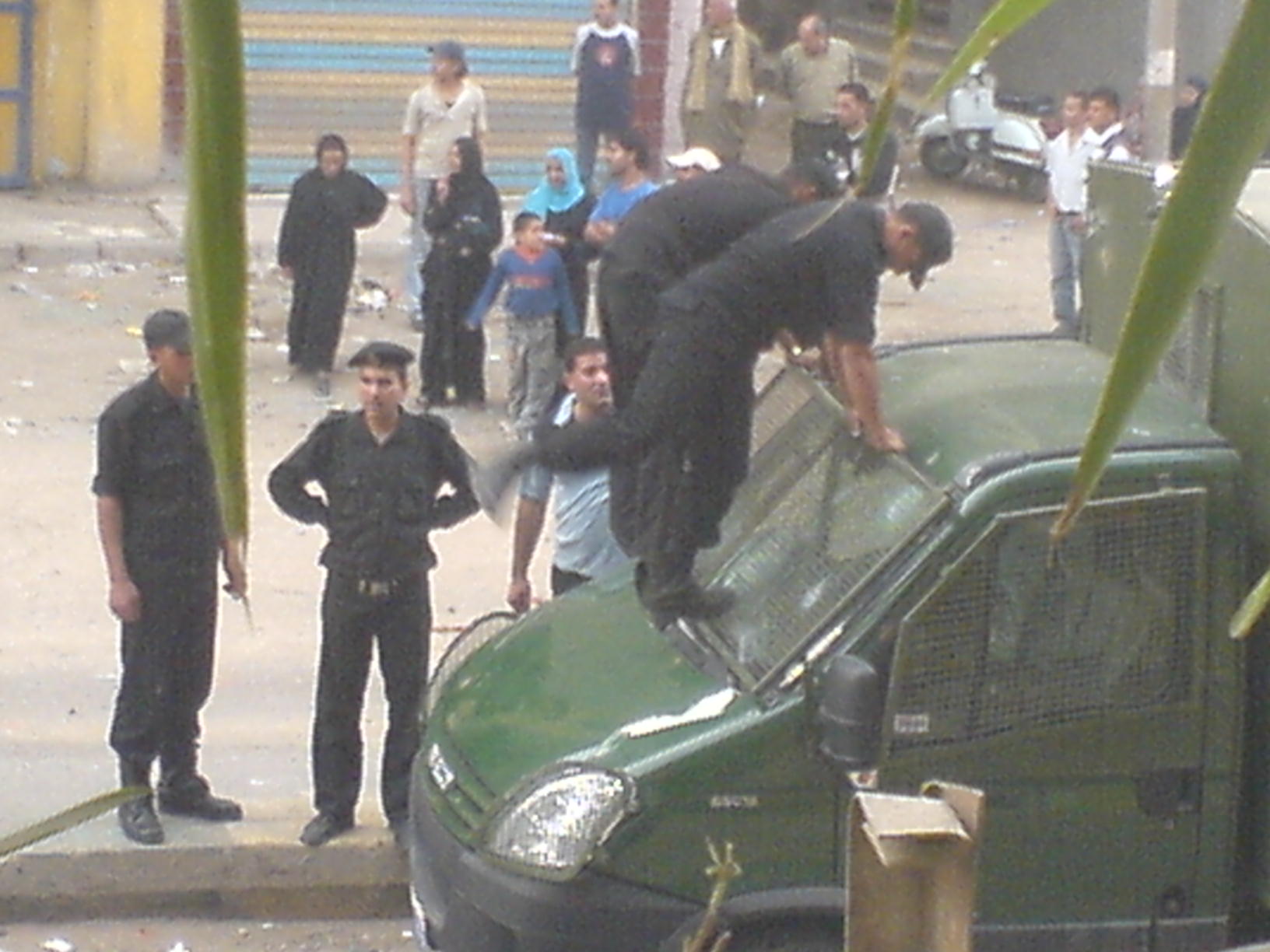
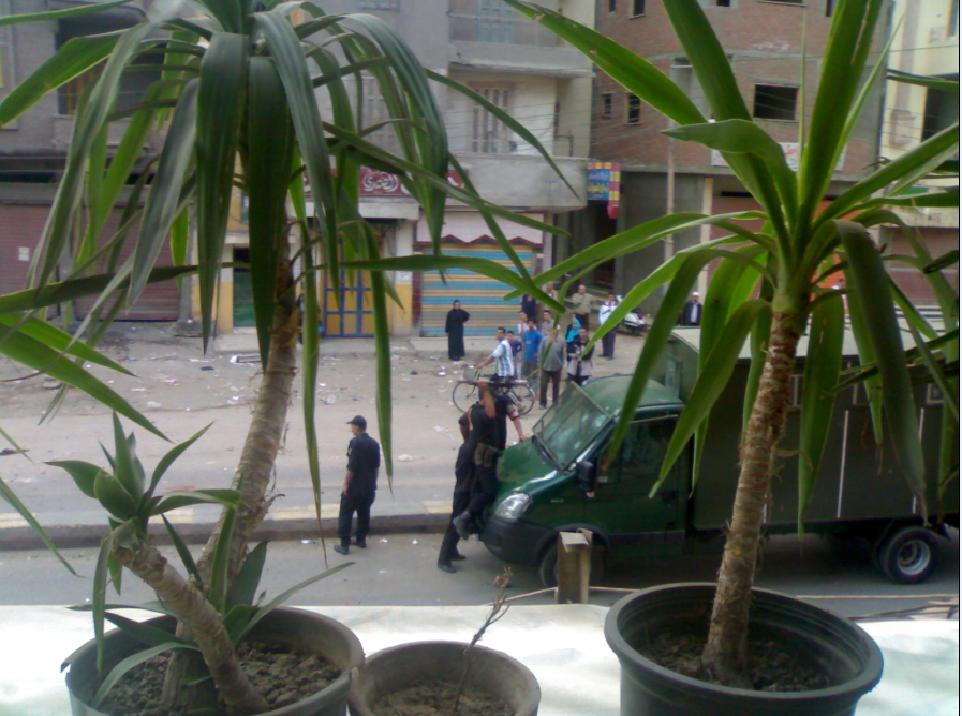
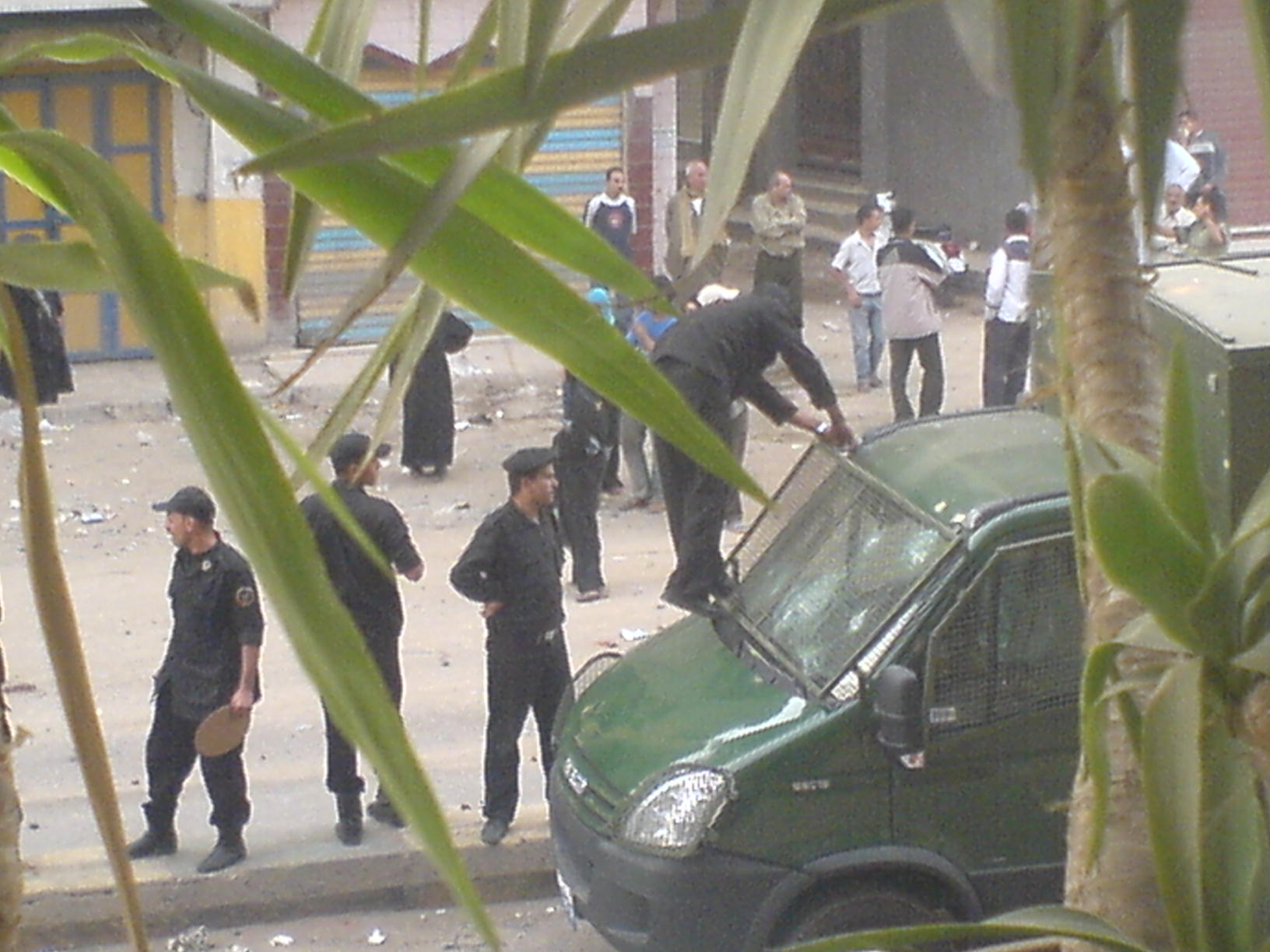
Photos also appeared on the blogs where Central Security Forces conscripts themselves (not the protesters) are destroying their own trucks:

  • Police sabotage their own trucks, then blame the demonstrators تخريب متعمد من شرطة مبارك لإلقاء اللوم زورا على المنتفضين بالمحلة
  • Police sabotage their own trucks, then blame the demonstrators تخريب متعمد من شرطة مبارك لإلقاء اللوم زورا على المنتفضين بالمحلة
  • Police sabotage their own trucks, then blame the demonstrators تخريب متعمد من شرطة مبارك لإلقاء اللوم زورا على المنتفضين بالمحلة

While those who fought the police during the Mahalla uprising were mainly the urban poor, because of the “Combined and Uneven” fashion capitalism has evolved in Egypt, class structures are sometimes elusive, and this couldn’t be more true in the case of the Nile Delta (in comparison, for example, to the new industrial urban centers like those in the 6th of October, 10th of Ramadan, etc..) This means that in one family you can have one industrial worker, his brother may be working in the informal sector, and their third brother could be the owner of a small plot of land that he farms with his wife and kids. So if the rioting was done mainly by the poor they will have relatives in the factories all over Mahalla and they are all angry.

But again, what’s next for Mahalla?
The socialist labor organizers in Ghazl el-Mahalla factory, who haven’t been arrested (yet), highlighted two things:
1- There’s so much tension in the factory over the detentions. This creating both fear among some and rage among others. The management cronies assure the workers every now and then that the detained organizers will be released soon. Muhammad el-Attar and the CTUWS activists who helped sabotage the 6th of April Strike in collaboration with the regime, on the other hand have “disappeared, and we don’t see them around that much. And when they show up, they keep talking about ‘how dangerous the communists in the factory are‘”
2- More importantly, all eyes are focused on the 30th of April, when Hosni makes his annual May Day speech, one day before the country marks it. There is a wait-and-see mood among the factory floor in Ghazl el-Mahalla. “The people are waiting to hear what he has to say about the national minimum wage and the other economic demands we made. Those in the factory understand what Nazif did was a bribe to calm down everyone and make sure the workers do not join the demonstrations outside the factory. And that worked for some. But this one month bonus decreed evaporates in few days because of the rising prices. Also the 20% increase announced by the govt is much less than what we want… Things can go on fire, and we find it difficult at the moment to predict what will the reaction be. Let’s hear what the guy (Hosni) has to say, as any mobilization prior to that and under the current conditions will be suicidal.”

ON GENERAL STRIKES, INTERNET ACTIVISM & CYBER-FANTASIES:
A general strike is when the workers bring the entire country to halt by stopping work. That’s the simple definition.. That’s it! Bring the bloody country to halt! How can this happen?
1) The action can happen spontaneously, without the direct intervention of political groups, just like the case of the Jan ’77 Bread Uprising… But in that case, expect the events (especially under the current conditions) to achieve minor gains, since it’ll be like a boiling water evaporating in the air without a valve that can direct all the energy in a certain direction. In the case of the Jan’77 uprising for example, the people managed to force Sadat into reversing the economic decrees, but didn’t overthrow the Sadat regime (which was very very very feasible to happen) who continued to rule till the dictator’s assassination in 1981.
2) A general strike can be called for by a political group(s)… BUT IN THAT CASE, WHOEVER CALLS FOR THE GENERAL STRIKE MUST HAVE THE ABILITY TO EXECUTE IT!!! A few bloggers sipping coffee in the Boursa Cafe in downtown Cairo cannot bring about this general strike… A group of “Facebook activists” cannot also mobilize for it, neither are the current opposition groups all together… You gotta have your cadres in the workplaces who will distribute leaflets in support of the strike, debate with their colleagues who may be skeptic about the action and its fruits, to be in touch with other workplaces who will simultaneously go on strike, organize smartly against the expected police assaults or management witch-hunt… A general strike is not a fucking joke! This is serious business people!
I expressed previously huge reservations, which I and my comrades in the Socialist movement had re the April 6th Strike call, and we made it clear for everyone that the Socialists are NOT endorsing the call, but will be mobilizing solely in Mahalla, the campuses and in some of the industrial centers where the movement has presence ON THE FREAKIN GROUND NOT THE CYBERSPACE!
And let’s face it: The country was not brought to halt on the 6th. Yes, traffic was very light in Cairo, and attendance in some universities was low.. But the trains kept on going, so did the buses and virtually all other main govt and business facilities… The factories that were brought to a halt or semi halt where the cement and grain mills… PLACES WHERE THE SOCIALISTS EITHER HAVE PRESENCE OR SYMPATHIZERS ON THE GROUND… ON THE GROUND PEOPLE.

Make sure you read Comrade Yehia Fekri’s article in the Lebanese daily Al-Akhbar, as well as the following statement issued by the Center for Socialist Studies.

The media hype around the bloggers and “Facebook activism” meant that the credit for the Mahalla events more or less went to the cyberspace! This was presented in the independent and foreign media as largely an effort mobilized by Israa and her peers on the Facebook strike group. The state-owned (and the Al-Masry Youm) media outlets did not miss out on the party either, and went on bashing the “internet activists) and of course they had slip in something about Israel too in the reports, and how the Israelis are now exploiting the Egyptian Facebook groups to learn more information about Egypt! Ya7’i A7a! Israel is waiting for our Facebook to know about Egyptian politics!!!?? Whatever Israel wants to know about Egypt, believe me they’ll get it from Omar Suleiman’s mouth itself! Stop this Ra’afat el-Haggan bullshit. These days are over. The Egyptian regime and the Israelis are sleeping in the same American bed.

But to make the problem worse, some bloggers and Facebook activists actually believed what the media said, and they think now they are the ones who hold the keys to street dissent. Others like the Islamist-leaning Labor Party went as far as founding a “provisional government” on facebook!! Well, good luck! And now the internet activists are calling for another “general strike” on May 4th to coincide with the dictator’s birthday.. What we are doing is making fools out of ourselves, destroy our credibility, confirm stereotype about bloggers being “IT nerds who sit in front of their computer screens and live in virtual reality’ remote from what goes on in the street… and cause demoralization among our supporters… Already I can read on my Twitter feeds some bloggers who were enthusiastic for the 6th of April strike are now feeling demoralized— especially when Ghad Party member Israa, who was presented in the media as the “leader” of the strike being the facebook group administrator and in the cyberspace she turned into some national champ with some even going as far as naming her the new “Baheyya” of Egypt, came out from prison to shower praise on the regime and express her “regret” over her initiative to launch this facebook strike group, and said she “repented” in prison and “would never do this again”…!

This does NOT mean we shouldn’t stage actions on that day… Let’s mobilize in solidarity with the detainees in Mahalla and elsewhere who are still in prison, thanks to the detention decrees by Mubarak’s Torturer-in-Chief General Habib el-Adly.

James Buck: Eyewitness to an uprising

Posted on 25/04/200805/02/2021 By 3arabawy

Photojournalist James Buck writes about what he saw in Mahalla.

  • Previous
  • 1
  • …
  • 242
  • 243
  • 244
  • …
  • 308
  • Next

Search 3arabawy

Follow 3arabawy

  • Facebook
  • Flickr
  • Instagram
  • Bluesky
  • X
  • YouTube
  • Spotify
©2026 3arabawy