Skip to content
3arabawy
3arabawy

Hossam el-Hamalawy

  • Home
  • About
  • Archive
  • Blog
  • Photos
  • Books
3arabawy

Hossam el-Hamalawy

Tag: neoliberalism

Private sector workers hit hardest

Posted on 08/08/200904/03/2021 By 3arabawy

A new report says private sector workers in Egypt are the most likely to suffer from the financial crisis, Jano Charbel reports for Al Masry Al Youm English Edition:

A few thousand Egyptians lost their jobs both locally and abroad during the month of July alone—triggering labor unrest and highlighting the vulnerability of many private sector employees in Egypt, a local rights watchdog said in a new report.
The report, issued by the independent Center for Trade Union and Workers’ Services (CTUWS), concludes that private sector workers have been hardest hit due to insufficient job protections compared to the public sector. In addition to layoffs, employers are starting to force workers to take unpaid vacations, CTUWS Director Kamal Abbas told Al Masry Al Youm.
“The public sector primarily employs workers on long-term contracts which specify wages, benefits, rights and end-of-service reimbursements. These safeguards are typically not available in Egypt’s private sector,” he said.
It’s common practice in private sector enterprises for a worker to sign an undated resignation letter before starting the job, thereby giving the employer the right to terminate them at any time with no consequences, Abbas added. At the heart of that problem, he said, is the difficulty of forming proper independent labor unions to Egypt to negotiate for workers’ collective rights.
While conceding that the local economy has been damaged by the global financial crisis, the report also charges Egyptian business owners with exploiting the crisis for their own agendas.
“Numerous private companies have truly and genuinely suffered as a result of the financial crisis. This crisis has indeed proven detrimental to plenty of businessmen across Egypt, and plenty more workers,” Abbas said. “Yet there are a number of businessmen who are using this financial crisis as an excuse to shirk their responsibilities toward their employees and workers; they are making use of this crisis as excuse to cut costs and increase their profits.”
The report mentions that “businessmen shout out their grievances as they call for laying-off workers and reducing production costs in order to maintain their profits. While these businessmen may end up losing some profits, workers may end up losing their livelihoods.”
Abbas said the hardest hit sectors have been tourism, private sector banks, financial service companies and foodstuffs production, as well as construction and woodworking companies, but few sectors have not felt the impact of the global crisis.
“In the current economic climate, businesses are faced with the immediate challenge of a rapid and significant decrease in demand and the availability of credit. The net effect is that businesses have fewer customers, spending less money, while banks are withholding the funding that could help sustain businesses through this period. To compound the situation further, businesses are faced with the hidden challenge of gaining access to accurate information to make informed decisions based on hard data and not on speculation and rumor,” wrote Dave Robinson, regional CEO of communications firm Hill & Knowlton, on the website American Chambers of Commerce in Egypt.
Despite citing some signs of optimism for the local economy, Abbas believes the downturn will last up to three years, with many more workers losing their jobs.
He claims Egypt’s true unemployment rate might be as high as 17 per cent, far more than the 9-11per cent in most government estimates. The labor ministry’s media spokesperson could not be reached for a statement.
More 20 pages long, the CTUWS report—the fifth such monthly bulletin CTUWS—cites field surveys, governmental statistics and official financial projections. Abbas said the organization is still working to accurately track conditions in Egypt’s large informal economy.
“This crisis is sure to negatively affect the five million workers employed in the informal sectors as well, but it is extremely difficult to assess conditions in this sector since very little is published in terms of accurate statistics,” Abbas said.
Other limitations of the report: certain governorates are underreported, while other governorates (especially Cairo and Assiut) seem to receive the most attention.
At times the report reads rather incoherently with its plethora of statistics and figures.
The report also tracks dozens of employee sit-ins and demonstrations in July to protect layoffs or pay cuts. It specifically mentions labor actions among hotel employees, fertilizer production workers and ceramics factory workers. But Abbas said the spontaneous worker flare-ups and hard to track.
“We don’t know the exact number of sit-ins, protests or strikes held. There are numerous incidents of labor unrest…a great deal of which are small localized incidents which go unreported.”
Chinese steel workers beat takeover boss to death over job cuts

Posted on 27/07/200905/03/2021 By 3arabawy

From the Guardian:

Workers who beat to death a steel firm executive in north-east China had been told that 25,000 of them would lose their jobs in a takeover, according to sources quoted by state media.
Officials in Jilin province ordered the deal to be scrapped after the death of Chen Guojun, the general manager of the Jianlong Steel Holding Company, on Friday.
Beijing-based Jianlong is one of the largest private steelmakers in China. It planned to take a majority stake in the state giant Tonghua Iron and Steel Group, which makes about 7m tonnes of steel a year.
But workers at Tonghua believed it would axe thousands of jobs. A demonstration halted production at the site and quickly escalated into violence.
“Employees [many of whom are shareholders] are close to enjoying financial gains as the price of steel continues to rise,” a police officer told the official newspaper China Daily.
“Then Chen disillusioned workers and provoked them by saying most of them would be laid off in three days. Chen, saying that a total number of 30,000 employees would be cut to 5,000, infuriated the crowd.”
According to state media, Jianlong had held a sizable stake in Tonghua since 2005 and had been instrumental in restructuring the company. Last year Jianlong left the partnership following poor results – reportedly leading workers to celebrate with firecrackers.
But as the price of steel rebounded, aided by the government’s stimulus package, Tonghua’s prospects improved and Jianlong sought a majority stake in the firm.

The ‘N-Word’

Posted on 04/07/200904/01/2021 By 3arabawy

My feature in Al-Masry Al-Youm English Edition on the Tanta Flax and Oil Co strike:
The “N-Word”
A political taboo for two decades, nationalization is a recurrent demand in the latest wave of labor strikes in privatized textile firms. Hossam el-Hamalawy reports
The Nile Delta village of Mit Hebeish, 10 minute drive from the southern entrance of the city of Tanta on the Cairo-Alexandria Agricultural Road, is usually a quite place, whose peace briefly gets disturbed every now and then by a microbus driver honking or a tok-tok acrobating its way across the nearby railway lines. Over the past month, however, the town saw Central Security Forces troops clashing with workers several times, amid a militant strike by one thousand workers in Tanta Flax and Oil Company.
Machines in the flax processing plant came to halt on 31 May, with strikers’ demands including: their 7% annual bonus unpaid from July 2008, raising their daily food allowance from LE32 to LE90 (as decreed by the government following the September 2007 strike in Mahalla) and the reinstatement of nine sacked workers including two trade unionists. For 33 days now the workers have been sleeping in the factory, sometimes bringing their families.
A marble signpost on the entrance of the factory once proudly declared the premise to be nationalized and re-inaugurated by Egypt’s former president Gamal Abdel Nasser in the 1960s. The signpost today is fractured, stained with paint, and missing chunks of marble that fell over the years. It is telling of the factory’s conditions.
“The company was privatized four years ago,” said 43-year-old Akkad Tantawi who is among the nine sacked workers. “They sold it to a Saudi investor who has turned our lives into hell. This is the fourth strike we stage in four years. Every year there is one strike.”
From roughly 2,500 workers constituting the factory’s labor force prior to privatization, the number fell down to 1,000 today, due to policies by the management to liquidate the firm, says the workers.
“The company’s ten factories are located on 74 feddans,” said striker Safwat Michel. “The investor wants to sell the plant as real estate. He’ll make a fortune out of this. Do you know how much land is worth in the Nile Delta?” Michel angrily pointed at the rusting machines in the light wood production factory in the plant, “These used to bring wealth. Now they do nothing. The investor promised to modernize the machinery when the company was privatized. We saw nothing of that.”
The accusation of liquidating businesses in the Nile Delta to be sold as real estate is regularly made by other strikers. For example, the Mansoura-España Garments Company workers, involved in a series of industrial actions since 2006, accused the owning United Bank of trying to sell the factory to a local businessman as land property. Mahalla workers made similar accusations against their state-owned company in 2007.
The machines in Tanta Flax and Oil Company factories are aging, and so is the labor force. The company, says the workers, deliberately stopped hiring new recruits, a policy which the state-run management was slowly enforcing a decade earlier with the restructuring of the textile sector. The average age of strikers, observed Al-Masry Al-Youm during a field visit, was well above 35 years. Most workers came from peasant backgrounds and did not necessarily receive elementary schooling. Striker Safwat Michel estimated 60% of the labor force depended on extra sources of income like farming the land. Labor experts usually contrast this “traditional” working class, with the “new” working class in cities like the 6th of October, Obour, 10th of Ramadan and Port Said, who are usually younger with higher rates of literacy.
Most production workers interviewed by Al-Masry Al-Youm received on average LE500 a month each, including bonuses, after an average 15 years of service. Around 200 workers are either on temporary contracts or without contracts at all, receiving LE8 a day, like Nagy Halim As’ad, 46, has been working as production worker for nine years.
As’ad, wearing a peasant hat, joined passionately his colleagues in chanting: “No Saudi, No Japanese! Tanta Flax is returning!”… returning to Egyptian state owners-that’s what As’ad and workers interviewed in the factory felt strongly for. “The company should be nationalized,” said Mostafa Ali el-Sawy, 37, who was sacked two years ago after taking part in strike. His colleagues roared in support.
Since the government embarked on its Structural Adjustment Programme in the early nineties, nationalization has been considered passé. However, in past years, the textile sector has suffered with its labor force dwindling from almost half a million blue collar workers in 1991 to almost quarter a million in 2001, which may explain why the “N-word” is now a popular demand in some of the privatized factory. Last March, for example, around 4000 workers in Shebeen el-Kom struck against their Indian management. Their factory was privatized in spring 2007, and since then it witnessed a record 76 strikes in 22 months, according to local press count, amid calls for re-nationalizing the firm.
From December 2006, Egypt has been going through its strongest and most sustained wave of strike action since 1946, when the working class and students staged mass strikes to end the British occupation. The center of militancy in the current wave is the textile sector, where Mahalla triggered on 7 December a Winter of Labor Discontent with its successful four day strike. The Nile Delta textile mills followed suit with wild cat strikes in the winter and spring of 2007, only to be followed by another strike in Mahalla that lasted more than a week in September 2007. The Mahalla textile workers continued spearheading class action, till an aborted strike on 6 April saw the town erupting in a two-day uprising over the prices of bread.
Faced with the strikes, the state-backed General Federation of Trade Unions has reacted largely with hostility, with most of its officials denouncing or aborting protests by workers on the factory floor. The federation, founded in 1957, had never officially endorsed a strike except once in 1993 when the General Union of Mining, Construction and Carpentry lent its support to a brief national strike by the miners. The body is regularly denounced by independent activists as a “state arm.”
The General Union of Textile Workers, headed by National Democratic Party (NDP) member Said el-Gohary, has been under fire from the start of the strike wave. The local union branches stood against the strikes and tried to suspend them, only to be met with workers’ resistance. In January 2007, around 200 Mahalla workers descended on the General Union of Textile Workers’ headquarters in Cairo’s Shobra el-Mazzallat district. In a stormy meeting with Gohary, they demanded the impeachment of their local union bureaucrats, and threatened to launch a parallel independent union. The local union head was later hospitalized by the strikers in September 2007 when he tried to suspend the strike. Gohary himself has been under attack, yet sandwiched between the workers’ pressures and the government’s desire to “put the situation under control.”
The success of Egypt’s property tax collectors in establishing the country’s first independent trade union in 51 years last December was an alarm bell for the state-backed federation that felt a wave of unionization was at the door step, which could be a silver bullet to the federation and its presence in the labor movement. Federation officials started adopting a more militant rhetoric vis a vis government ministers like the Finance Minister, and lent their nominal support for strikes. Gohary showed up in Shebeen el-Kom last March and denounced the Indian investors. The current strike in Tanta Flax and Oil Company is the second strike in the history of the federation to be endorsed officially by the union, after the 1993 miners’ strike.
But the workers’ patience is running out. Already under police siege, the workers stormed out of their factory gates twice last month, cutting the road in protest of the management’s refusal to negotiate. Another protest in front of the parliament in Cairo was also met with the police troops’ batons and sticks.
“We are staging a peaceful strike,” said Abdel Tawab Sheeha, 59, has been working in the company for 39 years. “The Egyptian government doesn’t understand the culture of peaceful strikes however. They will force us to do other things, to do violence to be heard. They are the ones to blame. No one is hearing our voices out here.” Another worker shouted: “If the government wants a Mahalla, we’ll give them one.”
And while the strike continues, a court is expected to look into complaints by the nine sacked workers on 17 September. Attempts by Al-Masry Al-Youm to get a comment from the company’s management failed, as managers had evacuated the factory from the start of the strike and left behind only security personnel, and police agents. The latter assaulted on Tuesday a video journalist with Al-Masry Al-Youm, banning him from entering the factory to cover the strike.

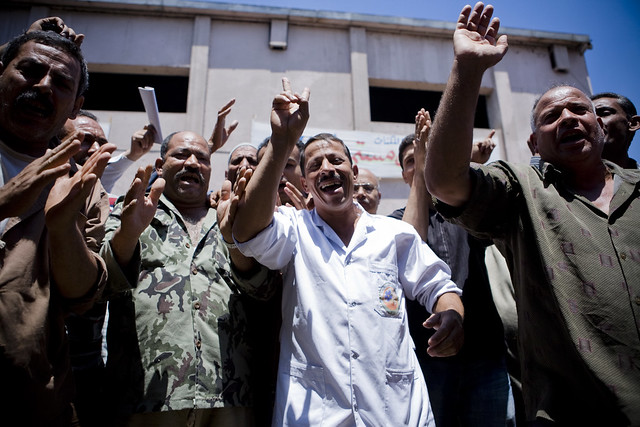
Tanta Flax & Oil Co Workers عمال طنطا للكتان والزيوت

  • Previous
  • 1
  • …
  • 28
  • 29
  • 30
  • …
  • 55
  • Next

Search 3arabawy

Follow 3arabawy

  • Facebook
  • Flickr
  • Instagram
  • X
  • YouTube
  • Spotify
  • Bluesky
©2026 3arabawy