Skip to content
3arabawy
3arabawy

Hossam el-Hamalawy

  • Home
  • About
  • Archive
  • Blog
  • Photos
  • Books
3arabawy

Hossam el-Hamalawy

Tag: palestine

Live-blogging: The Nature of conflict with Israel

Posted on 16/02/200909/01/2021 By 3arabawy

The Center for Socialist Studies is holding now (as I’m typing) a lecture on the nature of the conflict with Israel.
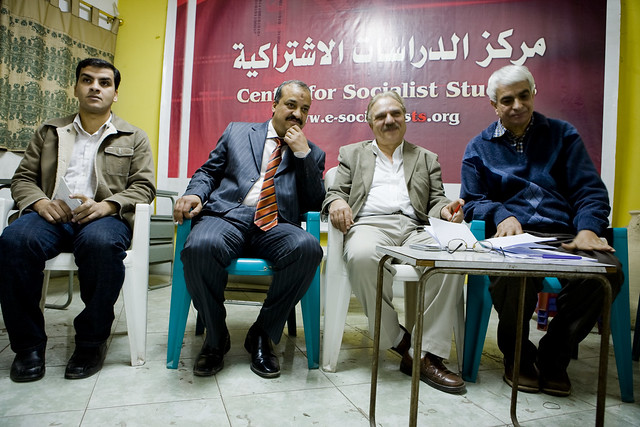
Center for Socialist Studies Lecture on the Nature of Conflict with Israel ندوة مركز الدراسات الاشتراكية حول طبيعة الصراع مع الكيان الصهيوني

The first speaker is Dr. Muhammad el-Beltaggi, a parliamentarian with the Muslim Brothers. He is now talking about the history of the conflict, making no reference however to religion at all. He’s talking about “Imperialism”, “Zionism”, but no mention of the religious rhetoric at all, up till now at least.
–Dr. Beltaggi is stressing that resistance is the only way forward, against the Zionist State.. The criticisms made against the Arab regimes however is diluted. Beltaggi didn’t mention the word “Mubarak” up till now.
— “No place for peace with such a barbaric entity like the Zionist entity. Resistance is the only option,” says Beltaggi
–Beltaggi, just finished his speech now. He spoke very eloquently, did not mention any word about religion. You could have mistaken him for a secular nationalist if you didn’t know he was MB. Still, his criticism of the regime is mild. He’s criticizing the “Egyptian leadership” for pressuring the Palestinians and for the siege coordinated with the Zionists.

–Sayyed Abdel Moneim now of the Center for Socialist Studies is now speaking.
–He’s discussing the historical ties between imperialism and the establishment of the Zionist state
–Israel has always been a base for imperialism in the region, Be it brits or or later the Americans.
–Why can’t the Palestinians, despite their bravery, not able to liberate their land? They are up against big imperial powers who are backing Israel, and they need extra help from their neighbors.
–Sayyed is talking about the rise of Zionism, as a reaction to the antisemitism in Europe in the age of colonialism
–“There is so much oil in this region. There is the Suez canal. This region is strategic. The imperial powers are using the Zionist settlers in Palestine in protect their interests in the region.
–Zionism sees Jews and Gentiles as irreconcilable, and cannot live together, according to the Zionist myths..
–Those who carry out attacks against Jews abroad in Europe and elsewhere give legitimacy to the Zionist logic. We should be firmly opposed to any attacks on synagogues in Europe. “Zionism and Anti-Semitism are two faces of the same coin,” says Sayyed.
–The Arab regimes do not care about Palestine. From 1948 till today, the role of the regimes have been negative…
–Sayyed is lashing out against the Egyptian regime for its complicity in the warcrimes and the siege
–The Palestinians on their own cannot liberate Palestine. The Arabs have to get involved. The biggest aid we can give them is overthrowing the regimes that are ruling us and are agents of imperialism and zionism

–Medhat el-Zahed, Consulting Editor of El-Badeel and leftist activist is now speaking.
–He’s making reference to Rachel Couri, who died defending the Palestinians.
–Medhad is talking about international solidarity with the Palestinians, which is not limited only to the Arab and Muslim Worlds.
–Medhat is praising Noam Chomsky, who’s Jewish, but at the same time a harsh critic of Israel. We have to end this mix up and confusion between Zionism and Judaism..
— There is a “globalization of people” vs. “globalization of capital,” says Medhat.
–The international solidarity is a a main asset in the fight against Israel.
–The Palestinian national liberation movement has managed to stand strongly in the face of Israel during the war on Gaza, and same for Lebanon in 2006
–But there are problems, according to Medhat, saying there should be diversification of the forms of resistance. “Things should not be limited to missiles only,” Medhat says. “We need mass participation of the Palestinians in resistance, including peaceful actions.”
–The military operations also shouldn’t be limited to the rockets. Operations against the settlements should escalate
–Medhat is also calling for unity between the Palestinian resistance factions. “Factions should discuss what is the next step, and agree together.”
–Medhat is also extremely concerned about the separation between Gaza and the West Bank.

Medhat has finished.. Now the floor is open for discussion. The contributions from the floor are critical of the MB’s stand towards the Arab regimes and is asking why aren’t the MBs bold enough to expose Mubarak and his allies. But the atmosphere is not tense and the dialogue is taking place in a civilized way.

I think I’ll stop here, and take some more pix. Excuse the typos and some of the points I missed blogging about above. It’s my first time to try Live-Blogging an event here in the center. I hope I tweak and improve this technique in the future by more practice.

US, UK, Ireland: BDS campaigners score victories

Posted on 13/02/200903/01/2021 By 3arabawy

From Haaretz:

Irish trade unionists said this week that they plan to launch a boycott of Israeli goods in 2009. Meanwhile, Manchester University Student Union adopted a resolution supporting a boycott of Israel.

And in the US:

Hampshire College in Amherst, Massachusetts, has become the first of any college or university in the US to divest from companies on the grounds of their involvement in the Israeli occupation of Palestine.
This landmark move is a direct result of a two-year intensive campaign by the campus group, Students for Justice in Palestine (SJP). The group pressured Hampshire College’s Board of Trustees to divest from six specific companies due to human rights concerns in occupied Palestine. More than 800 students, professors and alumni have signed SJP’s “institutional statement” calling for the divestment.

Police crack down on Gaza solidarity activists

Posted on 12/02/200929/12/2020 By 3arabawy

The crackdown on Egyptian pro-Gaza activists continues, Paul Schemm reports:

Egyptian authorities released a 26-year-old German-Egyptian blogger on Wednesday, five days after he was arrested after a march supporting Gaza, but three other pro-Palestinian activists were sentenced to prison by military courts.
Egypt is increasingly sensitive to criticism about its response to Israel’s Gaza offensive and appears to be cracking down on a new generation of activists.
The arrests over Gaza are the latest chapter in what has been a wider government crackdown on bloggers and independent activists over the past year.
With most traditional avenues of political dissent closed, bloggers have gained prominence in recent years, exposing government corruption and police brutality. Security agencies have struck back, and more than half a dozen are either in jail or out on bail with cases pending.
The government has also targeted the country’s main opposition movement, the Islamist Muslim Brotherhood, which has born the brunt of the government’s sensitivity over the Gaza situation. Police have jailed 800 of its members over the last two months, usually for attempting to bring aid to the embattled Palestinians.
Philip Rizk, a graduate student at the American University in Cairo, and a passionate blogger about the plight of the Palestinians in the Gaza Strip, was held for five days by Egypt’s plainclothes security men after marching with 15 others through the countryside outside Cairo carrying pro-Palestinian banners.
State Security never said why he was detained, but Rizk’s blog about the situation in Gaza was critical of the Egyptian government’s refusal to open its border crossing with Gaza during Israel’s the three-week offensive to stop Hamas rocket fire.
Rizk, a graduate of Wheaton College near Chicago, also spent two years in Gaza and produced a documentary there about daily life in the impoverished strip.
Popular anger in Egypt over the Gaza war has been running high due to pervasive media images of Palestinian suffering during the Israeli assault in which 1,300 Palestinians and 13 Israelis died. Many feel that Egypt could have done more to support the Palestinians.
Egyptian military tribunals convicted two young activists, Ahmad Douma and Ahmad Kamal, of illegally crossing into Gaza and blogging about the war there and sentenced them to a year in prison. Grizzled opposition politician Magdi Hussein, 58, received two years imprisonment on Wednesday for a similar offense.
On Friday, 22-year-old blogger Diaeddin Gad was also arrested by police at his home north of Cairo and remains in custody after criticizing Egyptian policy on Gaza in his blog, “Voice of Anger,” according to the Paris-based Reporters Without Borders. A number of others are also believed to be in custody for similar activism.
According to Ahmad Droubi, a 26-year-old environmental consultant who was present when Rizk was arrested, the regime overreacted to the small, peaceful march on Friday because they did not expect it.
“I think they were shocked, there was something they didn’t hear about, suddenly they just found these 15 people walking in the middle of nowhere,” he said, describing the six-mile (10-kilometer) march through the countryside north of Cairo.
Every member of the march was questioned and had their information taken down by officers, and many later received visits at their homes or workplaces from plainclothes security men.
“I haven’t slept at home in three days,” said Travis Randall, 26, of Boulder, Colorado, who took part in the march. He said lawyers recommended he wait until the furor over the whole affair had calmed down before returning home. “They believe it’s an intimidation thing.”
Unlike many people in State Security custody, Rizk was not physically tortured, according to Droubi who spoke to him after his release. “There was no physical mistreatment, he was interrogated for hours upon hours though.”
Egyptian security use such techniques to intimidate young activists and squelch opposition at an early age, explained Aida Seif el-Dawla, a psychologist and veteran political activist working at the Al-Nadim Center for victims of torture.
“The mere fact that you are being held incommunicado is itself a form of psychological torture,” she said, explaining that despite the small size of many of the protests, the youth of the activists is considered dangerous by the regime.
“The whole regime is aging and the potential of young people appearing here and there and taking the initiative is threatening, like for example the 6 April group,” she said. She was referring to a group that began on the social networking site Facebook calling for an anti-government strike in 2008. The Facebook site attracted tens of thousands of members.
The 27-year-old woman who co-founded the group was arrested and held by security for 18 days. She was released after promising never to engage in political activity again.
Online media has also played a major role in the campaign to release Rizk. Within hours of his detention a Facebook group with thousands of members had been founded, as well as a Web page dedicated to the campaign. Small but spirited rallies were held for his release around Cairo and in Europe and the U.S.
“I think direct action was the key to getting him released. I think also the media coverage was central in organizing that _ and Facebook of course,” said Adrienne Pine, a professor of anthropology at the American University in Cairo who organized rallies for his release.

  • Previous
  • 1
  • …
  • 79
  • 80
  • 81
  • …
  • 165
  • Next

Search 3arabawy

Follow 3arabawy

  • Facebook
  • Flickr
  • Instagram
  • Bluesky
  • X
  • YouTube
  • Spotify
©2026 3arabawy