Sarah Carr reports on the Center for Socialist Studies meeting:
Increasing violations of workers’ rights and an unrepresentative, state-controlled, trade union structure necessitate the formation of independent, worker-led, trade unions in Egypt, say labor rights activists.
This was the conclusion of a discussion held Thursday in Cairo’s Center for Socialist Studies in which labor leaders and activists discussed the role of the Egyptian Trade Union Federation in the country’s labor movement.

Workers allege that the Federation — the sole trade union organization in Egypt — has continuously betrayed workers’ interests.
They say that the state-controlled organization is emasculated by wide-ranging administrative and security body interference rendering it incapable of representing workers’ interests.
“It is significant that labor strikes are not being led by trade unions whose supposed role is to negotiate workers’ demands with employers,” Nagy Rashad, a labor activist within the Schindler Factory said.

Egypt has recently witnessed a surge of industrial action which began after the December 2006 strike in the Ghazl El-Mahalla spinning factory in the Delta town of Mahalla.
“Most of these protests were against both employers and official trade unions which are controlled by the state and businesses via state security bodies which vet nominations to the Federation,” he continued.
Rashad said that there needs to be a radical change in the treatment of industrial action.
“There needs to be no interference in the right of workers to form their own unions and to take strike action.
“Labor protests must be treated as the expression of a problem in employee-employer relations rather than a criminal act.”
Journalist Mostafa Bassiouny, who moderated the event, pointed out that since its establishment in 1957, the federation had only called for one strike in 1993.

“It has been 50 years since the establishment of the federation. While its establishment was the fulfilment of a long-cherished dream for Egyptian workers, an alliance developed between it and the government — to the extent that workers launched protest action against their own unions, which have consistently opposed their interests,” Rashad explained.
Rashad said that the existing trade union structure requires a radical overhaul.
“An independent trade union federation requires true union freedoms — something which currently doesn’t exist.
“In addition private sector workers must be incorporated into the federation: millions of these workers are not members of any union. Finally, the federation’s role must be reinvigorated, so that trade unions are empowered to play an effective role in negotiations,” he continued.
Muhammad Abdel Salam also underlined the importance of integrating non-unionized workers in Egypt’s new industrial zones into the trade union structure.
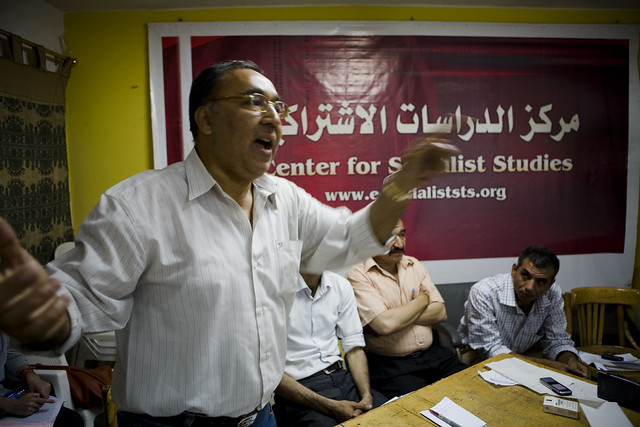
“Only 20 percent of Egypt’s workforce is integrated in the federation; it is extremely unrepresentative,” he said. “No one seems concerned to reach out to workers in the new industrial towns. There are several thousand factories in Sixth of October, Tenth of Ramadan etc, and only six trade unions.”
“The Federation doesn’t reflect the size and potential of Egypt’s workforce,” Abdel Salam explained.
He pointed to the absence of democracy within the Federation as one of its major problems.
“The Federation has been appropriated by administrative and security bodies so that it doesn’t act as a source of pressure on the government.”
“The Ministry of Manpower oversees all aspects of the Federation’s activities,” Abdel Salam said.
Lawyer Haytham Mohamadein traced the historical development of the legislation governing trade union activity.

He said that trade unions developed at the turn of the century and that their existence was not initially acknowledged by the law.
Mohamadein said that it was workers themselves who militated for a law — to protect them against police attacks.
“Workers called for a law to protect against police aggression and the first law acknowledging the existence of trade unions — as charity organizations defending workers’ rights — was promulgated in 1942.”
“This law was marked by a number of flaws which continue to exist in current legislation organizing trade unions.
“It deprived agricultural workers, nurses and servants from forming unions. It gave the Ministry of Social Affairs the right to oversee and approve the formation of trade unions and there were no provisions protecting workers from dismissal where they launched labor action.”
Mohamadein said that existing trade union legislation violates the Egyptian constitution by imposing conditions making trade union activity virtually impossible.
“The constitution gives workers the right to form unions: it doesn’t mention interference by administrative bodies in trade unions, nor restrict the number of unions in one workplace,”
“Existing law violates international instruments ratified by Egypt.”
Mohamadein made reference to Law 12, which organizes trade union activity and which was drafted by Cairo University professor Ahmad Hassan El-Borei.
Mohamadein said that collective bargaining is a sine qua non of Law 12.
“Five years after this law was promulgated El-Borei said that it required amendment. He said that the application of its main aim in practice had been rendered impossible because its central element – collective bargaining – no longer exists.
“When asked why it no longer exists, El-Borei said that the existing trade union structure doesn’t permit true collective bargaining in the name of workers — Law 12 is therefore based on a principle which doesn’t exist.”
Mohamadein emphasized that international law gives workers the right to organize themselves in independent trade unions.
“These instruments give the right to workers to form unions themselves, without prior permission and without administrative interference or supervision. They are also allowed to form more than one union within a single profession.”
“The formation of independent trade unions is a violation of neither international nor domestic law,” he said.
Kamal Abo Eita — one of the leaders of the historic December 2007 real estate tax collectors’ strike which workers won after a 10-day sit-in outside the Finance Ministry — called on workers to send letters notifying their federation trade union and employer of their resignation from the federation, as a prelude to the establishment of independent trade unions.
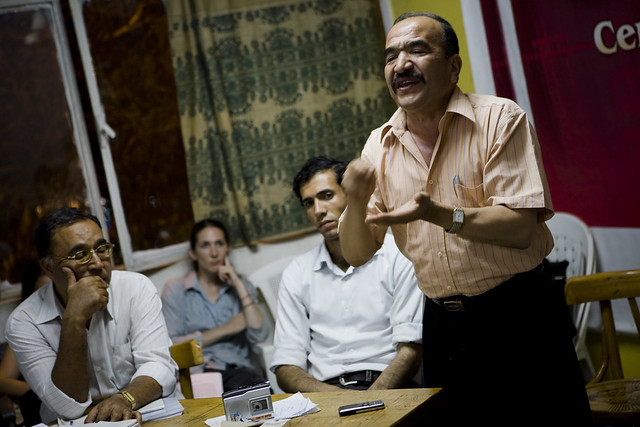
He pointed out that Egypt was recently voted number seven in the International Labor Organization’s blacklist of the 10 worst violators of workers’ rights.
Abo Eita attributed this to the absence of plurality within the federation, and its heavy infiltration by state security bodies — who he told the seminar, take part in labor negotiations.
“Does the federation deserve LE 2 of my wages every month? I say it doesn’t,” Abo Eita said.