Activists in Chicago are mobilizing for a protest in front of Mubarak’s Consulate, in solidarity with Mahalla and the detainees, on May 9
Over the last month, mass protests have erupted in Egypt – centered in the textile mill of Mahalla. These protests have erupted in response to spiraling food prices and severe hunger, anger at the dictatorship of Hosni Mubarak and long unmet demands of the Mahalla workers. Mubarak security forces used rubber bullets, tear gas and live ammunition against the Mahalla people, leaving two dead and hundreds injured. More than 800 people have been detained across the country, including 600 Mahalla workers and 150 political activists.
A Minority Lives off the Work of a Starved Majority
This most recent protest of the workers of Mahalla’s textile mill is one of hundreds in the wave of working-class collective action set off when the government of Prime Minister Ahmad Nazif, which took office in July 2004, began to accelerate the drive to privatize public-sector industrial and financial enterprises. From 1998 to 2004 there were over 1,000 workers’ collective actions. More than one quarter occurred in 2004 alone, particularly following the installation of the Nazif government. The number of actions has continued to grow. A total of 222 strikes, demonstrations and protests in 2006, 580 in 2007, and 27 collective actions in the first week of January 2008 alone have been reported. During 2007 strikes spread from their center of gravity in the textile and clothing industry to encompass building materials workers, transport workers, the Cairo subway workers, food processing workers, bakers, sanitation workers, oil workers in Suez and many others. Private-sector industrial workers comprised a more prominent component of the movement than ever before. In the summer of 2007 the movement broadened to encompass white-collar employees, civil servants and professionals.
In the past, although workers’ wages were modest, they were nevertheless able to buy subsidized goods, and benefit from low-cost housing and free education for their children. Since the beginning of the 1990s, the state has rapidly reduced subsidies on basic commodities, education, health and housing, leaving workers with no alternative but to demand wage rises to raise their living standards. On the other hand, a law issued in 1991 laid the legal foundations for privatization and aimed to sell off the majority of public sector workplaces and reduce the number of public sector workers by 1.3 million to around 0.5 million, while increasing the workforce in the private sector to 1.5 million.
Meanwhile, workers’ pay in private sector companies is on average $50 per month. Private sector pay is also relatively reduced once longer working hours are taken into consideration. The average working week in the private sector is 57 hours, but in reality, large numbers of private sector workers work 12 hours per day. Private sector workers have no real protection against dismissal, greatly reduced access to health and safety, and occupational health.
This exploitation and consequent pauperization of the majority of population is made the more unbearable by soaring inflation. The price of basic foodstuffs rose at rates of at least 33% (for meat), and as much as 146% (for chicken), from 2005 to 2008. The official annual rate of inflation for January 2008 was over 11% and over 12% for February, while the minimum wage rate has remained flat since 1984.
Moreover, recent bread shortages have precipitated several violent disturbances, which left up to 7 people dead. The long lines outside bakeries in Cairo’s poorer neighborhoods are the best indicator of how unequally the fruits of Egypt’s record economic growth are distributed. Indeed, Mubarak’s economic reforms, including privatization and lower corporate tax rates, have led to 7% economic growth in each of the last three years. This growth however has not benefited workers whose stagnant salaries have been met by soaring prices and a very high monthly inflation rate.
Hunger and hardship have led workers and professionals alike to protest throughout the country. Meanwhile, Mubarak regime continues to crackdown on opposition movements, to strangle freedom of the press, and to establish itself as the reaper of the fruits of economic growth and as the eternal despot ruling over a starved population.
The Hijacking of Peaceful Venues for Political Participation by the Ruling Regime
While workers and middle-class professionals have sought peaceful means to press their claims, Mubarak’s ruling National Democratic Party, has brutally cracked down on political opposition, jailed journalists and editors, closed a human rights organization and a trade union services and awareness-raising association, and imprisoned hundreds of members of the Muslim Brotherhood and other opposition groups.
Mubarak has ruled Egypt for the last 26 years and the 80-year-old president has been denying rumors that he is ill; several editors who dared raise the issue of the president’s health have faced criminal trials. Meanwhile, the president’s son Gamal is being groomed into the National Democratic Party’s leadership as a potential successor.
In 2006, the regime has reaffirmed its reluctance to compromise its monopoly of all venues for political participation. In November of that year, the leadership of the Egyptian Trade Union Federation Council, the highest-ranking trade union body in the country, was determined by default, for the term 2006-2011. The independent Center for Trade Union & Workers’ Services described the proceedings of the nationwide elections for the 2006-2011 trade union term as “the worst ever in terms of violations, and the worst elections conducted throughout the history of the Egyptian trade union movement”. Thousands of (would-be) candidates were barred from running in these elections.
The National Democratic Party has, again, abducted the ETUF Council. It took control of 22 out of the 23 ETUF Council seats. The NDP’s Hussein Megawer has also managed to preserve his position as president of the ETUF Council for another term, after 14 years in (appointed) office.
With the NDP’s domination over the country’s trade unions, the ruling regime and its businessmen allies, are now able to ensure that privatizations of public sector enterprises will be approved by the upper echelons of the union leadership; while simultaneously ensuring that workers’ strikes in opposition to privatization will remain unauthorized and illegal.
In fact, Egypt’s labor and trade union laws are, themselves, violations of workers’ rights – since they violate the object and purpose of conventions, which Egypt has ratified, including the International Labor Organization’s Convention 67 (Freedom of Association & Protection of the Right to Organize) and Convention 98 (Right to Organize & Collective Bargaining). Egypt’s trade unions are neither independent nor self-organized; they lack the right of arbitration and the right to strike. Without these rights a union is not a union at all. Moreover, union plurality is prohibited by law, under the pretext that it would lead to chaos. The leadership of the ETUF threatened to take legal measures against anybody organizing parallel trade unions.
In addition, in April 2007, and after a series of intimidations by plainclothes thugs, security officers shut down the headquarters of the Center for Trade Union & Workers’ Services, which offers legal aid to factory workers, raises their awareness as to their rights, and reports on labor rights-issues in the country.
On the other hand, the Egyptian government has been cracking down on the Muslim Brotherhood, the major opposition group in the country, in advance of the April 2008 local and municipal elections, in a policy aiming at their exclusion from the 2011 presidential election (as the 2005 constitutional amendment requires independent presidential candidates to secure the backing of 10 local councilors in at least 14 provinces).
Throughout last month, security forces have arbitrarily arrested and detained without charge more than 800 members of the Muslim Brotherhood, including at least 148 would-be candidates in the local and municipal elections. The Muslim Brotherhood had sought to register 5,574 candidates as independents in the nationwide elections, but electoral committees accepted only 498 of these applications. Local administrative courts then ruled that nomination papers of 2,664 Muslim Brotherhood-affiliated candidates had been improperly rejected.
Boycotted by the Muslim Brotherhood, and marked by significant forgery and rigging, the 2008 local and municipal elections scored a victory of 92% for the ruling party.
Mubarak’s repression and striking undemocratic practices have only drawn mild rebuke from the Bush administration, a close ally of Mubarak. In fact, the Bush administration has been supporting and applauding the Egyptian government’s most brutal and undemocratic practices indirectly, by accepting to hold talks with Mubarak’s son as a by-default heir of Egypt’s presidency –thereby disregarding popular demands for the democratic election of a successor to Mubarak’s 27-year-old rule. In May 2006 Gamal Mubarak made a secret trip to Washington to meet with Vice President Cheney and other senior U.S. officials a day after thousands of Egyptian riot police broke up a pro-democracy protest in Cairo. Gamal also had a separate White House meeting with national security adviser Stephen J. Hadley, during which he also met with president Bush and Secretary of State Condolezza Rice. Since his presidency of the ruling party’s policy committee, Gamal has helped push through initiatives expanding the party’s powers and blocking opposition challengers, but his pro-market agenda has been sufficient to win him the favors of the Bush administration. On the other hand, Mubarak’s regime has proven to be the perfect candidate for U.S renditions and outsourcing of torture. The general intelligence directorate in Lazoughly and in Mulhaq al-Mazra in Cairo is believed to hold many of the suspects abducted by the U.S and smuggled into Egypt to be severely tortured and to vanish into black holes.
The Regime’s Fierce Reaction to April 6 General Strike
Kifaya (an active pro-democracy movement) called for a nationwide strike against recent price hikes to take place on April 6. On April 5, the Interior Ministry condemned the “illegitimate groups” who had called for a strike and promised “the necessary and immediate firm measures against any attempt to demonstrate, lock traffic, or hinder public services or for inciting any of these acts”.
Opposition parties and labor leaders in Mahalla city had called for a strike on the same day, to protest low wages and price hikes for basic goods. However, on the morning of the 6, the strike was canceled as hundreds of plainclothes security agents surrounded and entered the Misr Spinning and Weaving factory, and forced the laborers to work. But after the day shift ended, workers and thousands of Mahalla residents took to the streets in demonstrations that continued the following day.
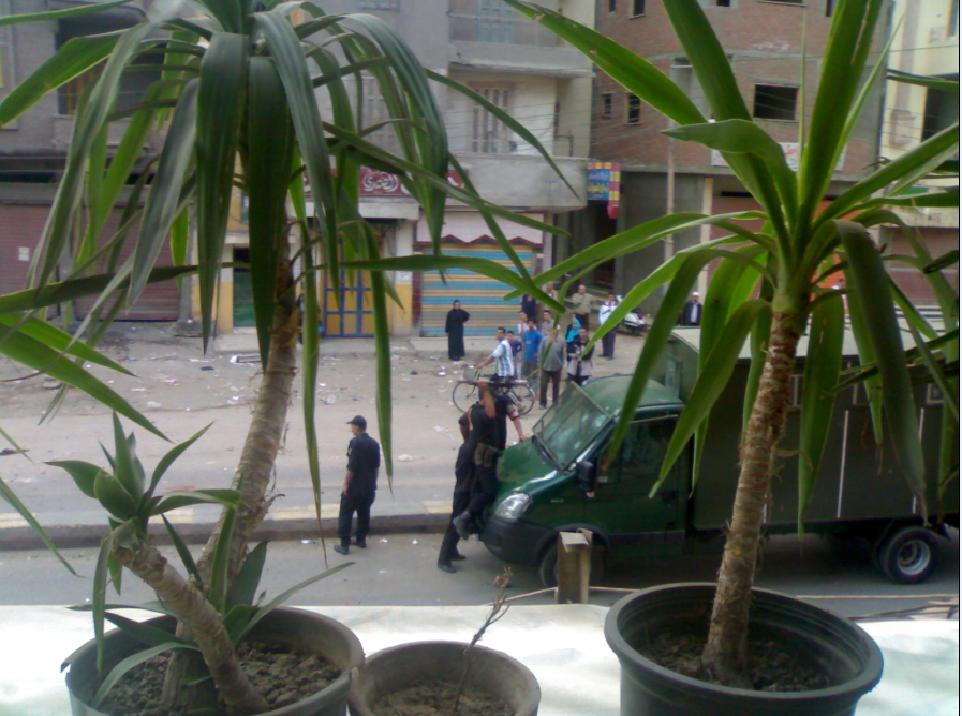
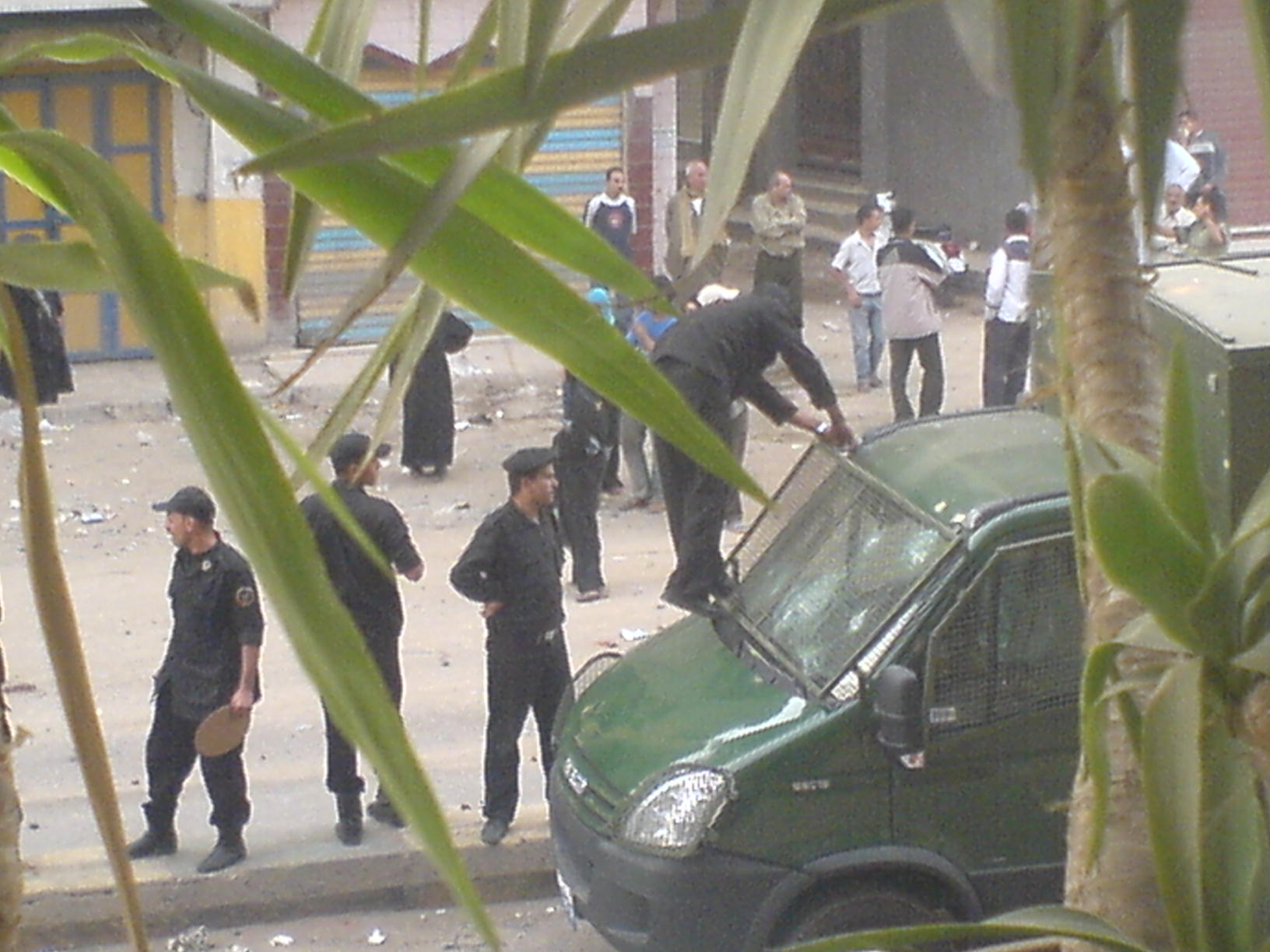
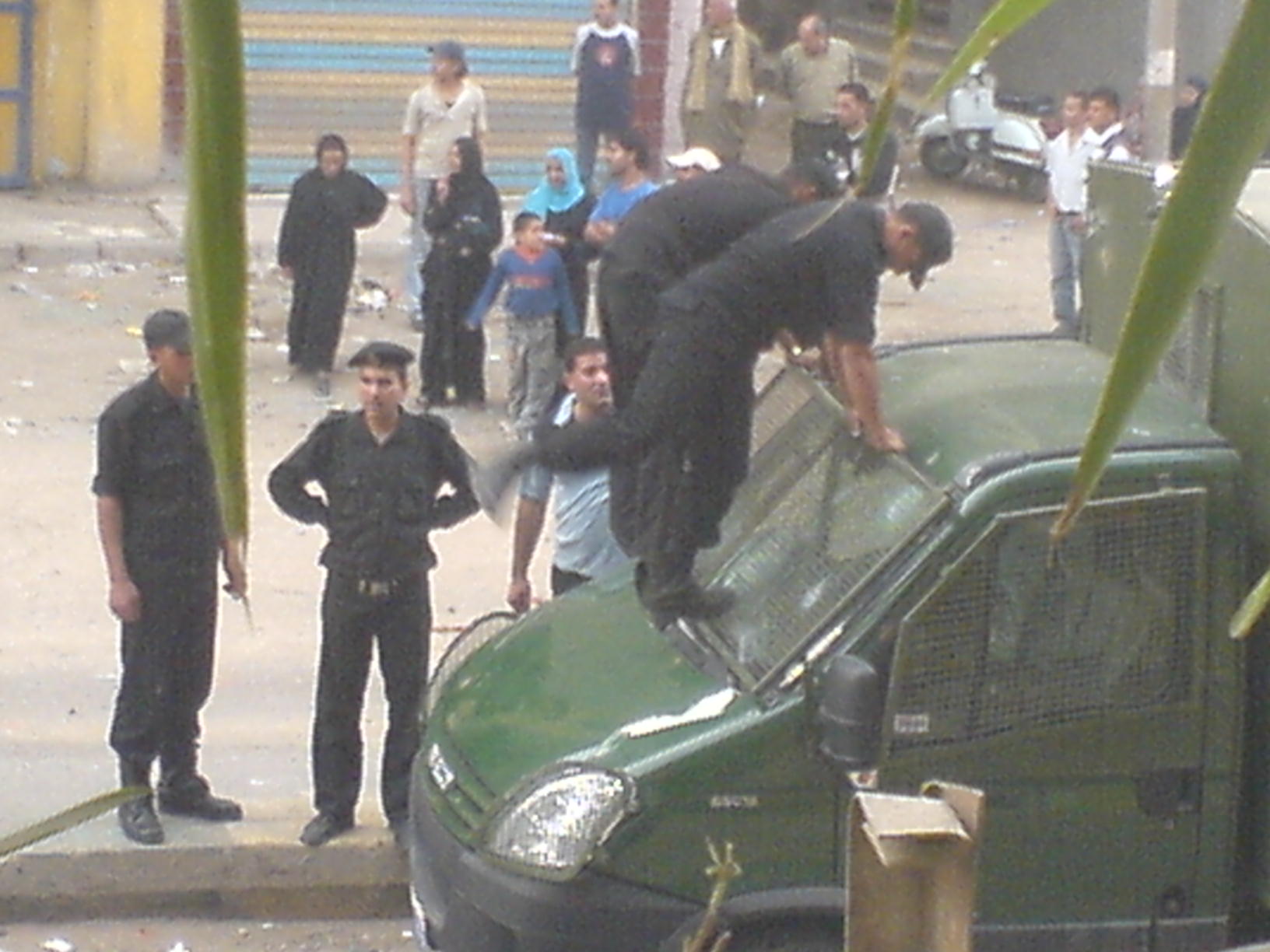
Police in riot gear used live ammunition and rubber bullets to suppress the protests. Two people were killed by police bullets, including a 15-year-old bystander, and more than 100 people were wounded, including some who lost eyes after being shot with rubber-coated bullets. Police also detained several journalists trying to cover the protests. Police dragged protesters to the ground and beat them with fists and sticks. Moreover, people with critical injuries were handcuffed to their beds in Mahalla hospital, and journalists were not allowed in.
In recent developments, the mother of a Mahalla detainee died on April 24, aged 55, as she was told that the police refused to abide by the court’s decision to release her son. Doctors were unable to bring her back to consciousness and she died under the shock.
On the other hand, Ahmad Ezzat, the lawyer of the Mahalla workers who have been detained since April 6, has reported great violations that they have been subjected to in detention. The workers charged with “vandalism and the disruption of public order” have confirmed having been psychologically and physically tortured by state security police during interrogation. Ezzat added that torture techniques included electric shocks applied to sensitive areas of their bodies, in addition to explicit threats to rape their wives if they refuse to admit charges of theft, defacing of public property and having engaged in random shootings during the demonstrations of April 6 and 7. Ezzat also said that “the charges that were registered against the detainees were not logical, one of the detainees is said to have confessed the acquisition of public phone booths, 13 chairs and a computer… it is not possible that such acts were committed by a single person and in light of the heavy security presence throughout the city on the day of the protest”. 14 of the people arrested received extended detention orders, for “possessing firearms and white arms and causing disturbances”. Moreover, the Ministry of Interior has issued additional orders of arrest, and as of today, the families of the detainees continue to hold protests for the release of the April 6 demonstrators.
The Jailing of Opposition Leaders and Political Activists on Groundless Charges
40 leading Muslim Brotherhood members had been charged with “belonging to a banned group” and “possessing anti-government literature”. In February 2007, President Mubarak ordered that the 40 be tried before a military tribunal after an ordinary criminal court dismissed charges against 17 of them, including the group’s Deputy Supreme Guide.
On April 15 the military tribunal sentenced the Deputy Supreme Guide and 24 others, to prison terms of up to 10 years, and ordered the seizure of their assets. At the verdict and sentencing hearing, defense lawyers as well as the public were excluded. The military and police used heavy-handed methods against families of the defendants who sought to attend the hearing, and 34 people were arrested outside the court on the day of the verdict.
On the other hand, following the protests of April 6 and 7, more than 600 demonstrators in Mahalla have been detained. A group of 30 doctors and academics, who had attempted to enter Mahalla the following day, in a solidarity mission with the victims of police violence were detained at a police checkpoint 20 km outside the town for four hours and prevented from either entering Mahalla or returning to Cairo.
On the night of April 9, state security forces arrested George Ishak, vice coordinator of the opposition Kifaya movement, at his home. Ishak, a prominent pro-democracy activist, was charged with “conspiring with others to incite protest with the intention of committing crimes against individuals and public property, and the use of violence and force to prevent the public authorities in the performance of their work”. During his interrogation, Ishak was not allowed legal representation. He was released two days later on LE 10,000 bail. More than 50 Kifaya members were also arrested since the protests in Mahalla began on April 6.
In addition, 27-year-old Esraa Abdel Fattah, who had publicized the April 6 strike on Facebook, was taken into custody by security forces, who picked her up from a coffee shop near her workplace. On Monday, Abdel Fattah was supposed to be released in accordance with an order from the Prosecutor General, but instead received a detainment order from the Interior Ministry for an unspecified period of time.
Mubarak’s and the National Democratic Party’s regime has established itself as a major violator of human rights. It has led the country into one of its worst periods of economic, political and social conditions. The regime has relied on a combination of clientalism and coercion to keep itself in power, despite rising dysfunctions in the State’s fulfillment of its social, political and economic roles, and despite its peeking unpopularity and illegitimacy among the population. Most importantly, the policies of the regime have significantly impoverished the Egyptian people, while benefiting a minority class of businessmen and technocrats. The government has maintained a policy of silencing opposition and oppressing unions and civil society organizations. It has considerably limited freedom of expression and of association. It has, and continues to use extreme forms of brutality and sheer force against a suffering population.
The regime continues to reap not only the fruits of a rapidly liberalizing economy, at the expense of the working class, but also it continues to benefit from the unconditional financial and military support of the U.S.
We, The Coalition for Democracy and Social Justice in Egypt, oppose such policies and pledge to employ sustained mobilization against state oppression in Egypt. We stand with the rights of the workers to organize independently of the State, to strike, protest and to express their claims against rising inequalities and dire working conditions.
We Demand
– The immediate release of all detainees that were arrested in the course of the strike and demonstrations that took place in the city of Mahalla as well as a number of Egyptian cities on April 6.
– An investigation into the killing of two people in Mahalla on April 6 by Security Forces’ bullets and the necessary measures to hold the perpetrators accountable.
– The legislation of a new labor law that allows for union plurality, and ensures the independence of unions, in accordance with the International Labor Organization’s Convention 67 (Freedom of Association & Protection of the Right to Organize) and Convention 98 (Right to Organize & Collective Bargaining)
– The raising of wages in both the public and private sectors, to match the inflation rates, and the implementation of workers’ demands including better job security and working conditions
– The revision (by a civil court) of the jail sentences pronounced by the Military Tribunals against members of the Muslim Brotherhood.
– An immediate end to police brutality and government-organized thuggery, and the reinforcement of accountability among the Police and State Security Forces
– Free and transparent elections to select true representatives of the Egyptian people in parliament, professional syndicates and trade unions. The supervision of the elections by a neutral electoral commission and an end to police interference in the whole electoral process.
– State fulfillment of the rights to education, health care, and humane standards of living for all.
The Coalition for Democracy and Social Justice in Egypt (CDSJE)
What you can do:
– Please sign the petition:
https://www.ipetitions.com/petition/democracyandjusticeinegypt/index.html
– Please forward this information widely
– Attend the picket, taking place downtown Chicago on May 9, at the entrance of the Egyptian Consulate, and bring as many people as possible
– Call or fax the Egyptian Consulate to register your protest: Phone: (312) 828-9162; Fax: (312) 828-9167