The Winter of Labor Discontent continues…
On Monday 8am, dozens of truck drivers assembled their trucks in front of Ain Sokhna Gate, blocking the road, in protest of the exponential sudden increase in the toll. The drivers transport rocks from the nearby mines, and were shocked to find the toll increased by roughly 400%. Traffic on the highway to Cairo came to complete halt. The police tried to negotiate with the drivers and miners, who insisted on paying the original toll. Around 11am, I was told, the police clashed with the drivers, and used electrically charged batons. The drivers left their trucks blocking the gates and dispersed. I’m still unclear about the details of what happened later, but I was told the dirvers were allowed passage at some point later in the day… and they paid the same old toll. I managed to reach one of the drivers over the phone, but he asked to be contacted on the following day. So may be I’ll update this posting with more details if I manage to reach him.
And fantastic news coming form Zefta. The Delta Textile Company workers’ strike ended today after the management responded to the demands of the workers, who will get paid their 45-day bonus. Mabrouk!
In Kafr el-Dawar, turblances occurred today at two more textile factories (El-Beda and Artificial Silk Companies) , whose total labor force amounts to 9,000 workers. The Artificial Silk Company workers went on strike demanding their 45-day bonus, and the management rushed to meet their demands on the same day, so the strike ended. In El-Beda however the management decided to pay the workers only 21-day bonus. Some of the workers accepted the pay, others refused, went on strike, insisting on the 45-day bonus. There is tension in the factory and the situation might escalate.
As for the Kafr el-Dawar Textile factory, the state management brought in the police “Karate Teams,” which took control of the factory gates. The police thugs are trying to starve the strikers out, by banning their families from bringing food supplies to the strikers. Despite the intimidation, the workers are still steadfast, with 9,000 of them occupying the factory, sleeping in the freezing cold. According to a statement from the Workers’ Coordination committee, “The workers broadcasted an obituary for the chief of management and trade union committee and chanted slogans demanding the 45 days bonus like other companies. Receiving the news of their colleagues in Zefta they celebrated the victory of their colleagues chanting: Strike until death.. Strike until payment.”
I’ve obtained some photos of the Kafr el-Dawar Textile strike, thanks to leftist lawyer Khaled Ali.
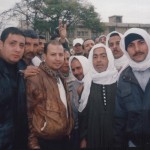
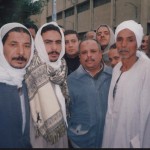
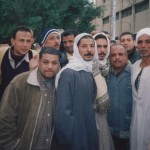
The Workers’ Coordination Committee has put together a fantastic round up of the strikes, thanks to Dr. Aida Seif el-Dawla and Khaled Ali…
“Diary of a Working Class”
Coordinating Committee for Workers’ Trade Union Rights and LibertiesSunday 4 February 2007
4 p.m.
New workers strikes in Kafr El Dawar, Saf and Zefta (1)
Workers at the Cairo company for poultry entered the second day of their strike, where more than 3000 workers refused payment five days ago protesting the management’s refusal to pay them work-related hazards compensation, compensation for the rise in prices and an additional bonus to improve their living conditions. The total wage of the workers ranges between 300 and 400 Egyptian pounds which is not compatible with the current economic conditions. The workers also demanded a compensation for work hazards considering that they run the risk of contracting bird flu. When the company declined responding to their demands, workers at the company’s Agricultural Sector and the fodder factory (both located in El-Saff, Giza) went on strike and refused to cash their payment. State security agents and the labor office are conducting negotiations with the workers, in the absence of any representative of the company. Shareholders in the company are Motaz El Shazli, Khorafi and others. Negotiations are still unsuccessful amidst security concerns that the strike might extend to the Nubareyya company workers.
At another front, textile workers at the Zefta textile company, affiliate of Delta Textile Company, continue their strike, which started with complete halt starting 8 a.m. until 10.30 a.m. followed by an alternating strike, where only some of the machines are operated for a set time. The workers are refusing the 21-day bonus offered by their management, and are demanding equal treatment as their colleagues in Mahalla and Helwan, where the bonus far exceeded that offered to Delta workers. Company security agents tried to enter into the wards and operate the machines, which workers me with a warning to escalate their protest upon any interference on part of the security, which was ordered not to intervene.
On a third front Kafr El Dawar textile workers, striking since the 30th of January, started a hunger strike yesterday at 10 p.m. refusing the 15 days bonus offered to them and demanded its increase to a 45 days bonus, like their colleagues in Mahalla. They also called for impeaching their trade union officials and the “workers’ representatives” at the company’s management board, as well as disbursement of the workers’ share of the company’s land which was sold over the past years. The number of striking workers amounts to 12 thousand workers.
4th of February 2007
7 p.m.
Three Shebeen el Kom workers on hunger strike transferred to hospital
The Shebeen el Kom workers strike enters its 7th day. The strike started at 3 p.m. on Tuesday 30th of January 2007. Yesterday 100 of them started a hunger strike, one of whom was transferred to hospital in view of his deteriorating health condition.
The negotiations had reached a deadlock yesterday, when it concluded with an offer to pay the workers their promised bonuses in cheques that could only be cashed when the Indian investor takes control of the factory. The workers refused, insisted to receive their dues before the foreign investor take control of the company and continued their strike and hunger strike. Three more workers were transferred to hospital this afternoon. The workers also collected close to 200 signatures demanding the impeachment of the plant trade union committee.
After signing the contract on the 15th of December 2006, the Indian investor had sent four managers, one of them director of engineering affairs, the second for the maintenance of the company and production, the third for administrative affairs and the fourth to chair this group. Two weeks ago the Indian investor sent 25 engineers and technicians, who were daily in the factory. Since Thursday they did not show up.Sunday 4th February 2007
9 p.m.
Workers strike in Shebeen el Kom, Zefta, Kafr El-Dawar and El-Saff (2)El-Saff
Negotiations between the management of the Cairo poultry company and the workers came to a successful conclusion. Attending those negotiations were all workers in addition to a representative of the general trade union of food industries and the company’s trade union committee. The vice chair of the management, representing the company, told the workers they would “study” their demands, and that they did not mind responding to several of them after agreeing with the workers on some details. The workers are to elect four representatives to continue the negotiations with the management at the latter’s HQ in Cairo during the coming days. The company also told them that the beginning of the negotiations are pending on the workers resuming their work and cashing their pay. The workers agreed to resume work, but without accepting to cash their pay until the end of negotiations with the company next Wednesday. They threatened that if their demands are not met, they will resume their strike.Kafr El Dawwar
Kafr El Dawwar textile workers continue their strike throughout all four shifts. Only the female workers left at night to sleep at their homes, but they will return to the factory early in the morning in case the strike continues. The Beheira Province Governor rushed to Kafr el-Dawar to handle the negotiations. He sent the factory’s security chief, Arafa Abul Ila, to negotiate with them on his behalf at the state security headquarters of Kafr El Dawwar. The workers refused and told him: whoever wants to negotiate with us should come to our factory. Said El Gohary, head of the general textile union arrived in Kafr El Dawwar and talked to the workers, telling them they were exaggerating in their demands, that the company is losing and that they do not deserve bonuses, upon which the workers stopped him and said: Profit and loss is the concern of the management. Our concern is our working hours.Zefta
The textile workers strike in Zefta continues until now. The first shift left the plant, replaced by the second shift which operates only 12 out of the 500 machines of the company. The Zefta strike is a revolving one.Shebeen El Kom
Also in Shebeen El Kom the strike continues. Government bodies are trying to reach a solution with the workers. Their concern lies with the deadline set for the Indian investor to take control of the factory which should take place between the 1st and 5th of February, since any delay will involve paying fines.Monday 5th February 2007
12.00 noon
Workers strike in Shebeen el Kom, Zefta, Kafr El Dawar (3)Zefta
The strike of Zefta Textile Company was successfully concluded today before the beginning of the third shift, when the company agreed to pay the workers a nonrefundable 45 days bonus. The payment should take place in the next four days. The workers announced that they will resume their strike if the company refuses to pay within those four days.Shebeen El Kom
The workers strike continues. The workers did not agree to the offer of the cheque payable after the new investor takes control of the company. The coordinating committee for workers and trade union rights and liberties supports the workers demands in receiving their dues before the company is handed over and to avoid the loss of workers rights amidst the legal regulations which permit the new owner not to abide by any earlier agreements. The objective of the company is to transfer to the problem as one between the investor and workers.Kafr el Dawwar (1)
Workers at the Kafr El Dawwar continue their strike. Throughout the night the chief security director at the company tried to negotiate with the workers to end the strike but they refused. This morning Police Karate Team (in plain clothes) took control of the three factory gates and allowed workers to leave but did not allow anybody in which led to preventing 2000 workers from entering the factors. The police also obstructed the entry of food to the 9000 striking workers which lead to their protest and demonstration inside and outside the factory until they managed to get some food in. The workers broadcasted an obituary for the chief of management and trade union committee and chanted slogans demanding the 45-day bonus like other companies. Receiving the news of their colleagues in Zefta they celebrated the victory of their colleagues chanting: Strike until death.. Strike until payment.Kafr el Dawwar (2)
On another front 9000 workers at El Beda and Artificial silk companies in Kafr El Dawwar started a strike this morning demanding a 45 days bonus like.
The Coordinating Committee for Workers is following several workers movements in different textile sectors, which carry the possibility for further strikes tomorrow morning.
And I received the following statement from the Land Center for Human Rights…
Workers’ strikes against the selling of state companies
Dear freinds, Join us in Demanding the Egyptian President and Prime Minister to stop the ill-treatment against striking workers, pay them their late dues and guarantee their rights to suitable work and decent living
H.E. Muhammad Hosni Mubarak
President of the Arab Republic of Egypt
Abedine Palace, Cairo, EGYPT
Fax: +20 2 390 1998
E-mail: webmaster@presidency.gov.egThe Council of Ministers
Magles El Sha’b Street – El Qasr El Einy – Cairo
Tel: 202 7958014/35/36
Fax: 202 7356449 – 7958016
E-mail: primemin@idsc.gov.eg