Skip to content
3arabawy
3arabawy

Hossam el-Hamalawy

  • Home
  • About
  • Archive
  • Blog
  • Photos
  • Books
3arabawy

Hossam el-Hamalawy

Tag: renditions

Cairo Anti-War Conference: Abu Omar makes an appearance; Sharqawi identifies his torturers

Posted on 31/03/200716/01/2021 By 3arabawy

The second day at Cairo’s 5th Anti-War Conference and 3rd Cairo Social Forum brought earthshaking surprises at it’s Anti-Torture Forum, held on Friday afternoon.
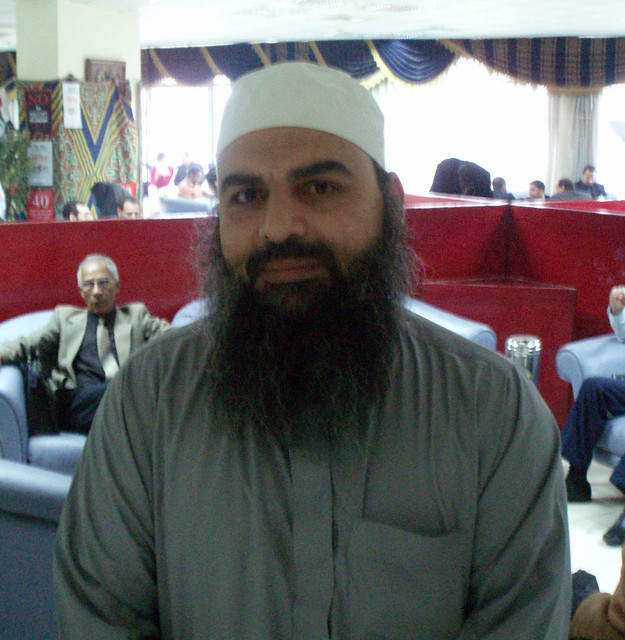
Abu Omar الشيخ أبو عمر

Abu Omar–the Alexandrian cleric kidnapped 2003 by the CIA in Milan and rendered to Egypt where he was brutally tortured–showed up today at the Press Syndicate, defying the travel ban imposed on him by State Security as a condition for his release. Abu Omar took part in the Anti-Torture Forum, chaired by leftist activist Dr. Aida Seif el-Dawla, where he presented his testimony about his torture odyssey from Milan to Cairo, via Germany. “I was severely tortured by the Mukhabarat and State Security,” Abu Omar said. “I was electrocuted for months, till my whole body turned black.”

Abu Omar speaking about his torture ordeal الشيخ أبو عمر يروي تفاصيل واقعة تعذيبه

Abu Omar expressed fears of re-arrest by the Egyptian police for speaking to the media, but insisted he will keep on talking. “If I stay silent, these practices (by the Egyptian security services) will continue.” The cleric also pleaded to be allowed to leave Egypt, back to Italy.

Another political bomb was thrown by blogger Muhammad el-Sharqawi, who gave his testimony about the torture and sexual abuse he faced in Qasr el-Nil Police Station on 25 May 2006. For the first time, Sharqawi named his torturers.

Anti-Torture Forum منتدى مناهضة التعذيب

“Police Major Samaw’al Muhammad Abu Sehla was the first to kidnap me from the car I was in on that day,” Sharqawi told the audience.
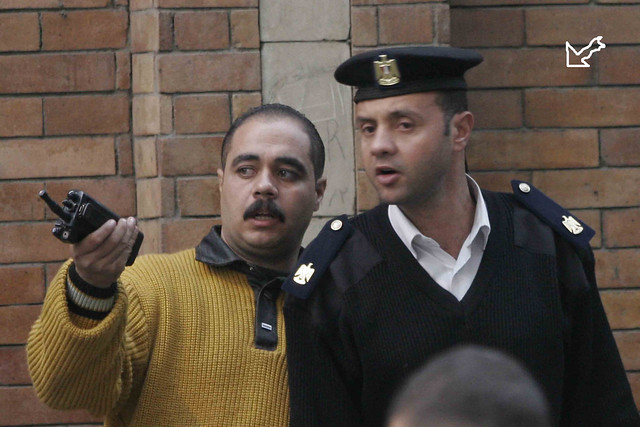
Police Major Samaw'al Mohamed Abu Sehla الرائد سماؤل أبو سحلة

And, “the State Security officer who supervised my torture inside Qasr el-Nil Police Station is named Sherif.”

State Security Officer Sherif el-Qamati

Sharqawi also expressed his frustration with the refusal of the authorities to open an investigation into his abuse, despite the repeated requests by his lawyers, accusing State Security of breaking into his house and stealing his laptop.

Al-Masry Al-Youm interviews Abu Omar

Posted on 27/02/200727/12/2020 By 3arabawy

Check it out here.

Follow up on Abu Omar

Posted on 24/02/200720/01/2021 By 3arabawy

A follow up on Abu Omar’s case by journalist Nadia Abou El-Magd:

Cleric at center of alleged CIA kidnapping case says he was tortured in Egypt
ALEXANDRIA (AP) _ An Egyptian cleric, speaking publicly for the first time, said that Egyptian officials tortured him in prison after he was kidnapped in Italy _ allegedly by CIA agents _ and sent here for interrogation.
The claims by Osama Hassan Mustafa Nasr sharpened the controversy over the CIA’s “extraordinary rendition” program, just days after Italy indicted 26 Americans and five Italian agents accused of seizing him.
The case is the first criminal trial connected to the rendition policy, in which U.S. agents secretly transferred terror suspects for interrogation to third countries where critics say they faced torture.
Italy has signaled it won’t seek the extradition of the 25 CIA agents and one U.S. Air Force lieutenant colonel, but it will likely try them in absentia. From the outset, U.S. officials have declined comment on the case.
Nasr, also known as Abu Omar, showed up unexpectedly Thursday at the trial of an Egyptian blogger in this Mediterranean coastal city _ his first public appearance since he was released Feb. 11 after four years in Egyptian custody.
“I was subjected to the worst kind of torture in Egyptian prisons. I have scars of torture all over my body,” Nasr told journalists outside the trial, which is unrelated to his case.
The 44-year-old bearded Muslim preacher showed dark, circular scars on his wrists and ankles that he said were from electrical shocks by Egyptian interrogators. He said he also has scars on his stomach and other areas but was embarrassed to show them in a public place.
He expressed fears that Egyptian security services would re-arrest him for speaking out. “I could be arrested the moment I leave here,” Nasr said.
“I don’t want trouble with anyone anymore. My body cannot bear any more prison and torture,” he said.
Nasr’s case has given a rare look into the renditions program.
Italian prosecutors say Nasr _ suspected of recruiting fighters for radical Islamic causes _ was kidnapped from the streets of Milan in February 2003 by CIA agents with help from Italian agents. He was allegedly taken to Aviano Air Base near Venice, then to Ramstein Air Base in southern Germany, and finally to Egypt.

U.S. officials said in December 2005 that up to 150 terror suspects had been seized and flown to their homelands for interrogation under the renditions program.
The Bush administration has insisted that it gets guarantees from those countries that suspects will not be tortured. Egypt, Syria, Algeria and Saudi Arabia _ all countries with records of torture, according to human rights activists _ are believed to be among the countries where suspects have been sent.
In Washington, U.S. State Department deputy spokesman Tom Casey said the administration has nothing more to say on Nasr’s case, adding that the United States “does not render people to countries where we assume they will be mistreated or tortured.”
Egypt, a close U.S. ally, has kept silent over its role in the program.
Nasr was freed in 2004, but was arrested again three weeks later after he spoke to a journalist by telephone. Egypt never acknowledged he was in custody, but the prime minister said in 2005 that “people have been sent” to Egypt, without elaborating.
An Italian prosecutor issued an arrest warrant for Nasr in April 2005 as part of a terrorism inquiry. Nasr was accused of fighting in Afghanistan and Bosnia, though his Egyptian lawyer denied he had ever visited those countries.
Nasr said Thursday he was innocent and wanted to return to Italy, where he was granted political asylum in 2001, four years after entering illegally. He appealed to Italy for help, saying Egyptian authorities had barred him from traveling.
“I want to go back and stand in front of the Italian judiciary and prove my innocence,” he said.
Italian prosecutor Armando Spataro said Thursday that judicial authorities would like Nasr to testify against the American and Italian agents. Egypt has never responded to an Italian request for access to the cleric.
“Obviously it would be useful to hear what he has to say, but obviously it does not depend on us,” Spataro said. “If he is banned from leaving (Egypt) there’s nothing we can do.”
Nasr spoke at the trial of Abdul-Kareem Nabil, a blogger from Alexandria who was convicted Thursday of insulting Islam and Egyptian President Hosni Mubarak in his Internet writings and sentenced to four years in prison.
Nasr said Nabil was his neighbor in Alexandria, though it appeared he came to the court to make his appeal to the media. After the court session, he told an Associated Press reporter that he could not speak more for fear of arrest.

  • Previous
  • 1
  • …
  • 6
  • 7
  • 8
  • …
  • 11
  • Next

Search 3arabawy

Follow 3arabawy

  • Facebook
  • Flickr
  • Instagram
  • X
  • YouTube
  • Spotify
©2026 3arabawy