Skip to content
3arabawy
3arabawy

Hossam el-Hamalawy

  • Home
  • About
  • Archive
  • Blog
  • Photos
  • Books
3arabawy

Hossam el-Hamalawy

Tag: #RevSoc

Resources on the Revolutionary Socialists

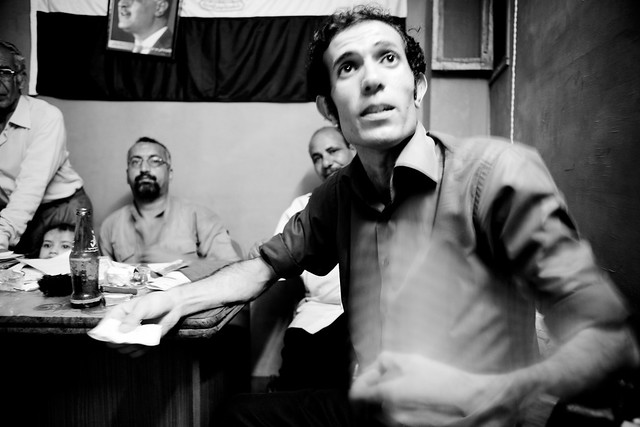
Transport workers meeting

Posted on 22/08/200911/02/2021 By 3arabawy

I attended yesterday a small celebration gathering hosted by the local branch of the Nasserist Party in Ezbet el-Nakhl, north of Cairo, that included some of the Public Transport strike leaders, activist lawyers and journalists.

Abdel Ghani عبد الغني

Abdel Ghani, Imbaba Garage: “The Mahalla workers and the textile strikes taught all Egyptian workers how to strike and to stage sit-ins.”

Samir سمير

Samir, Giza Branch: “We are ready to strike again if the government does not fulfill the agreement.”

Wael وائل

Wael, Nasr City’s el-Mostaqbal Garage: “The (state-backed) General Union (of Transport Workers) belongs to the government, not the workers. We need a new union. We already started our campaign to collect signatures from the workers to impeach the members of the union committee. If the General Union does not accept the impeachment requests, we will launch an independent union like what the real estate tax collectors did.”
Haitham Mohammadein هيثم محمدين

Socialist Lawyer, Haitham Mohammadein, the legal consultant for the Union of Real Estate Authority employees: “There is a lot to be learned from the experience of the Real Estate Tax Collectors. The government claims the General Federation of Trade Unions is the only representative of the workers. That is not true. This Federation represents the government interests only.  The tax collectors understood this fact well, and the law was on their side. The government breaches the constitution and the international conventions it signed by restricting your right to form a new independent union.”

Young doctors protest working conditions

Posted on 10/08/200910/02/2021 By 3arabawy

Via Al-Masry Al-Youm English Edition:

Around 40 young doctors staged their first demonstration today on the stair steps of the Doctors’ Syndicate, demanding better pay and improving work conditions. The fresh graduates’ two-hour protest was organized by the “Young Doctors of Egypt” Facebook group.
“Our starting salary is around LE 150 a month, and what can we expect after 10 years of practice? 900 pounds,” explains Ahmad Atef, a general practicioner, who founded the Facebook group around two months ago to give a voice to underpaid young doctors in Egypt. Atef stood in the protest waving a photocopy of his pay sheet around on which he had underlined his paltry salary.
Mohammed Shafiq, another member of the group responsible for publicizing the protest online, adds bitterly “we all studied medicine for 11 years. Do we really lose the best years of our youth for LE 250 a month?”
Salaries are not the only matter of concern for those young doctors, they say. They also face skyrocketing admission fees for post-graduate studies, which have recently jumped from LE 600 to LE 3650, and they are deprived of allowances for transportation, food and medicine.
“None of us receive any compensation of any kind, not even when we need to go to another province for work,” says Atef, who then compares young Egyptians doctors’ salaries to those received by their Saudis counterparts. “They start off with LE 15,000. Of course Saudi Arabia’s finances are much better, but the gap is far too wide!” he continues, his pay sheet still in his hand.
Emigration to the US or the Gulf states remains a possible, yet increasingly difficult, option for improving the young doctors’ salaries, but most of the protesters say they wish to stay in their homeland. Shafiq, for instance, says that “being humiliated by the Oil States,” does not appeal to him. “This is why this gathering is important, we want our work conditions to improve in Egypt and we will act concretely and peacefully to achieve this goal,” he declares.
On the stairs, the group of young doctors are silent. No humming or chants emanates from the crowd. The demonstration is peaceful and orderly, and the rows of policemen that normally surround any gathering are notably absent. “I guess the police know that we are not run by any political group,” Shafiq muses. “I do not know whether this (Young Doctors of Egypt) group will survive in the following months but if it does not I am confident that another one will take its place,” he concludes.

Young doctors to protest tomorrow over work conditions

Posted on 09/08/200910/02/2021 By 3arabawy

Via Al-Masry Al-Youm English Edition:

Young doctors will stage a protest tomorrow in front of the Doctors Syndicate’s headquarters demanding better salaries for fresh graduates.
Initiated by the “Young Doctors of Egypt” group on Facebook, which currently includes over 700 members, tomorrow’s two-hour demonstration is the first protest organized by that group.
Young Egyptian doctors suffer from very low incomes ranging between LE 150 and LE250 a month, which barely cover the costs of transportation to the hospitals in which they work. They equally suffer from bureaucratic complications with regards to the pursuance of their studies and professional trainings.
“We address our protest to the Ministry of Health and demand salaries ranging from LE 1,000 to LE 2,000,” explains Mohammed Shafiq, a young doctor who disseminated the demonstration online. Fresh graduates demand raising their basic salary to 1000 LE, to reach a minimal level of 2000 LE with the addition of all bonuses and allowances. They also asked for raising various allowances such as the contagion allowance, as well as transportation, post-graduate studies and other allowances.
“We are also concerned about elevating the quality of the scientific education we receive,” adds Shafiq, who hopes that at least 10 percent of the group members on Facebook will show up at noon tomorrow in front of the Doctors’ Syndicate. In their statement of demands, young doctors requested continuing education inside hospitals through visits by established medics, participation in international conferences, scholarships and fellowship programs. They also requested facilitating the admission procedures for post-graduates studies, which are instrumental to medics’ professional path. Further to post-graduate studies, they demanded fixing a ceiling for admission fees at LE600, a sum that has currently jumped to LE3650.
“We are willing to join forces with other doctors’ organizations for common demands later on,” says Shafiq.
Tomorrow’s protest has been discussed at the board of the Doctors’ Syndicate earlier this week and has garnered at least “verbal” support from its senior members, including some of the Muslim Brotherhood activists within the syndicate.
“It is an opportunity for those young doctors to protest,” says Essam el-Aryan, member of both the Brotherhood and the Doctors’ Syndicate Board, adding that any kind of demonstration in support of doctors is appreciated. But it remains unclear how many doctors belonging to the Brotherhood will actually protest on the stairs of the syndicate alongside their young colleagues. In March 2008, Brotherhood members were accused by secular doctors’ advocacy groups of aborting a planned national strike. The Brothers’ involvement in the syndicate politics, they charged, were only limited to “rhetoric” and regional issues like Palestine solidarity campaigns, refraining from active participation in the fight over work conditions.
Some of us will be present tomorrow, but others have meetings outside,” adds el-Aryan who himself says he has a meeting tomorrow at the time of the protest. “If the demonstration is still on when I come back to the syndicate I will attend it,” he concludes.
The head of the syndicate, Hamdi el-Sayyed, was not available for comment.

  • Previous
  • 1
  • …
  • 38
  • 39
  • 40
  • …
  • 105
  • Next

Search 3arabawy

Follow 3arabawy

  • Facebook
  • Flickr
  • Instagram
  • Bluesky
  • X
  • YouTube
  • Spotify
©2026 3arabawy