Skip to content
3arabawy
3arabawy

Hossam el-Hamalawy

  • Home
  • About
  • Archive
  • Blog
  • Photos
  • Books
3arabawy

Hossam el-Hamalawy

Tag: #RevSoc

Resources on the Revolutionary Socialists

Live-blogging: The fight for free unions

Posted on 05/03/200909/01/2021 By 3arabawy

I’m at the Center for Socialist Studies now. I’ll be live-blogging today’s event.
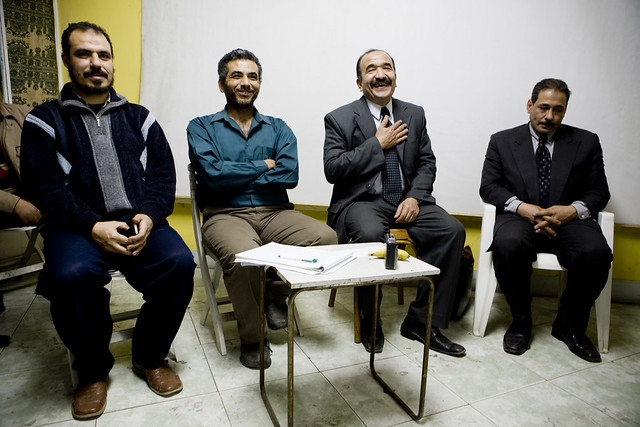
Lecture on the Fight for Free Unions

Now a short documentary on the Real Estate Tax Collectors strike is being screened.

The tax collectors present in the meeting are happy to see themselves on screen:) The film is by Mahmoud Farag. The film has some of my pix from the strike, interviews with strike leaders, men and women.

I forget how tough those women tax strike leaders are. I like the interviews. They were talking about their role in the strike. They have great sense of humor too. The film audience are exchanging comments and laughter whenever anyone of them appears on the screen.

There is a newspaper clip in the film, with headlines from local newspapers during the strike, and it includes headlines about international solidarity and European trade unions who came out in support of the Egyptian tax collectors

Videoshots from the free union declaration day (20 Dec 08).

The lecture started. Kamal Abu Eita is speaking now. Kamal is saying the fight for independent trade unions today, is as important as the fight for national independence from colonialism last century.

Labor journalist Mostafa Bassiouny is now talking, presenting briefly a background on the fight for free unions in Egypt.

1957 was a turning point for the trade unions, says Mostafa, with Nasser’s establishment of the General Federation of Trade Unions.. Mostafa details the history of the General Federation..
Today, Mostafa says, only a minority of the workers are part of this General Federation.. The Federation doesn’t care about unionizing workers in the private sector.

The Federation is an organization without bases.. The overwhelming majority of industrial and service facilities do not have union committees.

The Federation was established in the first place by the employers: The govt.
The govt was the biggest employer in Egypt then, and it was the govt that established the union.. What sort of union do we expect it to be?

Mostafa is breaking down the structures of the General Federation, and where corruption lies

Financial corruption, Mostafa is detailing.. How votes are rigged during syndicate elections…
Only those who have friendly relations with SS get “elected”…

Draconian restrictions on strikes, explains Mostafa.

The Federation’s membership is dwindling.

Nasser established the Federation, but the relations of work as outlined by the Nasser’s regime was very hostile to the workers. The unions did not have power to negotiate.. They were govt appointed officials.

The State-backed unions brag whenever they suppress strikes. Hussein Megawer, head of Federation, today is one of the big enemies of workers. Farouq Shehata, head of State-backed General Union for Financial workers sold out the tax strikers and coordinated with SS.

The state-backed unions in Mahalla played central role in aborting the strikes in the factory.

On occasions, “workers’ representatives” are nothing but the owners of the business! You get “trade unionists” who are major shareholders. They do not represent the workers, and never did.. they represent capital..

In 1989, Steel workers occupied their mill. The govt response was to break into the factory, smash the occupation, and stop production! The workers didn’t stop the production, it was the state.. The state put security considerations on top of everything..

During Mahalla sept strike, the workers didn’t sabotage.. Those who carryout trade unionist activism among workers are independent forces away from the state-backed union. The latter cannot monopolize trade unionism anymore..

The fight for free unions today is integral to changing the political situation. In other countries were there dictatorships, always the independent unions were an important factor in the collapse of this dictatorship.

Speakers lined up include Ghazl el-Mahalla Kamal el-Fayoumi, Tax strike leader Abdel Qader Nada, and several strike leaders from other sectors.
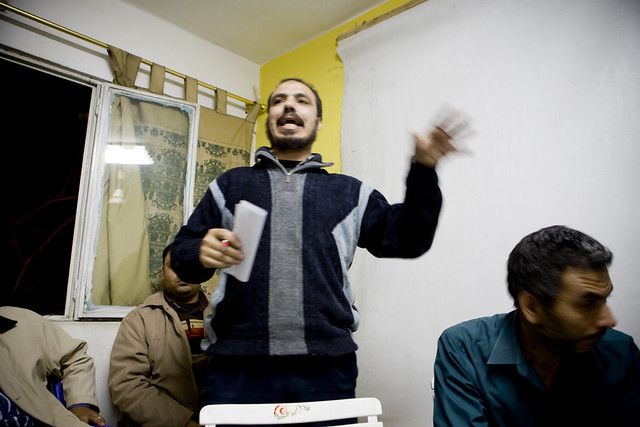
Kamal el-Fayoumi كمال الفيومي

The hero of Mahalla Kamal el-Fayoumi is now speaking. This guy makes me shiver each time I hear him. He’s very charismatic, sincere. When he talks he thunders.
He spoke about the Mahalla strikes, and the state-backed unions position towards them.
He spoke about his detention in April 2007, slamming State Security police, the govt, and the attempts to privatize the firm.

“The independent union established by the Real Estate Tax Collectors is a model we have to follow,” Kamal Fayoumi says. “Our free unions will not be born except by strikes. The Mahalla workers are capable of doing the same. We were the first to introduce the culture of strikes in Egypt.”
When confronting the state-backed unions, we have to confront privatization. We cannot end up in the street.

The govt is a govt of businessmen

Kamal is slamming Mubarak himself. Everyone is full of adrenaline now at the audience…
He finished his talk. Strong applause from the audience.

Tax Strike leader Abdel Qader Nada is now gonna speak.

Abdel Qader talks about the start of the 2007 real estate tax collectors strike.. He’s denouncing the state-backed unions, explaining what the govt corrupt union officials were doing during their strike.

Abdel Qader is also stressing that establishing a free union is a constitutional right. “We cannot just establish a union, we can also establish a general federation of unions. That’s our right!”

Abdel Qader is detailing the rights Egyptian workers have under the law, which is not implemented and violated always by the govt.

Egypt’s strike wave

Posted on 03/03/200929/01/2021 By 3arabawy

Live-blogging: Discussion on recent strike wave – Pharmacists, truck drivers, lawyers

Posted on 02/03/200910/02/2021 By 3arabawy

I’m at the Center for Socialist Studies, and will be live-blogging today’s discussion, led by trade unionist Fatma Ramdan, on the recent wave of strikes.

Activist Fatma Ramadan: Which strikes can we support? who was protesting:
1- Workers in the factories or the services sector or govt civil service,
2- Professionals: Journalists, Doctors, Teachers, Profs, Lawyers,
3- Petty bourgeoisie: Shop owners, owners of trucks and pharmacies..

The attack by govt on workers is escalating, because of the economic crisis. Most of the strikes by the workers were induced by sackings, layoffs, liquidation of business, privatization.
There are mass layoffs in 10th of Ramadan, 6th of October, Port Said..

Layoffs in auto industry:
In cases, workers haven’t gotten paid for months, like El-Nile Cottons. Workers staged sitins in El-Minya, despite SS intimidation..
Railway workers have been staging industrial actions over the last period.. Drivers brought trains to halt. They have so much power.. Signal Operators too… However the technicians were less powerful, it took them two days to start creating impact on the govt.. Those in the Railways administrative affairs (poor civil servants) also have demands. The govt has been dividing and ruling .. Railway workers leaders have to unite and avoid this..
Fatma cites tons of other examples from the recent factories strikes..
“But there is also hope.”
Cement Tora scored victories..

The 30% bonus decreed by Mubarak last year hasn’t been paid to many workers up till now… El-Nile Cottons, Cleopatra Ceramics are just two examples.. This has led to more protests…
The explosive issue in govt civil service is temporary employment.. There have been

Another category:
Microbus Drivers have been suffering from the police corruption and fines imposed by the traffic authorities…
The implementation of the Traffic Law is marred with corruption, with fines and penalties reaching imprisonment.

Lawyers’s strike escalated
Lawyers are subject to systematic abuse by the police and court officials
They are also mobilizing against the new infamous increase in the fees of court procedures, which means people will not afford any more filing legal suits..

Pharmacists: The strike called for by the Syndicate against the new tax law…
Pharmacists in the provinces, especially poor pharmacies, will suffer a lot. It’s not true the big pharmacists were the only beneficiaries of the new tax law. It’s mostly the poor pharmacies (70% of the pharmacies)

The cheapest truck would be on million egyptian pounds. The drivers are not workers. Some of them are owners of their vehicles.

The govt decree of course encourages monopoly, for the sake of big business.. But I can’t treat the truck driver in the same way as the worker.

Capitalists can go on strike, like what happens in Venezuela, which is not necessarily the case in Egypt. We support strikes against the regime. But not all strikes (espcially those by the truck drivers and the big pharmacies) are what we aspire for to bring down the system.. But we can’t denounce those strikes..
I have to be clear about my priorities when I’m devoting efforts to a solidarity campaign with a strike. Workers strikes have the priority

Audience contributions:
Blogger Ahmad Abdel Fattah: How can we build a media network to monitor strikes? The best solidarity we can give the labor movement is spread its news, and alert activists and journalists to what’s going on minute by minute.
Jaiku is a good service for that.. Why don’t we launch a jaiku channel for labor news. We have to train fellow journalists and activists on how to use Jaiku and the internet tools to disseminate information quickly..
The State TV directors and presenters, because they read about the workers strikes, got inspired into action. This means we have to put more effort into spreading the word about the workers actions.

Marwa: Not all pharmacists are rich, and not all strikers were the owners of the big pharmacies…
We supported the strikes of the Judges, though they were not poor. But we saw their movement as something that could encourage and mobilize other sectors in the society to move..
We should support, carefully, the pharmacists strike. The lorry drivers are a different case..

Another contributor: The reason why everyone heard of the pharmacists and the lorry drivers strikes, and not much about Mahalla, is that the former have access to wealth.
Those who would be harmed by the law are essentially the owners of the trucks not the drivers.
When a capitalist is about to lose his business because of some law, he’s more than happy to flood the newspapers with advertisement that “Poor families will lose their jobs”, but when they sack their workers, they forget about this talk…

Another contributor: We have to groom labor leaders.. We have to be in touch with the working class..

I’ve just made a five minute contribution about the importance of media, social media, and briefly explained the live blogging that I’ve been doing..

Fatma is wrapping up: We have to bring strike leaders, exchange experiences and pool in our resources.. The labor leaders have to meet up face to face, and coordinate their actions. When one factory will go on srtrike, others will strike in solidarity..
Media is important. Workers during strikes always as “Are we alone?” They get demoralized when they do not read any thing about their actions in the media..
The Amanco strike was lost, mainly because of the lack of support from the media.. Nothing was written about them. The owners managed to isolate the workers actions and crush the strike
We shouldn’t wait for the media. The bloggers are doing a good job. We have to encourage the young bloggers to continue their activism and dissemination of info..
We support the pharmacists and lorry drivers strikes, coz their actions help break down monopoly, but again let’s not have illusions about the limitations of that movement. These are not workers.

  • Previous
  • 1
  • …
  • 50
  • 51
  • 52
  • …
  • 105
  • Next

Search 3arabawy

Follow 3arabawy

  • Facebook
  • Flickr
  • Instagram
  • Bluesky
  • X
  • YouTube
  • Spotify
©2026 3arabawy