Skip to content
3arabawy
3arabawy

Hossam el-Hamalawy

  • Home
  • About
  • Archive
  • Blog
  • Photos
  • Books
3arabawy

Hossam el-Hamalawy

Tag: state backed unions

Monday: Mahalla textile workers demand their pro-govt union dissolved

Posted on 28/01/200730/03/2015 By 3arabawy

It is happening…

In what could be the biggest challenge to the state-controlled General Federation of Trade Unions since its foundation in 1957, a delegation of 100 workers from Ghazl el-Mahalla Textile factory will show up on the door step of the General Union of Textile Workers in Cairo (located 327 Shobra – Mazzallat St.) on Monday 10 am, armed with a petition signed by 14,000 workers demanding the dissolution of their Factory Union Committee, after the latter took a pro-management stand during the December strike.
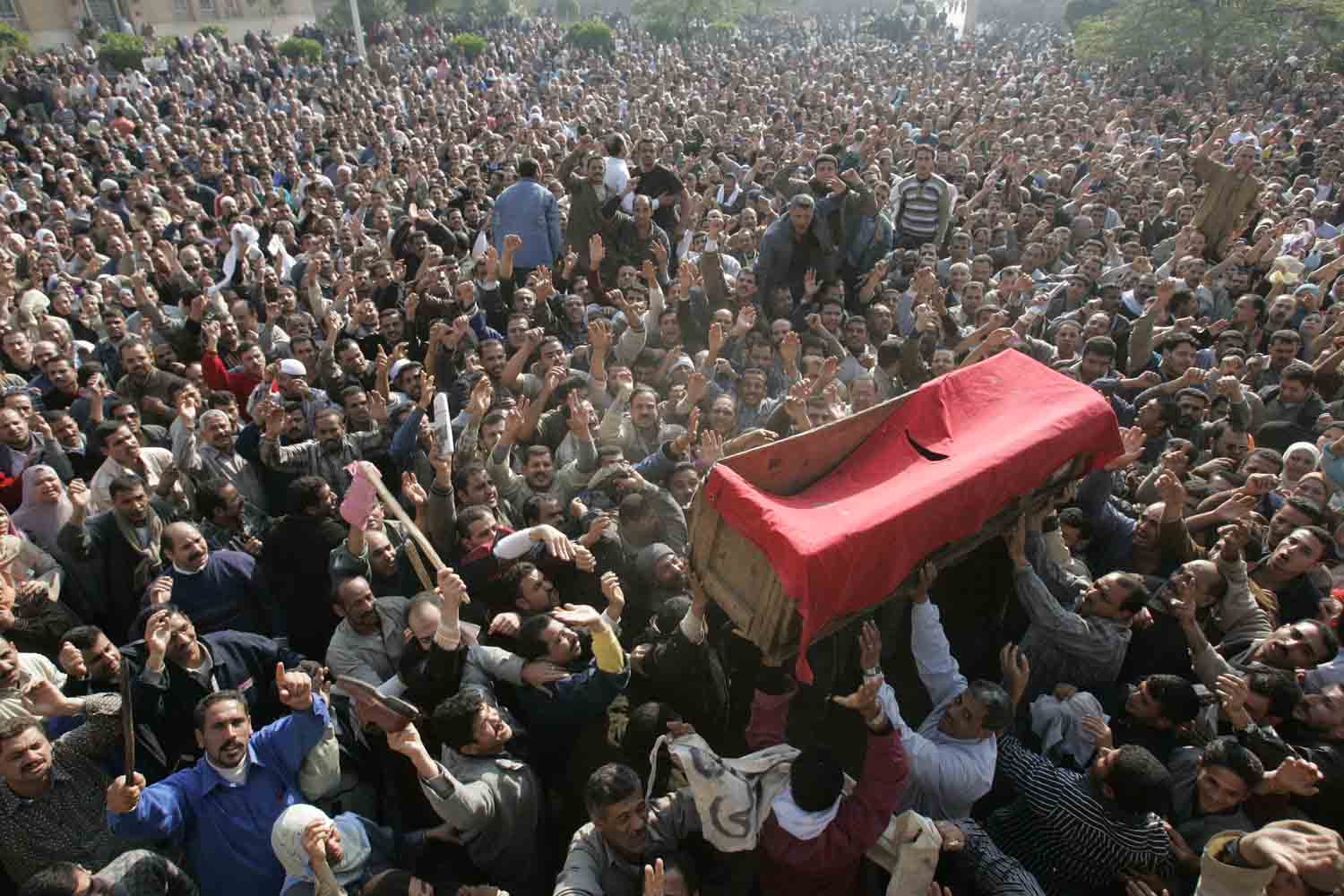
9 December 2006: More than 20,000 workers at the state-owned Ghazl el-Mahalla are striking, demanding two-month bonus and the impeachment of their corrupt management. Photo by Nasser Nouri

[Above: Photo of Ghazl el-Mahalla Textile workers staging mock funeral for their management, during the December strike. Click on the photo to watch a slide-show by Nasser Nouri.]

The campaign to impeach the factory union representatives started shortly after the 27,000-strong labor strike ended in victory, despite the open conspiring from the union bureaucrats against the strike and the factory occupation. According to Law 35/1976 (Egyptian Labor Unions Law), the required percentage is 50% +1 to impeach the union officials. (The workers, according to a Socialist source, have actually managed to collect 19,000 signatures.) This means the General Union is obliged to impeach the Factory Union Committee officials now.

If met with refusal, the Ghazl el-Mahalla Textile workers have clearly stated they are resigning en masse from the General Federation, and will be launching an independent labor union body.

Ghazl El-Mahalla is probably the biggest factory in Egypt, where 27,000 workers work shoulder to shoulder, and enjoy a historical fame for labor militancy. The leadership of the December strike, however, was composed mainly of young workers in their 20s and 30s. More interestingly, women played a central role in the strike, according to a Revolutionary Socialist activist I met tonight who’s connected to the December strike. The young age of the strike leaders can mean they lack the experience, but at the same time this can still be a plus, as they have not seen the catastrophic defeats and brutal crackdowns of the 1980s, when General Zaki Badr’s troops used to open live ammunition on strikers. They are fresh blood, who were thrown into battle last December… and they won… the sweet taste of victory is still in their mouths as they now take on their General Federation.

If Ghazl el-Mahalla workers manage to score a victory against their union bureaucracy, this will encourage other workers to step in. It is no secret there is mass frustration among the ranks of workers in other sectors (like the railways) against their union leaders (who mostly got their seats via vote rigging and security connections).

Whatever the outcome of Monday’s battle, this is just the beginning of a long-awaited fight against the General Federation–the regime’s arm within with the working class. And it couldn’t have come at a more critical time, where the Federation is already in a shaky position.

The General Federation cannot claim anymore it is the “representative of Egypt’s workers.” The Federation’s membership today stands roughly at 3.7 million workers– only 20 to 25% of Egypt’s working class. The vast majority of the workers are outside the govt-controlled union structures at the present time… and they don’t have any representative body.

The General Federation is facing international isolation, after repeated requests to join international labor bodies were refused because of obvious lack of independence and the draconian restrictions the Federation itself imposes on the right to strike.

Shaking the echelons of the General Federation means drastic implications to the regime:

The ongoing constitutional amendments circus will need to be ceremonially endorsed by the Federation to add the necessary facade of legitimacy the regime needs. In other words, Mubarak needs Hussein Megawer (the sec-gen of the Federation) to go out in public and say: “In the name of Egypt’s workers, we support the amendments Mr. President.” If the Federation is shaken now, this can indirectly affect the constitutional amendments process.

The regime depends strongly on the union bureaucracy for mobilization. Those buses that were shipping in the “NDP supporters” to electoral posts during the November 2005 parliamentary elections, to rig the vote in the provinces, were carrying no ones but poor public sector workers, mobilized by the union bureaucrats who are closely affiliated with the NDP.

The “mass demos” that the NDP mobilizes, whether to cheer the president’s visit to some town, or to protest the Iraq war in the Cairo Stadium in February 2003, were also mobilized by the unions.

In the past, the General Federation played a crucial role in mobilizing (together with the Arab Socialist Union, the NDP’s grand daddy) mass pro-Nasser demos following the 1967 defeat, and in countering the January 1977 “Bread Intifada”… providing the successive military regimes with an arm inside the working class, and with a vital tool for pro-government street mobilization.

If there is, as many believe in Egypt, a family power succession scheme in brewing, then our elite cannot afford losing the General Federation, in order to ensure no troubles happen in the factories or the industrial centers.

The Ghazl el-Mahalla Textile workers are asking for your solidarity. If you are in Cairo, please show up on Monday 10 am in front of the General Union for Textile Workers, as they present their petition.

See you there…

Maadi garbage collectors demonstrate; El-Haram Hospital workers on strike

Posted on 25/01/200703/02/2021 By 3arabawy

Dozens of Maadi garbage collectors demonstrated in front of Cairo’s Cleaning Authorities in Abassiya Square on Monday demanding their fees from the private company “Europe 2000,” which runs the garbage collection and street cleaning operation’s in Cairo’s southern upscale neigborhood. The workers told Al-Masry Al-Youm that they have not been paid since since 2004, and are subject to royalties and intimidation from the company and the municipal authorities.

In other developments, Al-Wafd reported that 500 hospital workers have gone on strike in El-Haram Hospital, in Giza on Tuesday morning, after not receiving their salaries for two months.

And on another front, the signatories to the Mahalla Textile workers petition to dissolve their Factory Committee (after the latter conspired with the management during last December’s strike) have exceeded 15,000–even more than the number required by labor law to dissolve their union. The workers, according to socialist sources, have announced either the government-controlled General Federation of Trade Unions accept their petition, or the workers will resign en masse from the union, stop paying their membership fees…. and form a new independent labor union.

Again, keep your eyes on Mahalla. More interesting developments are expected in the next couple of weeks…

More on labor union elections

Posted on 23/11/200625/12/2020 By 3arabawy

I received the following report from journalist Jano Charbel, who’s been monitoring the General Labor Union elections.

Indirect General Trade Union Elections & Calls for the Independence of the Egyptian Workers’ Movement
The representatives of Egypt’s 23 almighty general trade unions were determined on November 20 – through indirect elections in eight of these unions, and through predetermined results (without elections) in fifteen others.
The results for over 315 general union seats, out of a total of 483, were determined by default – without competitive elections. Thus, more than 65% of the general union council representatives were neither directly, nor quite democratically, elected.
The representatives of the eight remaining general unions were determined through indirect elections that were either partially-contested, or openly-contested. Therefore, fewer than 168 representatives (less than 35% of the total seats) were actually elected – even then, indirectly so. Amongst these eight unions, the most contested elections were those for the General Union of Maritime Transport Workers & the General Union of Railway Workers.

Ali Mansour Qassem, an aged council member, who had served several five-year terms in the General Union of Textile Workers, said “we didn’t have elections this year; the 21 members of our general union council were determined by default. We had 21 candidates for the 21 seats – so we didn’t need to hold any election since there were no competitors. We knew the results by November 16 – so we didn’t have to wait for the elections on November 20.”
Qassem added “I chose to give up my council seat to one of my NDP colleagues. We have no opposition currents within our general union, all our council members are from the NDP.”
Indirect & Unrepresentative Elections
General union elections are indirect in the sense that ordinary unionized workers, at the local level, cannot vote for their representatives in their respective general union. Only elected local union council members can vote, or nominate themselves or others in general union elections.
In contrast, the electoral process for Egypt’s professional syndicates (journalists, lawyers, accountants, physicians, etc.) is more direct and representative. For example, members of the local Lawyers’ Syndicate in the Assiut Governorate are entitled to vote for their representatives in Assiut-Branch Lawyers’ Syndicate Council – and are also entitled to vote for their representatives in the (Cairo-based) Lawyers’ General Syndicate Council.
What makes the general trade union elections all the more indirect is the fact that local union council members may nominate other candidates to run for their respective general union – even if those candidates were not elected by workers on the local union level! Therefore, unelected and unrepresentative individuals may make their way to the top of the union structure, by skipping the most basic level of elections.
The Powers of the Disconnected, Unrepresentative, and Almighty General Unions
According to Trade Union Law 35/1976 and its amendments, it is only the general unions and the Egyptian Trade Union Federation/ETUF Council that have legal personality – local trade unions are merely their subjects.
By law, each and every local union committee must affiliate to their respective general union – according to the specific industry in which they operate. It is illegal to establish or organize independent trade unions outside the strict confines of the state-controlled national union hierarchy.
Article 7 of Law 35/1976 stipulates that “the union structure shall be pyramid-shaped and shall be based on the (obligatory) unity of the union movement.” Furthermore, the provisions of Law 35 dictate that union powers shall be concentrated at the apex and the center of the pyramid.
Domestic trade union legislation and labor laws grant the 23 general unions far-reaching powers including – control of strike funds, the authorization of strikes, authority to issue/deny certification papers to local union candidates, penalizing and expelling local-level unionists, amongst a host of other administrative powers.
How have the general unions utilized all these powers? First of all, strike funds are frozen assets in the hands of the state-controlled general unions; not a single strike has been authorized by any general union in the history of the union movement (although thousands of “wild cat” strikes, sit-ins, and protests have been conducted at the local union level – without authorization;) and the general union council members have refused to grant certification papers to well over 16,000 local union candidates – especially not to opposition, independent, and competing candidates.
Alternatives to Government-Controlled Unions
Over the past few weeks university students, disillusioned by interference and vote-rigging in their student union elections, have established a “Free Students’ Union” in the Universities of Alexandria, Al-Azhar, Helwan, Cairo, Ain Shams, and Al-Mansoura.
The establishment of these “Free Students’ Unions,” which operate in parallel to the official student unions, were proposed by opposition students – especially those from the Moslem Brotherhood (whose candidates are said to have won an overall average of about 50-60% in the various FSU councils.)
The Brotherhood has spoken of replicating this experiment with the workers’ movement. However, the idea of establishing independent trade unions was not first proposed by the Brotherhood; leftist & independent unionists as well as labor activists have, for many decades, been calling for independent and democratically-elected trade unions that are freely organized outside the official ETUF structure. In fact the Brotherhood is not proposing the establishment of independent trade unions.
The Moslem Brotherhood’s Labor Affairs Coordinator, Saber Abul Fotouh, said “we are calling for the establishment of independent workers’ organization – not independent trade unions. We are not talking about parallel trade unions.”
“The Egyptian State is party to the International Labor Organization’s Convention #87 (Freedom of Association & Protection of the Right to Organize) which states that trade unions have the right to organize freely,” said Abul Fotouh.

In fact, Article 2 of ILO Convention # 87 stipulates that “Workers and employers, without distinction whatsoever, shall have the right to establish and, subject only to the rules of the organization concerned, to join organizations of their own choosing without previous authorization.”
The Egyptian Statehas also voluntarily chosen to ratify a host of other labor and human rights conventions which safeguard trade unions’ rights to organize independently – yet the Egyptian State chooses to disregard those trade union rights that it doesn’t wish to see enforced.
Abul Fotouh added “we want to organize workers in both the public and private sectors. We expect that the NDP and the government will move to suppress our efforts, as they did during the (FSU) student elections. It is for this reason that we call upon all political forces to participate in our efforts.”
Indeed Labor Minister Aisha Abdel Hady and ETUF President Hussein Megawer have both made announcements to the effect that legal measures shall be taken against anybody attempting to establish parallel trade unions or organizations outside the framework of the ETUF structure.
The Tagammu, Wafd, and Nasserist Parties, together with the Revolutionary Socialists, have offered differing levels of tentative support for the Brotherhood’s calls – although the Tagammu Party also denies that it is coordinating with the “Outlawed Moslem Brotherhood.”
Commenting on the proposals for the establishment of independent/parallel unions, the Director of the Center for Trade Union & Workers’ Services, Kamal Abbas, said “the calls for establishing parallel or independent unions/organizations has ushered in a sense of optimism amongst the Egyptian trade union movement.”
Abbas added, “However, the presence of the Brotherhood and the Revolutionary Socialists within the trade union movement is very minor, so I don’t believe much will result from their calls for free trade unions.” Indeed the Brotherhood’s presence in the blue-collar trade union councils has historically been weak – although their presence and influence in the white-collar professional syndicates has been immense.
Abbas went on to say that Egypt needs “representative, democratic, and independent unions. These latest union elections have proven that the ETUF is a tool in the hands of the state; these elections have also revealed that general unions do not represent the will of the workers – especially given all the interventions on the part of the Labor Ministry, security apparatuses, and the ETUF leadership.”
The “elections” for the 23-member Egyptian Trade Union Federation Council are scheduled for November 27.

  • Previous
  • 1
  • …
  • 39
  • 40
  • 41
  • 42
  • Next

Search 3arabawy

Follow 3arabawy

  • Facebook
  • Flickr
  • Instagram
  • X
  • YouTube
©2025 3arabawy