Skip to content
3arabawy
3arabawy

Hossam el-Hamalawy

  • Home
  • About
  • Archive
  • Blog
  • Photos
  • Books
3arabawy

Hossam el-Hamalawy

Tag: Textile

Egypt workers demand raises and rights

Posted on 25/07/200729/03/2015 By 3arabawy

From the BBC…

Hidden away in a concrete loading bay around the side of a major Cairo postal office, about 100 workers in their 20s and 30s gather among a forest of placards.
Following a trail blazed by a succession of Egyptian textile workers, concrete makers, train drivers and others in recent months, they say they will stay put until their demands are met.
In a country where political opposition is heavily stifled and largely left to a small intellectual elite, the current series of strikes, sit-ins and protests is an unusually broad-based protest among a population normally associated with political indifference.
Joel Beinin, head of Middle East Studies at the American University in Cairo, says proponents of democratic reform in Egypt should be “more excited” by the wave of labor unrest than they were by the emergence of anti-government street protests by the opposition Kifaya (Enough) group in 2005.
Underlying most of the strikes are demands for wage rises in an economy where it is not unusual even for professionals to hold down two jobs to feed their families.
But some strikes have taken on a political edge as workers protest against privatisations under President Hosni Mubarak’s sweeping economic reform programme.
And a few workers have begun calling for something Egypt has not had for decades – independent trade unions.
Strikes spread
Mohammad Attar is a textile worker in the Nile Delta town of Mahalla, and was an organizer in one of most successful strikes.
Some 20,000 workers downed tools and occupied their factory last December, inspiring a series of copycat strikes as their demands for an unpaid bonus promised to all laborers nationally were eventually met.
The father of three is in jubilant mood as we speak on the phone.
Recent threats to strike further have just earned him and his co-workers a raise – boosting his monthly salary of 320 Egyptian pounds (US$56) by 50 Egyptian pounds (US$9), with 7% annual increases promised.
He says his activities have resulted in several summonses from the security forces.
But, for the first time, he says he is not afraid: “I stand in front of them and we are equal. In fact we are even better than them – we are in the production sector but they are just in the service sector. We are the backbone of the national economy.”
Within four months of the Mahalla strike, workers at three other large textile factories and two cement factories had held stoppages and railway employees had briefly blockaded the Cairo-Alexandria train line backed by a go-slow by Cairo metro drivers.
And the sit-in by the postal workers, who are calling for fixed term contracts, is one among hundreds of other smaller-scale actions by workers ranging from rubbish collectors to bakers and poultry workers to Suez Canal employees which have also been reported in the Egyptian media.
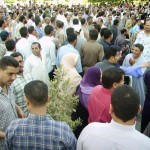
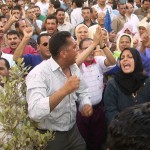
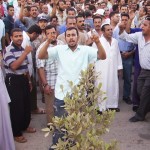
Mahalla Updates

Posted on 15/07/200729/03/2015 By 3arabawy

Since the early morning, a delegation of labor leaders from Ghazl el-Mahalla has been in negotiations with the General Federation of Trade Unions, in an attempt by the government to avert the scheduled 21 July strike by the workers.

The delegation includes five activists, among them Muhammad el-Attar and Sayyed Habib.

The invitation for the meeting came from the General Union of Textile Union bureaucrats, who are racing against time to abort the scheduled 21 July protest.

I still cannot find out what happened in the meeting, since those I know among the delegation have their mobile phones switched off. I don’t think any thing bad has happened to them, though.. So let’s wait a bit, and I’ll give it another try later tonight and in the morning to try to find out more… But there is a couple of points we have to consider here:

1-It is VERY significant that the General Union invited those five workers, and not the members of the Factory Union Committee. This means that the union bureaucracy understands well now who is running the show inside the factory: It’s those independent labor leaders, not the corrupt officials from the state-sponsored union.

2- My sources tell me that the mood in the factory is pretty militant. What has been scheduled on 21 July originally as a “sit-in”… has now turned into a “STRIKE” plan… and the mood on the ground means, if the industrial action is not averted by a compromise from the govt (or mass crackdown on the labor leaders), the 21 July strike may well last for more than a day.

More on the Mahalla textile workers protest

Posted on 02/07/200723/03/2015 By 3arabawy

I received more photos of the protest held Saturday by the Mahalla textile workers, taken by journalist Muhammad Abul Dahab…

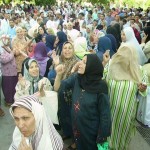
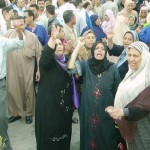
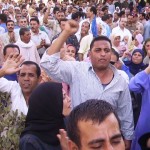
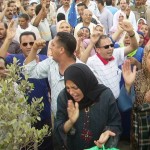
Mahalla textile workers protest, Photo by Muhammad Abul Dahab, July 2007

Al-Masry Al-Youm, I have to say, screwed up again with its sensationalist coverage. The report it ran claimed that 27,000 workers took part in the industrial action. This is NOT true. 27,000 is the total labor force at the company. Those who took part in yesterday’s action were 3000 according to Kareem el-Beheiry. Another estimate I heard from a journalist put the number of demonstrators at 10,000, saying most of the (morning) first shift workers participated in the demo.

Keep your eyes on Mahalla.

  • Previous
  • 1
  • …
  • 7
  • 8
  • 9
  • 10
  • Next

Search 3arabawy

Follow 3arabawy

  • Facebook
  • Flickr
  • Instagram
  • X
  • YouTube
©2025 3arabawy