Skip to content
3arabawy
3arabawy

Hossam el-Hamalawy

  • Home
  • About
  • Archive
  • Blog
  • Photos
  • Books
3arabawy

Hossam el-Hamalawy

Tag: videogate

Imbaba police abuse victim identified

Posted on 01/02/200726/12/2020 By 3arabawy

Al-Masry Al-Youm’s investigative journalist Ali Zalat has managed to identify the victim of Imbaba police brutality video, one of the first to be leaked online in April 2006.

According to Thursday’s issue (which I bought an hour ago from a night news stand and should be available online in the morning), the victim is Ihab Magdi Farouk, a 19-year-old worker in a leather factory in El-Mounira El-Gharbeia district of Imbaba, Giza.

Ihab told Al-Masry Al-Youm he was detained by Police Corporals Ahmad Abdel Fattah and Ahmad el-Wardani, in Zaki Mattar Street as the police was breaking up a fight two summers ago. Ihab was then carrying a load of new leather bags. And of course if you look poor and carrying a load of new leather bags, then you cannot be a leather bags distributor (Ihab’s job), you must be a thief! So the two corporals locked him in Imbaba Police Station, till the leather factory owner showed up and explained Ihab had not stolen anything.

Fifteen days later, Ihab bumped into Corporal Ahmad el-Wardani in the street again. The latter just showered him with insults against his mother and family, and then the Corporal pulled out a knife, and dragged Ihab with the help of another police agent into a nearby marble cutting workshop, where they brutally beat him, with kicks and slaps. Then, Corporal Wardani took Ihab to the Imbaba Police Station, where Wardani, his colleague Corporal Abdel Fattah, and other agents kept on sadistically torturing him for two entire days: Ihab was blindfolded, slapped, kicked, whipped with a stick, under the supervision of the corporals and a police officer called Kareem. Before his release, Officer Kareem asked Corporal Abdel Fattah to shower Ihab with slaps, while Kareem was filming them for the fun of it.

Note there is still another leaked abuse video from Imbaba Police Station, and the victim is still unidentified, and the Interior Ministry did not announce any investigation into it yet, though the face of the Corporal is clear in the video.

And only God knows what else happens in that police station that was not caught on camera.

UPDATE: A scan of Al-Masry Al-Youm article.
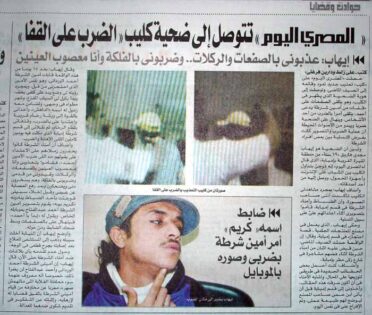
Al-Masry Al-Youm Report

Al-Jazeera journalist to go on trial over torture documentary

Posted on 28/01/200716/01/2021 By 3arabawy

I’m expecting a crackdown on bloggers and anyone who speaks about torture in Egypt soon:

Case of Al-Jazeera journalist accused of endangering Egypt’s national interest to go to trial
By NADIA ABOU EL-MAGD
Associated Press Writer
CAIRO _ Egypt has launched trial proceedings against a journalist for the pan-Arab Al-Jazeera Television accused of harming the country’s national interest, the state prosecutor’s office and the channel said Sunday.
The case is that of Howaida Taha, 43, Egyptian documentary producer for Al-Jazeera who was detained earlier this month after 50 videotapes were confiscated by police from her luggage at the Cairo airport.
Taha was held for over a day and interrogated about the footage which authorities said contained fabricated scenes of torture by Egyptian police.
Egyptian prosecutors accused Taha of “practicing activities that harm the national interest of the country” and of “possessing and giving false pictures about the internal situation in Egypt that could undermine the dignity of the country.”
Taha was later released on bail pending trial.
At the time, Taha told The Associated Press the footage she produced was created with actors for the purpose of a documentary film about police torture in Egypt and that she had “filmed with the authorities’ permission.”
Taha subsequently left for Qatar and is currently back in Doha, Hussein Abdel Ghani, the Al-Jazeera bureau chief in Cairo, said on Sunday.
No trial date has been set yet in Taha’s case, an official with the prosecutor’s office said, speaking on condition of anonymity as he was not authorized to talk to media. Taha, who will likely be tried in absentia unless she returns to Egypt for the proceedings, faces up to three years in prison if convicted.
Abdel Ghani has publicly defended Taha, saying that reconstructing scenes with actors _ such as in Taha’s footage _ is a well-known method in the production of documentaries.
Al-Jazeera is “not the only network to talk about (police) torture,” said Abdel Ghani, himself briefly detained by police for his coverage of terrorist attacks in Egypt last April.
Egyptian authorities have been increasingly sensitive about leaked videos showing citizens, both men and women, tortured in police stations. Rights groups say torture, including sexual abuse, is routinely conducted in Egyptian police stations.
The government denies systematic torture, but has investigated several officers on allegations of abuse. Some were convicted and sentenced to prison.
In November, several Egyptian bloggers posted a video depicting a man, naked from the waist down, being sodomized at a police station. The man was later identified as Imad el-Kabir, 21, a bus driver.
The case sparked a public uproar, and two police officers were jailed pending investigation into sexual assault allegations. However, el-Kabir was also imprisoned last week, for resisting authorities.
Egyptian Interior Minister Habib el-Adly told Egyptian state television on Friday that many in the country are “upset about … some videos, newspapers and some critics who were trying to increase the view of police hostility.”
“I consider this to be an intended unpatriotic campaign,” el-Adly said.
Several leading Egyptian human rights groups have said that Taha’s case was part of “an ongoing policy of terrorizing the voices that are revealing torture” in Egypt.
Al-Jazeera, watched by millions of Arab viewers, has extensively covered anti-government demonstrations and the activities of opposition groups in Egypt, as well as terrorist attacks against the U.S. ally.
But the channel has also been accused of bias by Washington and encountered problems in several Arab countries. Its reporters have been barred by Iran, Iraq, Saudi Arabia and Tunisia.
Accusations that Egypt is imposing severe freedom of speech restrictions have mounted recently.
The New York-based Human Rights Watch on Saturday demanded that authorities drop all charges against blogger Abdel Kareem Nabil, on trial since earlier this month. Nabil, 22, was arrested in November for denouncing Islamic authorities and criticizing President Hosni Mubarak on his Arabic-language blog. He faces up to nine years in prison if convicted.

And here’s an AP report, also by Nadia Abou El-Magd, on blogger Kareem’s trial:

Egyptian court refuses to release on bail a blogger accused of sectarian strife and insulting Islam
CAIRO (AP) _ An Egyptian court refused Thursday to release on bail a blogger who is on trial on charges of insulting Islam and causing sectarian strife for his Internet writings in Egypt’s first prosecution of a blogger.
Abdel Kareem Nabil, 22, who has been in detention since his arrest in early November, often denounced Islamic authorities and criticized Egyptian President Hosni Mubarak on his Arabic-language blog. He faces up to nine years in prison if convicted on the charges.
In a statement Thursday, the Egyptian Organization for Human Rights, called on human rights groups to “pressure the government to drop charges against (Nabil) as a prisoner of conscience.”
Two U.S. congressmen also expressed deep concern about the arrest of Nabil _ who also goes by the blogger name of Kareem Amer _ and called for the charges to be dropped.
“The Egyptian government’s arrest of Mr. Amer simply for displeasure over writings on the personal weblog raises serious concern about the level of respect for freedoms in Egypt,” Trent Franks, an Arizona Republican, and Massachusetts Democrat Barney Frank wrote in a letter to Egypt’s U.S. ambassador, Nabil Fahmy.
The Bush administration has not commented on Nabil’s trial, unlike its criticisms of other arrests of Egyptian rights activists in past years.
In 2005, the Bush administration made Egypt _ which Mubarak has ruled unquestioned for a quarter century _ the centerpiece of what it called a policy priority of promoting democratic change in the Arab world.
But Egyptian reformists say Washington has all but dropped its pressure on Mubarak amid a need for his support on Iraq and in the Israeli-Palestinian conflict. The United States was also spooked when Egypt’s Muslim Brotherhood made big gains in 2005 parliamentary elections and the radical Hamas movement won 2006 Palestinian elections _ raising fears that greater democracy would increase fundamentalists’ power, activists say.
Nabil, whose trial began Jan. 18, has been charged with inciting sedition, insulting Islam, harming national unity and insulting the president.
In Thursday’s session, his lawyers requested he be released on bail during the trial, but the court rejected the motion, Nabil’s lawyer Ahmad Seif el-Islam said.
In his blog, Nabil was a fierce critic of conservative Muslims and in particularly of al-Azhar, one of the most prestigious religious institutions in the Sunni Muslim world.
Nabil was a law student at al-Azhar University, but denounced it as “the university of terrorism,” accusing it of promoting radical ideas and suppressing free thought. Al-Azhar “stuffs its students’ brains and turns them into human beasts … teaching them that there is not place for differences in this life,” he wrote. He was thrown out of the university in March.
In other posts, Nabil described Mubarak’s regime as a “symbol of dictatorship.”

New questions raised about human rights record of US ally

Posted on 23/01/200704/01/2021 By 3arabawy

The San Francisco Chronicle covered El-Adly Video-Gate, and how Mubarak’s participation in the US-sponsored “extraordinary renditions” program (whereby Cairo receives Islamist suspects, and interrogate them under torture on behalf of the US) is giving the regime a sense of immunity from prosecution:

Torture video stirs fury over Egypt penal system
New questions raised about human rights record of U.S. ally
Joseph Krauss, Chronicle Foreign Service
Monday, January 22, 2007
Cairo — The man in the video lies on the floor on his back, naked from the waist down, with his feet hoisted into the air, surrounded by pairs of anonymous black boots.
The camera captures an act of brutality before zooming in until the man’s face, scrunched with agony, fills the frame. He cries out for mercy from his tormentors, but within seconds the words give way to screams of desperation. The abuse continues, and the camera holds steady.
The rare footage, shot on a cell phone camera inside a Cairo police station in January 2006, is the most striking evidence to date of what Egyptian and international human rights organizations have long called an epidemic of torture in the country’s penal system.
The video, which appeared on YouTube in November and quickly made the rounds of the local blogosphere, has sparked outrage in recent weeks, casting a harsh light on the deteriorating human rights situation in one of the United States’ closest allies in the Arab world.
The United States gives Egypt around $2 billion annually in military and development aid, and the Bush administration has come to see it as a crucial Sunni Arab ally in its escalating conflict with Iran. In recent years, Egypt has also emerged as a prime destination for “extraordinary rendition” — the controversial U.S. policy of kidnapping suspected terrorists and secretly sending them to be imprisoned and interrogated in countries that are known to practice torture.
Torture in Egyptian prisons has a long history, but human rights experts say Egypt’s participation in extraordinary rendition gives it an unspoken immunity from international criticism.
“Some countries, including the United States, are involved in torture and are benefiting by having Egypt assume the role of interrogating suspects,” said Bahey El Din Hassan, director of the Cairo Institute for Human Rights Studies. “They can’t send people here to be tortured and then take a stand against it.”
In 2005, Egyptian Prime Minister Ahmad Nazif said the United States had sent 60 to 70 Egyptians back to their home country for interrogation, including Hassan Mustafa Osama Nasr, an Islamist preacher who goes by the name of Abu Omar.
Abu Omar was kidnapped in 2003 near his home in Milan and flown to Egypt, where he remains imprisoned without any formal charges lodged against him. His case sparked outrage in Europe, and an Italian court is trying 25 CIA agents and a U.S. Air Force officer — in absentia — along with nine Italian secret service agents for their participation in the kidnapping.
In November, Abu Omar smuggled out of prison an 11-page handwritten letter in which he described the abduction and the torture he had received since being brought to Egypt. According to the Washington Post, which obtained a copy of the letter, he claimed to have lost hearing in one ear as a result of repeated beatings and described being strapped to an iron device known as the “Bride” before being shocked with electric stun guns.
Montasser el-Zayat, his lawyer, said that although the authorities are no longer physically torturing Abu Omar, he continues to endure psychological torture from being held in solitary confinement with few visitors, and that he has tried to kill himself on three occasions.
El-Zayat, who has represented several prominent Islamists, said Abu Omar was never affiliated with any al Qaeda or any other organization. “He was only an activist, and he delivered Friday sermons in the mosque,” el-Zayat said.
While high-profile suspects have attracted the most attention, experts say the majority of torture victims in Egypt are, like the man in the video, ordinary citizens without political affiliations and that torture, once reserved for political dissidents and Islamist militants, is now applied across the penal system.
After the video surfaced, a local newspaper identified the victim as Imad Al-Kabir, a microbus driver who was brought in after intervening in an argument between his cousin and two plainclothes police officers. Al-Kabir was not accused of anything at the time, and he has said the police filmed the incident and sent the clip to local microbus drivers merely to humiliate him and to intimidate others.
“Torture has become endemic to Egyptian prison facilities, detention centers and police stations,” said Elijah Zarwan, a spokesman for Human Rights Watch in Cairo. “That the police videotaped everything and then circulated it among the public shows that they know they can get away with this sort of thing. It’s yet more evidence of a culture of impunity.”
The Egyptian Organization for Human Rights documented 34 cases of torture in 2005 and 27 in 2006, but Zarwan and other human rights advocates insist that many if not most cases go unreported.
Although the worst forms of torture are usually reserved for suspected terrorists, the abuse of prisoners is more often aimed at collective punishment and intimidation than intelligence-gathering, said Dr. Magda Adly, director of the Nadim Center, which counsels and treats victims of torture.
“Torture sends a message not only to the victim and the victim’s family, but to the whole society, and that message is that if you speak out, you will never see the sun again,” she said.
On Jan. 15, the center, which sees an average of 70 new cases of torture each year, submitted a list of 189 names of suspected torturers, compiled primarily from the testimony of victims, to the Interior Ministry.
Egyptian bloggers have also taken up the cause and, in recent months, have published several videos showing the abuse of prisoners. The most recent shows a young woman suspended by her hands and knees from a pole between two chairs, confessing to murder and screaming that her hands are about to break off. The woman’s identity remains a mystery, but the Interior Ministry says it is investigating the matter.
The Imad Al-Kabir video, however, remains the most graphic, and has sent shock waves through the local human rights and activist community. After a local newspaper located and identified Al-Kabir, human rights lawyers persuaded him to identify his tormentors and take the case to the public prosecutor, who has since detained two of the officers involved and scheduled a trial for the first week in March.
But what at first seemed like a triumph for human rights advocates turned into a potential nightmare earlier this month, when the same court sentenced Al-Kabir himself to three months in prison for “resisting authorities.”
“We wanted the video to be seen so that the criminals in it could get the punishment they deserved, but so far that hasn’t happened,” said Wael Abbas, one of the first bloggers to publish the video. “Instead, the victim has been punished.”
Egyptian law narrowly defines torture as acts carried out against suspects during interrogation. Since Al-Kabir was not, at the time he was tortured, accused of any crime or in the process of being interrogated, it’s unlikely that the officers will be found guilty.
The Interior Ministry, which is in charge of Egyptian security services, has denied it practices torture, and some officials have accused Abbas and other bloggers of defaming the country’s image by putting the videos on the Internet instead of taking them directly to the ministry.
Human rights experts say the government is more interested in protecting its image than in addressing the problem of torture.
“Everyone in the human rights community agrees it is a huge problem, not only in the police stations but in the entire penal system, but nothing is being done because the government refuses to recognize it,” said Hassan, of the Cairo Institute for Human Rights Studies. “It’s grown into a cancer, and the government treats it like a mild headache.”

  • Previous
  • 1
  • …
  • 17
  • 18
  • 19
  • …
  • 29
  • Next

Search 3arabawy

Follow 3arabawy

  • Facebook
  • Flickr
  • Instagram
  • X
  • YouTube
©2025 3arabawy