The Egyptian Workers and Trade Unions Watch issued a case study report on the Hennawi Tobacco Company workers.
Tag: workers
Mervat
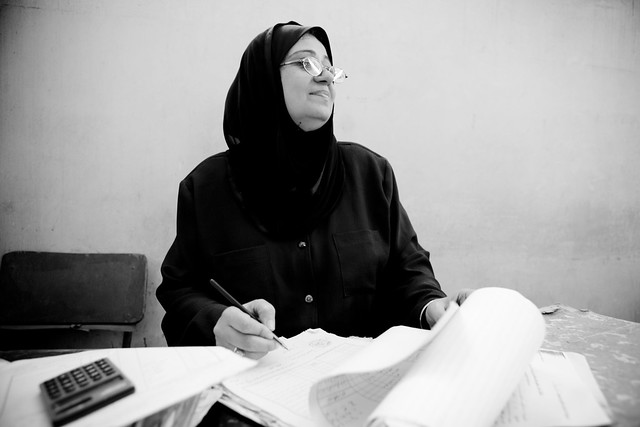
Mervat, an independent trade unionist from el-Warraq Office, was among the few members of the Giza Union Committee who supported the 2007 strike. Out of 11 union committees which belong to the state-controlled General Union of Bank and Insurance Workers, only the Daqahilya union committee and half of the Giza union committee supported (and took a leading role in) the three month protests, followed by 11 day-street occupation in front of the downtown Cairo ministerial cabinet HQ. The rest of the state-backed trade unionists did their best to sabotage the protests but were completely sidelined by the Higher Strike Committee, which led the 55,000 civil servants to victory.
Recalling the Hussein Hegazi Street occupation, Mervat proudly said: “I slept in the street for 11 days, and was not planning to go home except with my rights regained. There was no difference between men and women in the strike. We were all family. Ostaz Kamal (Abu Eita) was our eldest brother… The women were doing the cooking, and were also leading the chants in demonstrations. The women from Daqahliya particularly were good at chanting and coming up with slogans.” With a shy smile she added, “I’m not good at leading the chants, but I can repeat with the crowd.”
Mervat denounced the state-backed General Federation of Trade Unions‘ position during the strike, and spoke with enthusiasm regarding the establishment of a new free union: “Many of us support it. It’s our right to choose people who can represent us with honesty. There are those of course who are trying to sabotage the project. They are khawana (traitors)! But they are very few. We are on the right side and we will win.”
Canal workers continue third day of protest
Sarah Carr reports…
Workers in Ismailia on Wednesday continued a third day of protest against what they allege are government plans to close down the Canal Company for Ports and Large Projects.
Established in 1965, the company employs 2,000 people and undertakes sewage, electricity and infrastructure projects in the Suez Canal area.
Ashraf Abbas, a member of the Egyptian Workers and Trade Unions Watch’s Ismailia branch told Daily News Egypt that the workers have 15 demands, including wage parity with employees of the Suez Canal Authority (of which the Canal Company is a subsidiary).
Average wages range between LE 250 and LE 600 per month.
Muhammad Anwar, the head of the company’s trade union committee, told Daily News Egypt that the workers’ primary grievance is the decision by the National Authority for Drinking Water and Sewage, taken three weeks ago, to cancel 19 water station projects the Canal Company has held since 1990.
“The National Authority claims that it’s because we were late in fulfilling our obligations. Yes, we were late, but it’s the National Authority which is responsible. We spent years exchanging correspondence with them clarifying aspects of the project, and this is what caused the delay,” Anwar explained.
Anwar says that the decision to cancel the projects with the Canal Company was premeditated.
“It was planned. This is part of a scheme to destroy the Canal Company and place state-owned utilities under the control of an international cartel.“This protest is not just to defend workers’ rights. We are also defending national security,” Anwar told Daily News Egypt.
Abbas told Daily News Egypt that in 1996 a decision was made to stop buying spare parts for the company’s equipment.
“Young people no longer receive training in the company, and in fact there are no workers under 40 employed in it. In addition, one quarter of the company’s workers are on short-term contracts. This is part of an eventual plan to privatize the Suez Canal,” he said.
He says that services provided by the company are already being contracted out to private contractors.
“The company has to pay for the difference between what the work actually costs and the rate charged by the contractors. As a result, it is making a loss.
“Contractors however who deal with the Canal Company come out millionaires, and individuals within the company’s administration also benefit from these contracts,” Abbas said.