Skip to content
3arabawy
3arabawy

Hossam el-Hamalawy

  • Home
  • About
  • Archive
  • Blog
  • Photos
  • Books
3arabawy

Hossam el-Hamalawy

Tag: workers

Mahalla Updates: Mubarak’s pigs crack down on pro-Gaza protest; journalists detained; pay strike continues

Posted on 06/03/200825/03/2015 By 3arabawy

More details and photos coming soon…

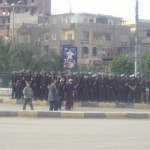
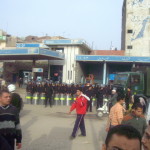
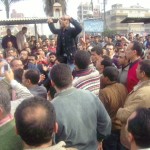
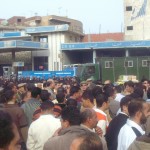
UPDATE: Around 2000 Ghazl el-Mahalla workers and activists demonstrated in Mahalla in solidarity with the Palestinians in Gaza. Police laid siege on the factory, and cracked down on the organizers and journalists.

In a phone call with a Socialist source in Cairo, he said 16 were detained, including a number of journalists. But they are all released now. The protesters chanted against the US, Israel, Mubarak, and the rising prices of basic commodities.

UPDATE: Some pix, taken by blogger Kareem el-Beheiri…
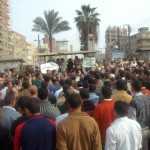
Police break up Mahalla Pro-Gaza Protest, March 2008, Photo by Kareem el-Beheiri

UPDATE: Here’s a report from the Daily News Egypt…

Al Mahalla Al-Kubra workers staged a demonstration in solidarity with the people of Gaza on Thursday.
Organized by a board of parties and movements including the Muslim Brotherhood, workers gathered in the El-Shoun square to shout slogans such as “Arabs, why are you silent on Israel,” and calling for immediate Arab intervention in Gaza.
However, sources told the Daily News Egypt that demonstrators were surrounded by state security agents who prevented Mahalla residents from entering the place of protest.
“We were warned by security against protesting against Israeli action,” Hamdy Hussein of Afaq socialist center told Daily News Egypt. “There were plain clothed policemen loitering everywhere, so we moved the site slightly. However, we were soon surrounded within the square, and around 5,000 people were prevented from participating in the protest.”
As the protest was broken up, 15 activists and journalists, including Muhammad Abu Dahab of Al-Dostour opposition newspaper, Ahmad Abdel Maqsoud and Ahmad El-Shawihy, were also detained and threatened with charges of disturbing the peace.
This comes on the fifth day of the Gazl El-Mahalla textile workers’ wages strike.
Although employees at the weaving factory are continuing their work, they are refusing to take wages to protest against the disparity in the incentive payments among colleagues. While some take LE 37 as incentives, others receive LE 50.

Just to clarify: the ones who are currently on pay strike in Ghazl el-Mahalla are the company’s Exports Warehouse workers, who number 400. The total workforce in the factory is 27,000…

Labor updates

Posted on 06/03/200812/01/2021 By 3arabawy

The Egyptian Workers and Trade Unions Watch issued two reports, one on the protests by fish merchants in Suez, and the other on the downtown Cairo protests by 10th of Ramadan workers.

Also the Tadamon blog posted a solidarity call from the light bulbs manufacturing factory workers, owned by the Lebanese Egyptian tycoon Rami Lakkah, who are fighting for social insurance, and El-Badeel ran a report on escalating militancy among the northern fishermen, who are organizing a national conference next month.

Egyptian doctors threatening to strike

Posted on 04/03/200810/02/2021 By 3arabawy

From the Los Angeles Times…

Enter the lounge in the Nile Hospital, take a seat on a ripped leather couch, brush away the cigarette smoke and listen to a litany of complaints on the cruel economics of healthcare from doctors whose salaries are as low as $63 a month and who live with their parents.The travails of doctors mirror the larger shortcomings of a government struggling to provide medical care in a country where about 45% of the population lives in poverty. Physicians across the nation complain of long hours, shrinking respect for their profession, lack of medicine and broken equipment. One gynecologist said his public hospital is so broke that he buys his own rubber gloves rather than wearing ones that have been washed for reuse.

“You get 10 extra pounds [about $1.80] if you work a 24-hour shift,” said Mohammed Farahat, an orthopedic specialist. “But to buy your dinner during that shift costs you 15 pounds. So you’re thinking, what good does it do?”

Egypt’s doctors have been protesting for weeks and have set a March deadline for a nationwide strike. Their battle is the latest ripple of labor unrest that in recent months has sparked demonstrations by textile workers, university professors, pharmacists, train conductors and real estate tax collectors. High inflation, flat wages and anger at the government of President Hosni Mubarak are increasingly agitating both the educated and working classes in a moderate Arab state that is one of America’s closest Middle East allies.

The Doctors Union is demanding an immediate minimum monthly salary of 1,000 pounds or about $180 for the 93,000 physicians working directly for the state. No salary at the Nile Hospital in northwest Cairo exceeds that, including the pay for surgeons, Farahat said.

The starting monthly pay for doctors can be as low as $23. The Egyptian Health Ministry said that it would gradually increase pay based on performance, but that its budget, like those of many government agencies, is too strapped to meet the union’s demands.

“We sympathize with doctors,” said Abdel Rahman Shahin, a ministry spokesman. “The state should finance [higher pay], but the state has a lot of obligations.” He added that with phased-in performance bonuses “at least there is some change doctors will feel” by the end of the year.

Many doctors view the proposal as a paltry attempt to correct years of low salaries that are now quickly eaten up by a surge in inflation that has increased prices as much as 50% for food and other commodities over the last two years. The crisis has also reminded doctors that despite years of education and training, their average salaries are slightly higher than that of government accountants, who earn about $35 a month, and less than many university professors.

“Life is very difficult, but people expect you, as a doctor, to have a car, spend generously and leave huge tips,” said Ahmad Sobhi, an internist at Nile Hospital who earns less than $65 a month. “The reality is my small salary. My wife and I and our new daughter live in an apartment owned by my father. We never go to the movies. Our only entertainment is to watch TV.”

That description fits thousands of Egyptian doctors, many of whom vent their anxiety on a blog sponsored by Doctors Without Rights, a lobbying group founded in 2007.

A post filed by Dr. Ali Said reads: “An inspector from the municipality has passed by our hospital today. All he cared to check was whether we had trees or not. You tell inspectors, ‘There is a shortage in equipment.’ They tell you, ‘There is no money for this nonsense.’ . . . Have you ever heard of anything like this in any other part of the world?”

The physicians’ stature and sense of professional entitlement have been tested by a state healthcare system burdened by bureaucracy and debt. Most doctors moonlight by rotating shifts at different hospitals and private clinics. This accumulates into strings of sleepless nights but can earn doctors an extra $90 a month. Many leave Egypt for richer Persian Gulf oil countries, where hospital salaries are many times higher.

“This is causing a brain drain,” said Farahat, who sat puffy-eyed in scrubs and a lab coat. “I have doctor friends who have moved abroad and I’m thinking of going to Saudi Arabia, Kuwait or the United Arab Emirates. The problem is that in 10 to 15 years, if all the doctors leave, there will be no one left to teach a younger generation of Egyptian physicians.”

It is a sensitive time for doctors to be contemplating a strike. Mubarak and his ruling National Democratic Party are under pressure from labor groups demanding better wages and from opposition organizations, such as the Muslim Brotherhood, pushing for political reforms. Calls for change have highlighted the widening anger the poor have for an upper class they regard as corrupt and aloof to the nation’s problems.

The Doctors Union has a history of involvement with the Muslim Brotherhood, which wants Egypt governed by Islamic law and has seen hundreds of members arrested by security forces seeking to limit the group’s chances in upcoming local elections. The doctors have been careful in recent demonstrations not to let their cause for higher salaries be subsumed into a wider and more dangerous political debate.

But many physicians feel that, although they still command a degree of respect in society, they are part of a vanishing middle class. “We have two classes today in Egypt — the capitalists and the poor,” Farahat said. “We have no middle class anymore. Given such conditions, there must be labor strikes.”

His colleague, Mohammed Sayed, an orthopedic specialist, agreed. “Five years ago a strike by doctors would have been unthinkable,” he said. “Overall, the economy is doing well, but the money is not getting to the people. It’s going to the elite. In the 1960s and 1970s, Egypt had rich people but they were self-made, the sons of farmers who came from the Nile Delta. Today, the rich come from the rich class; they’ve done nothing to work for it. We are asking for a reasonable demand of 1,000 pounds a month.”

The Egyptian government’s underfunding of healthcare has created a public system in which the poor are forced to pay for medications, sutures and other items that would normally be covered by subsidies. The nation’s healthcare system is divided into public and private institutions, but most hospital beds are funded by the state. Inflation and supply shortages prevent patients from filling prescriptions, resulting in extended illnesses and longer recovery times.

“We face difficulties in serving patients because public healthcare is, in effect, being privatized in a ruthless way,” said Said Sayed, a spokesman for the Doctors Union, which represents Egypt’s 167,000 physicians. “We cannot serve the poor patient in public hospitals.”
Mohammed Sayed, a husky, congenial man, said he works a number of 24-hour shifts a month, which earns him an extra $10. Even before the rapid rise in inflation, he said, that was a maddeningly low sum.

His friend, Mohammed Wael Saad, a surgeon at Nile Hospital, said most Egyptians view doctors as singularly altruistic and find it odd that they would consider striking over financial matters.
“People think we are beyond money. But how can we live?” said Saad. “How can I give the best when I work long hours and earn as much as a nurse or a mill worker? Our salaries need to be commensurate with prosecutors’. They earn 2,000 pounds [about $365] a month. So, is it more important to put someone in jail or to save someone from dying?”

  • Previous
  • 1
  • …
  • 342
  • 343
  • 344
  • …
  • 484
  • Next

Search 3arabawy

Follow 3arabawy

  • Facebook
  • Flickr
  • Instagram
  • Bluesky
  • X
  • YouTube
  • Spotify
©2026 3arabawy