Skip to content
3arabawy
3arabawy

Hossam el-Hamalawy

  • Home
  • About
  • Archive
  • Blog
  • Photos
  • Books
3arabawy

Hossam el-Hamalawy

Tag: piggipedia

Resources, photos and videos of Egyptian police officers involved in torture and human rights violations.

Egypt bloggers reveal new torture case

Posted on 01/02/200710/01/2021 By 3arabawy

A report by AFP journalist Paul Schemm about the bloggers’ and rights activists’ campaign to prosecute State Security torturers:

Egypt bloggers reveal new torture case
by Paul Schemm
CAIRO, Feb 1, 2007 (AFP) – Egypt’s politically active blogger community has brought to light another torture case against the regime’s security services amid a rising tide of outrage over police brutality.
On Saturday, lawyers from the Association for Human Rights and Legal Aid (AHRLA) will go to court in a last-ditch effort to keep alive the case against a state security officer accused of torturing to death a man he arrested three and a half years ago.
The case against Captain Ashraf Safwat is gaining new attention following the decision by Egypt’s activist blogger community to post the details online in the wake of several other cases of police brutality in recent weeks.
“The most significant aspect of the case is this is the first state security officer to truly be put in front of a criminal court,” said Mohsen Bahnasi, a member of AHRLA’s board, referring to the country’s feared plainclothes security service.
Mohammed Abdel Qader and his brother were summoned to a Cairo police station on September 16, 2003 by Safwat. Abdel Qader died five days later and an autopsy gave torture by electric shock combined with a weak heart as the cause of death.
More than three years later, the case continues to drag on, hampered by slow prosecutors, uncooperative security services and now the family’s decision to drop the case and disappear.
In the past few months, however, torture cases have gained new prominence in Egypt as bloggers have posted videos, photos and accounts of brutality in police stations, prompting renewed investigations.
On January 20, Abdel Qader’s case appeared on a blog, featuring excerpts from the forensic report and gruesome autopsy pictures showing the mangled corpse of a heavily bearded man.
“There is evidence of the application of high temperature to the right and left breast and the penis resembling the effects of electrocution with an electric wire,” read an excerpt. “He was subject to those injuries hours before his death.”
“The pictures have done something, because they are visual — it is a shock,” said Aida Seif al-Dawla, a veteran anti-torture activist who credits the bloggers for raising public awareness on the pervasive use of torture by security services.
Hossam el-Hamalawy, on whose Arabawy blog the pictures appear, said it comes as no surprise bloggers should take interest in such cases.
“The bloggers themselves were victims of torture during the past years,” he said, referring to the case of Mohammed al-Sharqawi who was allegedly sodomised after being arrested. “We are receiving so many videos now.”
Bloggers came to public attention during the political ferment surrounding elections in 2005 and then most recently when they posted the grim video of bus driver Imad al-Kabir being sodomised in a police station in 2006 — the first of many such examples of police brutality to be publicised.
Interior Minister Interior Habib al-Adly last week lashed out at the bloggers, condemning the “intentionally unpatriotic campaign striking a national service that seeks stability in the country.”
The campaign strikes at the heart of official assertions that torture is not widespread and limited to individual cases.
“The outcry has encouraged people to come forward in person and take the government at its word that it takes torture seriously and prosecutes it whenever possible,” said Elijah Zarwan of Human Rights Watch.
Proving a torture case in Egypt, he added, is very difficult due to a narrow definition of torture by authorities and lengthy incommunicado detentions during which the marks often fade.
It took seven months for Safwat to answer the subpoena in the current case, and when he did it was with his own autopsy report claiming the burns came from a defibrillator used to revive the victim after a heart attack, indicating he was familiar with the case prior to the trial.
A special committee of experts then took two tries to conduct a new autopsy based on the pictures and available documents which finally concluded that there was torture, opening the way for the trial to begin in June 2006.
The repeated delays, leaking of information to defendants and allowing the suspected officers to remain free during the trial are typical of attempts to bring torture cases against police, said AHRLA president Tariq al-Khater.
“The prosecutors in Egypt are in collusion with the police,” he said.
In November, the officer’s lawyer suddenly produced a paper signed by Abdel Qader’s family withdrawing Khater’s power of attorney and dropping the civil case for damages against the officer.
Khater is convinced that state security pressured the family, which has since disappeared, by threatening their still imprisoned other son, Sameh.
With his case against Safwat threatening to fall to pieces, Khater has taken the unusual step of challenging the family’s decision on the behalf Abdel Qader’s three daughters on the grounds it is against their interests.
On Saturday, the criminal court will decide whether the case proceeds.

Torture banner

Photographers to demonstrate against police assaults

Posted on 01/02/200723/12/2020 By 3arabawy

For the first time in their history, Egyptian photographers are getting together to demonstrate on Saturday 11am, in front of the Press Syndicate, against increased police assaults.

Photographers face attacks from police agents and the thugs they deploy in demos, who smash cameras, intimidate, physically assault, and detain photographers while performing their professional duties.

I’m not a professional photographer, but my camera also had its share of Mubarak’s police wrath. Police Captain Muhammad Bassiouny of Bandar Damanhour Police Station stole my camera after his thugs showered me with kicks as I was photographing them kidnapping voters in front of polling stations in Damanhour during the November 2005 parliamentary elections. The camera was returned to me after few days (photos deleted)–only to be smashed by police thugs in June 2006 as I was photographing them kidnapping anti-torture activists.

I’m personally excited about this protest, and will attend it. I hope to see as many of you there. Those brave photographers who played a crucial role in exposing police brutality against peaceful dissent deserve our support. The least we can do to help them is to show up at the syndicate and show them we care. It will boost their morale next time they are working in this war zone, formerly known as Downtown Cairo.

UPDATE: I received the following statement from the protest organizers…

We, Photojournalists and photographers working in Egypt, call on the Egyptian authorities to:
-Provide the needed security measures to protect photojournalists while performing their professional duties
-Protect photojournalists from the irresponsible actions taken by some police agents, that include encouraging thugs to physically assault photographers and smash their cameras. This has led to severe injuries among photographers: Our colleague Amr Nabil of AP has lost his right eye during covering the 2005 parliamentary elections; our colleague Khaled Gamal was subject to thugs’ assaults (in the presence of the security), while covering the trial of Emad el-Gelda. Last but not least, photographers are now banned from entering the Parliament, and cover its sessions.
These violations have to stop now.
Our protest is just the beginning of a campaign to retrieve our rights back.
We also express our solidarity with our Sudanese detained colleague in Guantanamo, Sami el-Haj, Al-Jazeera’s cameraman, and demand his immediate release.

Imbaba police abuse victim identified

Posted on 01/02/200726/12/2020 By 3arabawy

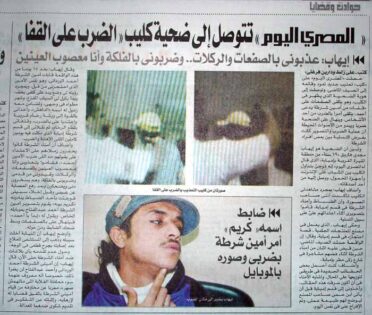
Al-Masry Al-Youm’s investigative journalist Ali Zalat has managed to identify the victim of Imbaba police brutality video, one of the first to be leaked online in April 2006.

According to Thursday’s issue (which I bought an hour ago from a night news stand and should be available online in the morning), the victim is Ihab Magdi Farouk, a 19-year-old worker in a leather factory in El-Mounira El-Gharbeia district of Imbaba, Giza.

Ihab told Al-Masry Al-Youm he was detained by Police Corporals Ahmad Abdel Fattah and Ahmad el-Wardani, in Zaki Mattar Street as the police was breaking up a fight two summers ago. Ihab was then carrying a load of new leather bags. And of course if you look poor and carrying a load of new leather bags, then you cannot be a leather bags distributor (Ihab’s job), you must be a thief! So the two corporals locked him in Imbaba Police Station, till the leather factory owner showed up and explained Ihab had not stolen anything.

Fifteen days later, Ihab bumped into Corporal Ahmad el-Wardani in the street again. The latter just showered him with insults against his mother and family, and then the Corporal pulled out a knife, and dragged Ihab with the help of another police agent into a nearby marble cutting workshop, where they brutally beat him, with kicks and slaps. Then, Corporal Wardani took Ihab to the Imbaba Police Station, where Wardani, his colleague Corporal Abdel Fattah, and other agents kept on sadistically torturing him for two entire days: Ihab was blindfolded, slapped, kicked, whipped with a stick, under the supervision of the corporals and a police officer called Kareem. Before his release, Officer Kareem asked Corporal Abdel Fattah to shower Ihab with slaps, while Kareem was filming them for the fun of it.

Note there is still another leaked abuse video from Imbaba Police Station, and the victim is still unidentified, and the Interior Ministry did not announce any investigation into it yet, though the face of the Corporal is clear in the video.

And only God knows what else happens in that police station that was not caught on camera.

UPDATE: A scan of Al-Masry Al-Youm article.

Al-Masry Al-Youm Report
  • Previous
  • 1
  • …
  • 60
  • 61
  • 62
  • …
  • 65
  • Next

Search 3arabawy

Follow 3arabawy

  • Facebook
  • Flickr
  • Instagram
  • X
  • YouTube
©2025 3arabawy